 Add to Chrome
 Add to Firefox
 Add to Edge
Rationally Enriched Chebyshev Trunk Bases for DeepONet Surrogates of High Péclet Entrance Transport
Aug 20, 2026
This study demonstrates a rationally enriched Chebyshev (REC) trunk for deep operator network (DeepONet) surrogate models of singularly perturbed and high-Péclet transport problems whose solution profiles are characterized by thin localized boundary or wall layers. The REC trunk combines Chebyshev polynomial dictionary elements with rational dictionary elements constructed using the adaptive Antoulas-Anderson (AAA) algorithm. Over five independent training runs, the resulting REC-trunk DeepONet is evaluated against a vanilla DeepONet and a Chebyshev-trunk DeepONet whose prescribed dictionary consists only of Chebyshev polynomials across three problems whose singular perturbation parameters are diffusion-to-advection ratios: a singularly perturbed scalar boundary-value problem (BVP), the thermal entrance problem with a prescribed wall temperature, and the concentration entrance problem with an absorbing wall. Across the held-out test profiles, the REC-trunk DeepONet improves over the vanilla DeepONet and remains comparable to the Chebyshev-trunk DeepONet in predicting the scalar profile, with its clearest advantage over the Chebyshev-trunk DeepONet appearing when the perturbation parameter lies between $1.00\times10^{-4}$ and $1.78\times10^{-4}$, where it reduces the profile-error metrics by up to $19.5\,\%$ relative to the Chebyshev-trunk DeepONet. In predicting the wall-normal temperature and concentration profiles, the REC-trunk DeepONet reduces the profile-error metrics by up to $60.2\,\%$ and $32.2\,\%$ relative to the vanilla and Chebyshev-trunk DeepONets, respectively, while suppressing artificial near-wall oscillations as the Péclet or mass-transfer Péclet number ranges from $10^{2}$ to $10^{4}$.

A Comprehensive Design Framework for Vertical Power Delivery in High-Performance Computing
Jun 27, 2026Power delivery -- including high-to-low voltage conversion, complex power distribution across heterogeneously integrated chiplets, and efficient interconnect allocation -- remains a critical bottleneck in high-performance computing (HPC) systems. Existing vertical power delivery (VPD) solutions are estimated to achieve less than 70\% system-wide end-to-end power delivery efficiency, defined from platform input power to delivered on-chip load power, with substantial energy lost as heat before reaching on-chip point-of-loads (POLs). In the absence of systematic design methodologies, evaluating power quality, exploring architectural alternatives, and optimizing performance rely on computationally prohibitive simulations, resulting in suboptimal designs. This paper introduces an end-to-end scalable power delivery framework for HPC systems, including distributed VPD (DVPD) architecture, DVPD design optimization methodology, and analytical models. The framework leverages substrate-embedded GaN power switches together with arrays of unit inductors and capacitors tailored for HPC applications. Multi-stage power conversion schemes (48V-to-1V, 48V-to-24V-to-1V, and 48V-to-12V-to-1V) are explored, with system-wide voltage drops and power losses evaluated under steady-state conditions. Design specifications for passive and active devices are formulated to meet next-generation efficiency targets. For the 48V-to-1V case, the proposed DVPD approach achieves 84\% system-wide efficiency while occupying 54\% of the area beneath the load system, with efficiency increasing to 87.6\% at 75\% area utilization across a 1--50~kW load range. Furthermore, steady-state voltage drops peak at 2.7\% and transient drops at 9\% (without decoupling capacitors), demonstrating the viability of DVPD for future wafer-scale HPC platforms.
RareSpot+: A Benchmark, Model, and Active Learning Framework for Small and Rare Wildlife in Aerial Imagery
Apr 21, 2026Automated wildlife monitoring from aerial imagery is vital for conservation but remains limited by two persistent challenges: the difficulty of detecting small, rare species and the high cost of large-scale expert annotation. Prairie dogs exemplify this problem -- they are ecologically important yet appear tiny, sparsely distributed, and visually indistinct from their surroundings, posing a severe challenge for conventional detection models. To overcome these limitations, we present RareSpot+, a detection framework that integrates multi-scale consistency learning, context-aware augmentation, and geospatially guided active learning to address these issues. A novel multi-scale consistency loss aligns intermediate feature maps across detection heads, enhancing localization of small (approx. 30 pixels wide) objects without architectural changes, while context-aware augmentation improves robustness by synthesizing hard, ecologically plausible examples. A geospatial active learning module exploits domain-specific spatial priors linking prairie dogs and burrows, together with test-time augmentation and a meta-uncertainty model, to reduce redundant labeling. On a 2 km^2 aerial dataset, RareSpot+ improves detection over the baseline mAP@50 by +35.2% (absolute +0.13). Cross-dataset tests on HerdNet, AED, and several other wildlife benchmarks demonstrate robust detector-level transferability. The active learning module further boosts prairie dog AP by 14.5% using an annotation budget of just 1.7% of the unlabeled tiles. Beyond detection, RareSpot+ enables spatial ecological analyses such as clustering and co-occurrence, linking vision-based detection with quantitative ecology.
RareSpot: Spotting Small and Rare Wildlife in Aerial Imagery with Multi-Scale Consistency and Context-Aware Augmentation
Jun 23, 2025Automated detection of small and rare wildlife in aerial imagery is crucial for effective conservation, yet remains a significant technical challenge. Prairie dogs exemplify this issue: their ecological importance as keystone species contrasts sharply with their elusive presence--marked by small size, sparse distribution, and subtle visual features--which undermines existing detection approaches. To address these challenges, we propose RareSpot, a robust detection framework integrating multi-scale consistency learning and context-aware augmentation. Our multi-scale consistency approach leverages structured alignment across feature pyramids, enhancing fine-grained object representation and mitigating scale-related feature loss. Complementarily, context-aware augmentation strategically synthesizes challenging training instances by embedding difficult-to-detect samples into realistic environmental contexts, significantly boosting model precision and recall. Evaluated on an expert-annotated prairie dog drone imagery benchmark, our method achieves state-of-the-art performance, improving detection accuracy by over 35% compared to baseline methods. Importantly, it generalizes effectively across additional wildlife datasets, demonstrating broad applicability. The RareSpot benchmark and approach not only support critical ecological monitoring but also establish a new foundation for detecting small, rare species in complex aerial scenes.
MethaneMapper: Spectral Absorption aware Hyperspectral Transformer for Methane Detection
Apr 05, 2023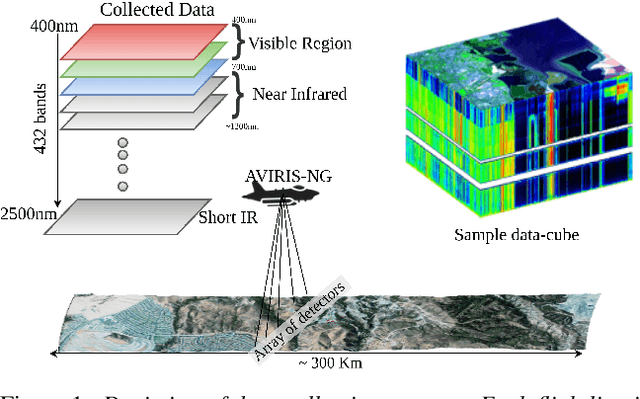
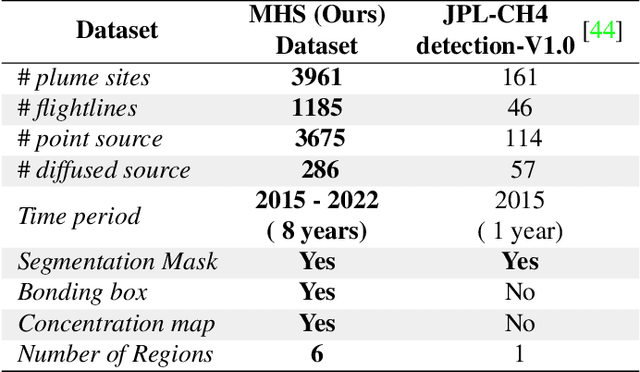
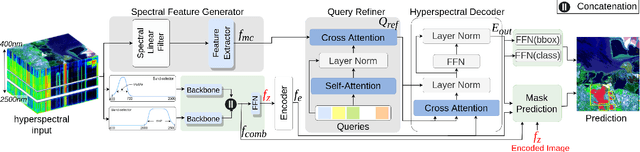
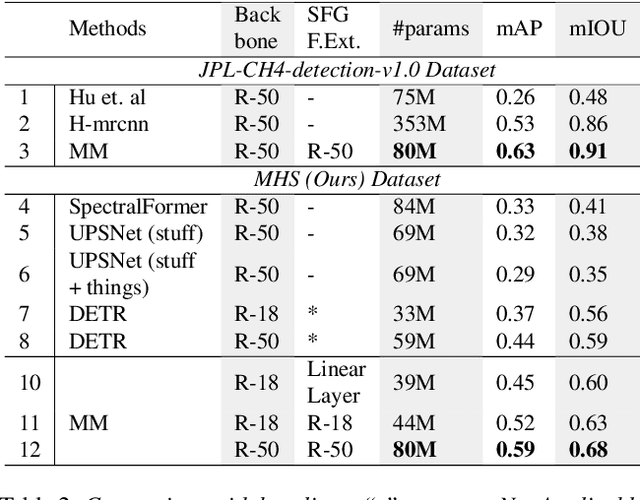
Methane (CH$_4$) is the chief contributor to global climate change. Recent Airborne Visible-Infrared Imaging Spectrometer-Next Generation (AVIRIS-NG) has been very useful in quantitative mapping of methane emissions. Existing methods for analyzing this data are sensitive to local terrain conditions, often require manual inspection from domain experts, prone to significant error and hence are not scalable. To address these challenges, we propose a novel end-to-end spectral absorption wavelength aware transformer network, MethaneMapper, to detect and quantify the emissions. MethaneMapper introduces two novel modules that help to locate the most relevant methane plume regions in the spectral domain and uses them to localize these accurately. Thorough evaluation shows that MethaneMapper achieves 0.63 mAP in detection and reduces the model size (by 5x) compared to the current state of the art. In addition, we also introduce a large-scale dataset of methane plume segmentation mask for over 1200 AVIRIS-NG flight lines from 2015-2022. It contains over 4000 methane plume sites. Our dataset will provide researchers the opportunity to develop and advance new methods for tackling this challenging green-house gas detection problem with significant broader social impact. Dataset and source code are public
In-situ Water quality monitoring in Oil and Gas operations
Jan 20, 2023From agriculture to mining, to energy, surface water quality monitoring is an essential task. As oil and gas operators work to reduce the consumption of freshwater, it is increasingly important to actively manage fresh and non-fresh water resources over the long term. For large-scale monitoring, manual sampling at many sites has become too time-consuming and unsustainable, given the sheer number of dispersed ponds, small lakes, playas, and wetlands over a large area. Therefore, satellite-based environmental monitoring presents great potential. Many existing satellite-based monitoring studies utilize index-based methods to monitor large water bodies such as rivers and oceans. However, these existing methods fail when monitoring small ponds-the reflectance signal received from small water bodies is too weak to detect. To address this challenge, we propose a new Water Quality Enhanced Index (WQEI) Model, which is designed to enable users to determine contamination levels in water bodies with weak reflectance patterns. Our results show that 1) WQEI is a good indicator of water turbidity validated with 1200 water samples measured in the laboratory, and 2) by applying our method to commonly available satellite data (e.g. LandSat8), one can achieve high accuracy water quality monitoring efficiently in large regions. This provides a tool for operators to optimize the quality of water stored within surface storage ponds and increasing the readiness and availability of non-fresh water.
DDS: Decoupled Dynamic Scene-Graph Generation Network
Jan 18, 2023Scene-graph generation involves creating a structural representation of the relationships between objects in a scene by predicting subject-object-relation triplets from input data. However, existing methods show poor performance in detecting triplets outside of a predefined set, primarily due to their reliance on dependent feature learning. To address this issue we propose DDS -- a decoupled dynamic scene-graph generation network -- that consists of two independent branches that can disentangle extracted features. The key innovation of the current paper is the decoupling of the features representing the relationships from those of the objects, which enables the detection of novel object-relationship combinations. The DDS model is evaluated on three datasets and outperforms previous methods by a significant margin, especially in detecting previously unseen triplets.
LOCL: Learning Object-Attribute Composition using Localization
Oct 07, 2022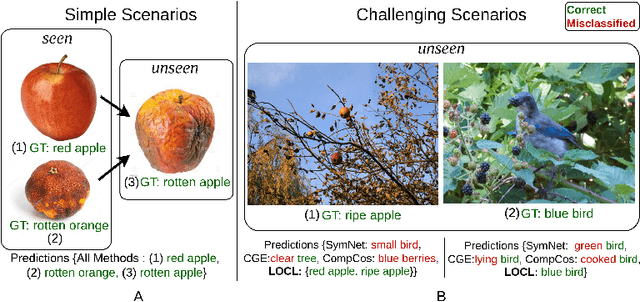
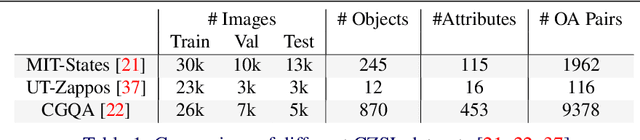
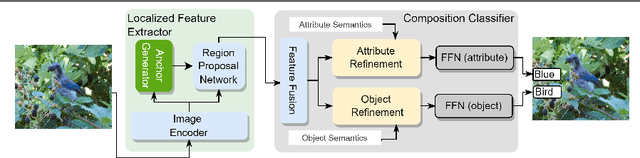
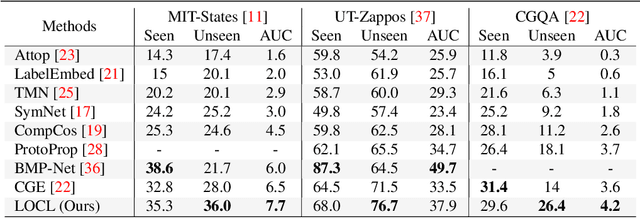
This paper describes LOCL (Learning Object Attribute Composition using Localization) that generalizes composition zero shot learning to objects in cluttered and more realistic settings. The problem of unseen Object Attribute (OA) associations has been well studied in the field, however, the performance of existing methods is limited in challenging scenes. In this context, our key contribution is a modular approach to localizing objects and attributes of interest in a weakly supervised context that generalizes robustly to unseen configurations. Localization coupled with a composition classifier significantly outperforms state of the art (SOTA) methods, with an improvement of about 12% on currently available challenging datasets. Further, the modularity enables the use of localized feature extractor to be used with existing OA compositional learning methods to improve their overall performance.
GTNet:Guided Transformer Network for Detecting Human-Object Interactions
Aug 03, 2021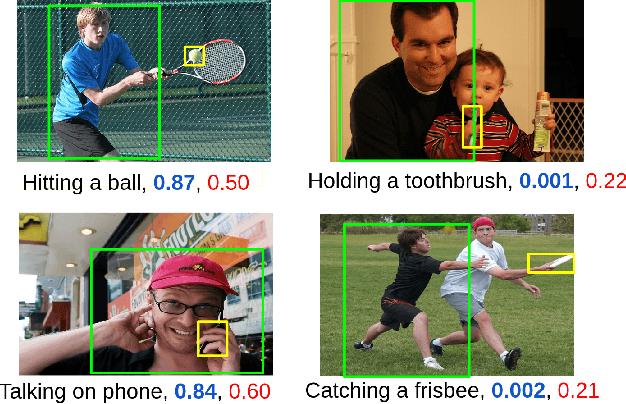
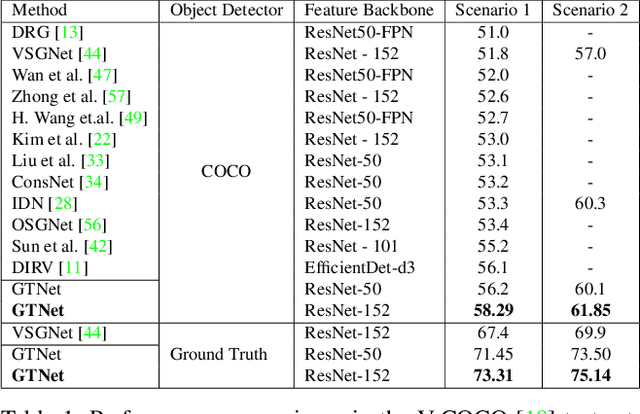
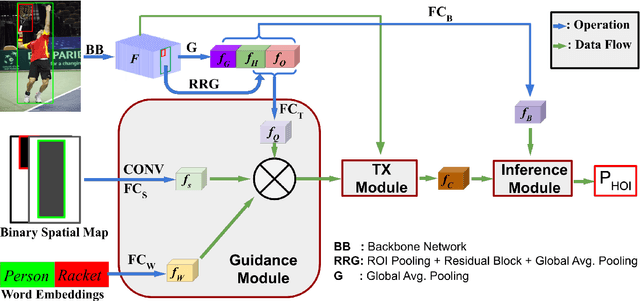
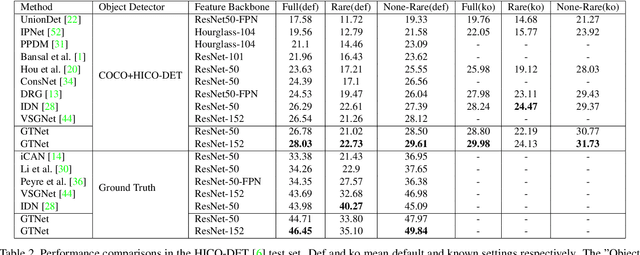
The human-object interaction (HOI) detection task refers to localizing humans, localizing objects, and predicting the interactions between each human-object pair. HOI is considered one of the fundamental steps in truly understanding complex visual scenes. For detecting HOI, it is important to utilize relative spatial configurations and object semantics to find salient spatial regions of images that highlight the interactions between human object pairs. This issue is addressed by the proposed self-attention based guided transformer network, GTNet. GTNet encodes this spatial contextual information in human and object visual features via self-attention while achieving a 4%-6% improvement over previous state of the art results on both the V-COCO and HICO-DET datasets. Code will be made available online.
StressNet: Detecting Stress in Thermal Videos
Nov 23, 2020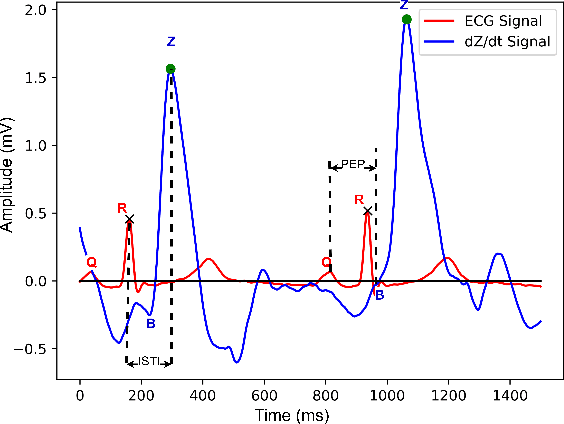
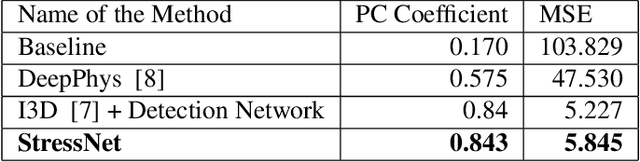
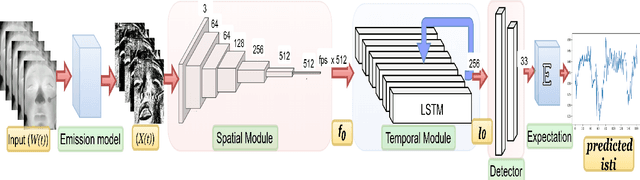
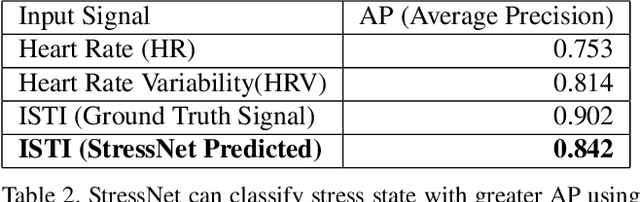
Precise measurement of physiological signals is critical for the effective monitoring of human vital signs. Recent developments in computer vision have demonstrated that signals such as pulse rate and respiration rate can be extracted from digital video of humans, increasing the possibility of contact-less monitoring. This paper presents a novel approach to obtaining physiological signals and classifying stress states from thermal video. The proposed network--"StressNet"--features a hybrid emission representation model that models the direct emission and absorption of heat by the skin and underlying blood vessels. This results in an information-rich feature representation of the face, which is used by spatio-temporal network for reconstructing the ISTI ( Initial Systolic Time Interval: a measure of change in cardiac sympathetic activity that is considered to be a quantitative index of stress in humans ). The reconstructed ISTI signal is fed into a stress-detection model to detect and classify the individual's stress state ( i.e. stress or no stress ). A detailed evaluation demonstrates that StressNet achieves estimated the ISTI signal with 95% accuracy and detect stress with average precision of 0.842. The source code is available on Github.