 Add to Chrome
 Add to Firefox
 Add to Edge
FullCircle: Effortless 3D Reconstruction from Casual 360$^\circ$ Captures
Mar 23, 2026
Radiance fields have emerged as powerful tools for 3D scene reconstruction. However, casual capture remains challenging due to the narrow field of view of perspective cameras, which limits viewpoint coverage and feature correspondences necessary for reliable camera calibration and reconstruction. While commercially available 360$^\circ$ cameras offer significantly broader coverage than perspective cameras for the same capture effort, existing 360$^\circ$ reconstruction methods require special capture protocols and pre-processing steps that undermine the promise of radiance fields: effortless workflows to capture and reconstruct 3D scenes. We propose a practical pipeline for reconstructing 3D scenes directly from raw 360$^\circ$ camera captures. We require no special capture protocols or pre-processing, and exhibit robustness to a prevalent source of reconstruction errors: the human operator that is visible in all 360$^\circ$ imagery. To facilitate evaluation, we introduce a multi-tiered dataset of scenes captured as raw dual-fisheye images, establishing a benchmark for robust casual 360$^\circ$ reconstruction. Our method significantly outperforms not only vanilla 3DGS for 360$^\circ$ cameras but also robust perspective baselines when perspective cameras are simulated from the same capture, demonstrating the advantages of 360$^\circ$ capture for casual reconstruction. Additional results are available at: https://theialab.github.io/fullcircle

3D Stylization via Large Reconstruction Model
Apr 30, 2025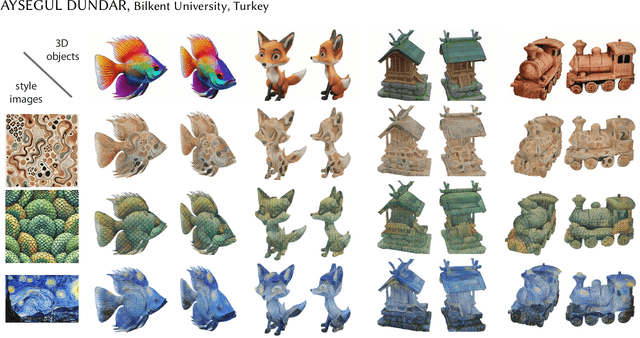

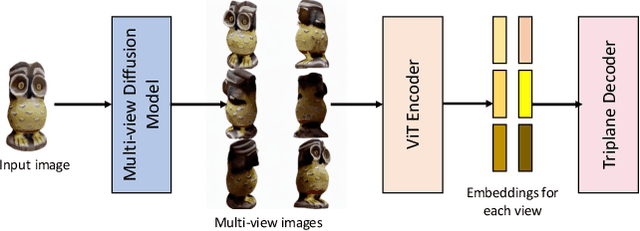
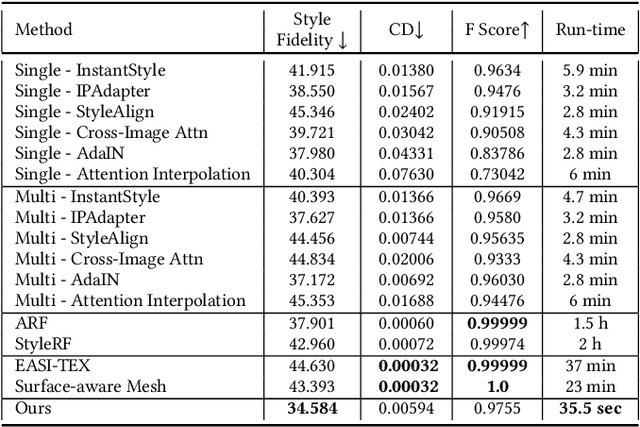
With the growing success of text or image guided 3D generators, users demand more control over the generation process, appearance stylization being one of them. Given a reference image, this requires adapting the appearance of a generated 3D asset to reflect the visual style of the reference while maintaining visual consistency from multiple viewpoints. To tackle this problem, we draw inspiration from the success of 2D stylization methods that leverage the attention mechanisms in large image generation models to capture and transfer visual style. In particular, we probe if large reconstruction models, commonly used in the context of 3D generation, has a similar capability. We discover that the certain attention blocks in these models capture the appearance specific features. By injecting features from a visual style image to such blocks, we develop a simple yet effective 3D appearance stylization method. Our method does not require training or test time optimization. Through both quantitative and qualitative evaluations, we demonstrate that our approach achieves superior results in terms of 3D appearance stylization, significantly improving efficiency while maintaining high-quality visual outcomes.