 Add to Chrome
 Add to Firefox
 Add to Edge
B$^2$F-Map: Crowd-sourced Mapping with Bayesian B-spline Fusion
Mar 02, 2026
Crowd-sourced mapping offers a scalable alternative to creating maps using traditional survey vehicles. Yet, existing methods either rely on prior high-definition (HD) maps or neglect uncertainties in the map fusion. In this work, we present a complete pipeline for HD map generation using production vehicles equipped only with a monocular camera, consumer-grade GNSS, and IMU. Our approach includes on-cloud localization using lightweight standard-definition maps, on-vehicle mapping via an extended object trajectory (EOT) Poisson multi-Bernoulli (PMB) filter with Gibbs sampling, and on-cloud multi-drive optimization and Bayesian map fusion. We represent the lane lines using B-splines, where each B-spline is parameterized by a sequence of Gaussian distributed control points, and propose a novel Bayesian fusion framework for B-spline trajectories with differing density representation, enabling principled handling of uncertainties. We evaluate our proposed approach, B$^2$F-Map, on large-scale real-world datasets collected across diverse driving conditions and demonstrate that our method is able to produce geometrically consistent lane-level maps.

Towards Accurate Ego-lane Identification with Early Time Series Classification
May 27, 2024
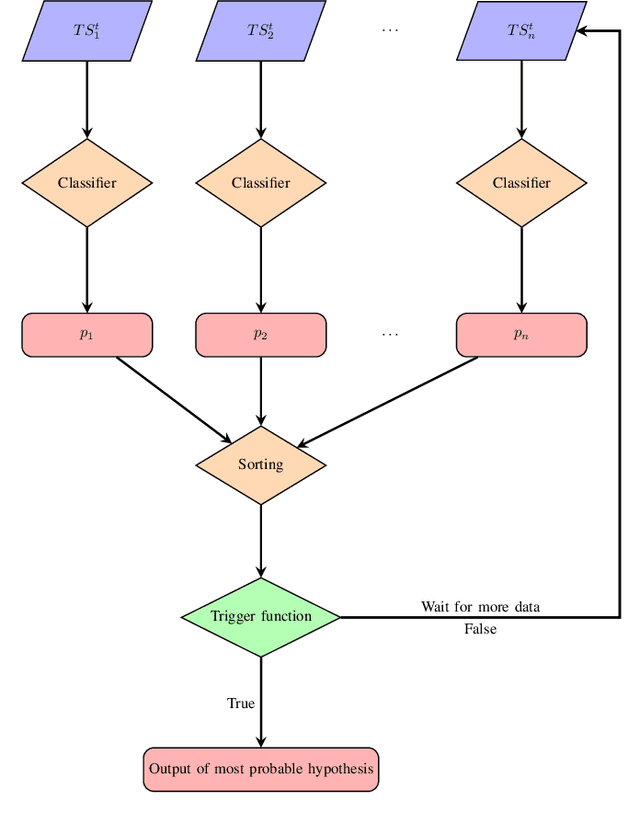


Accurate and timely determination of a vehicle's current lane within a map is a critical task in autonomous driving systems. This paper utilizes an Early Time Series Classification (ETSC) method to achieve precise and rapid ego-lane identification in real-world driving data. The method begins by assessing the similarities between map and lane markings perceived by the vehicle's camera using measurement model quality metrics. These metrics are then fed into a selected ETSC method, comprising a probabilistic classifier and a tailored trigger function, optimized via multi-objective optimization to strike a balance between early prediction and accuracy. Our solution has been evaluated on a comprehensive dataset consisting of 114 hours of real-world traffic data, collected across 5 different countries by our test vehicles. Results show that by leveraging road lane-marking geometry and lane-marking type derived solely from a camera, our solution achieves an impressive accuracy of 99.6%, with an average prediction time of only 0.84 seconds.