 Add to Chrome
 Add to Firefox
 Add to Edge
MDL Meets Latent Confounders: LNML-based Causal Discovery
Jul 05, 2026
Causal discovery with nonlinear mechanisms and latent confounders remains challenging. Existing methods often rely on either linear assumptions or causal sufficiency, limiting their applicability. We propose an MDL-based causal discovery framework that explicitly accounts for latent confounders while allowing flexible nonlinear mechanisms by minimizing the luckiness normalized maximum likelihood (LNML) code-length. The causal relationship between each variable pair is determined by selecting the shortest code-length of the causal model, and we introduce the notion of $Δ$-pseudo-collinearity to identify dependencies induced by latent confounders. Based on these ideas, we develop a greedy algorithm, termed Pseudo-Collinearity Guided Causal Discovery (PCG-CD). Experiments on synthetic and real-world datasets demonstrate that the proposed method accurately recovers directed causal relationships and effectively detects latent confounders.

Policy Optimization Achieves Data-Dependent Regret Bounds in MDPs with Unknown Transitions
Jun 30, 2026We study policy optimization for online episodic tabular Markov decision processes with unknown transition kernels, aiming for best-of-both-worlds guarantees together with data-dependent regret bounds. Recent work (Dann et al., 2023; Li et al., 2026) has shown that policy optimization can adapt to both adversarial and stochastic losses with first-order, second-order, and path-length bounds, but only under known transitions, leaving open whether such data-dependent guarantees are achievable by policy optimization when the transition kernel is unknown. We resolve this by developing a new algorithm based on optimistic follow-the-regularized-leader that attains these guarantees under unknown transitions. The key ingredient is a new design of optimistic $Q$-function estimators together with a data-dependent transition bonus that controls estimator bias through the loss-prediction error. Our analysis further identifies an unavoidable transition-dependent complexity term that captures the intrinsic cost of estimating the transition kernel. As a result, we obtain first-order, second-order, and path-length bounds with the transition-dependent complexity term while simultaneously achieving gap-dependent $\mathrm{polylog}(T)$ regret in the stochastic regime.
An Information Theoretic Framework for Graph Novelty Generation via Latent Mixture Modeling
Jun 18, 2026We propose an information-theoretic framework for graph novelty generation, which aims to generate data that are distinct from existing patterns while preserving global structural consistency. Our approach embeds data into a latent space, models the latent distribution using finite mixture models, and generates novel samples by imposing explicit novelty and reliability conditions formulated in terms of description length. Specifically, novelty is enforced by requiring generated samples to be poorly explained by all existing mixture components, while reliability constrains their impact on the overall mixture structure under the Minimum Description Length (MDL) principle. We provide a theoretical analysis showing that, with appropriate threshold choices, the probabilities of misclassifying non-novel or unreliable samples converge to zero with explicit rates. Experiments on synthetic and benchmark graph datasets demonstrate that the proposed method enables principled novelty generation with quantifiable risk.
Data- and Variance-dependent Regret Bounds for Online Tabular MDPs
Feb 02, 2026This work studies online episodic tabular Markov decision processes (MDPs) with known transitions and develops best-of-both-worlds algorithms that achieve refined data-dependent regret bounds in the adversarial regime and variance-dependent regret bounds in the stochastic regime. We quantify MDP complexity using a first-order quantity and several new data-dependent measures for the adversarial regime, including a second-order quantity and a path-length measure, as well as variance-based measures for the stochastic regime. To adapt to these measures, we develop algorithms based on global optimization and policy optimization, both built on optimistic follow-the-regularized-leader with log-barrier regularization. For global optimization, our algorithms achieve first-order, second-order, and path-length regret bounds in the adversarial regime, and in the stochastic regime, they achieve a variance-aware gap-independent bound and a variance-aware gap-dependent bound that is polylogarithmic in the number of episodes. For policy optimization, our algorithms achieve the same data- and variance-dependent adaptivity, up to a factor of the episode horizon, by exploiting a new optimistic $Q$-function estimator. Finally, we establish regret lower bounds in terms of data-dependent complexity measures for the adversarial regime and a variance measure for the stochastic regime, implying that the regret upper bounds achieved by the global-optimization approach are nearly optimal.
Bandit and Delayed Feedback in Online Structured Prediction
Feb 26, 2025Online structured prediction is a task of sequentially predicting outputs with complex structures based on inputs and past observations, encompassing online classification. Recent studies showed that in the full information setup, we can achieve finite bounds on the surrogate regret, i.e., the extra target loss relative to the best possible surrogate loss. In practice, however, full information feedback is often unrealistic as it requires immediate access to the whole structure of complex outputs. Motivated by this, we propose algorithms that work with less demanding feedback, bandit and delayed feedback. For the bandit setting, using a standard inverse-weighted gradient estimator, we achieve a surrogate regret bound of $O(\sqrt{KT})$ for the time horizon $T$ and the size of the output set $K$. However, $K$ can be extremely large when outputs are highly complex, making this result less desirable. To address this, we propose an algorithm that achieves a surrogate regret bound of $O(T^{2/3})$, which is independent of $K$. This is enabled with a carefully designed pseudo-inverse matrix estimator. Furthermore, for the delayed full information feedback setup, we obtain a surrogate regret bound of $O(D^{2/3} T^{1/3})$ for the delay time $D$. We also provide algorithms for the delayed bandit feedback setup. Finally, we numerically evaluate the performance of the proposed algorithms in online classification with bandit feedback.
Graph Community Augmentation with GMM-based Modeling in Latent Space
Dec 02, 2024
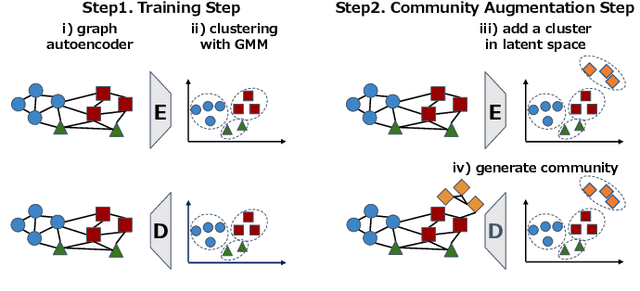
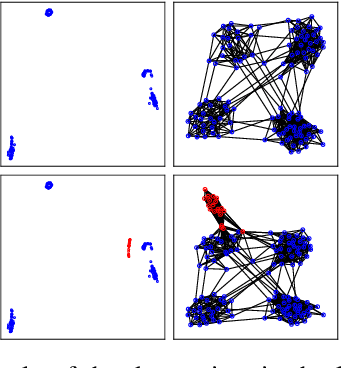
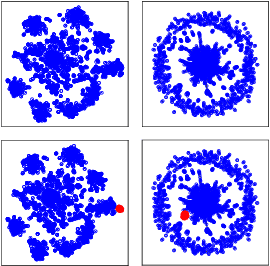
This study addresses the issue of graph generation with generative models. In particular, we are concerned with graph community augmentation problem, which refers to the problem of generating unseen or unfamiliar graphs with a new community out of the probability distribution estimated with a given graph dataset. The graph community augmentation means that the generated graphs have a new community. There is a chance of discovering an unseen but important structure of graphs with a new community, for example, in a social network such as a purchaser network. Graph community augmentation may also be helpful for generalization of data mining models in a case where it is difficult to collect real graph data enough. In fact, there are many ways to generate a new community in an existing graph. It is desirable to discover a new graph with a new community beyond the given graph while we keep the structure of the original graphs to some extent for the generated graphs to be realistic. To this end, we propose an algorithm called the graph community augmentation (GCA). The key ideas of GCA are (i) to fit Gaussian mixture model (GMM) to data points in the latent space into which the nodes in the original graph are embedded, and (ii) to add data points in the new cluster in the latent space for generating a new community based on the minimum description length (MDL) principle. We empirically demonstrate the effectiveness of GCA for generating graphs with a new community structure on synthetic and real datasets.
Foundation of Calculating Normalized Maximum Likelihood for Continuous Probability Models
Sep 12, 2024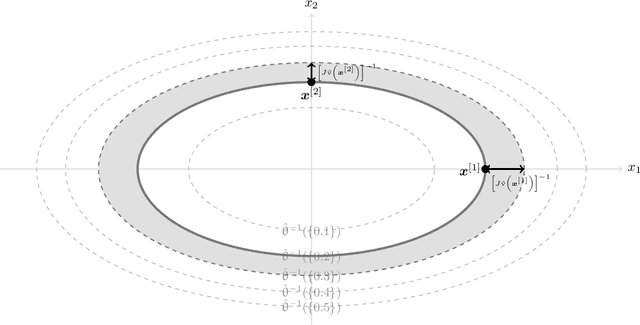
The normalized maximum likelihood (NML) code length is widely used as a model selection criterion based on the minimum description length principle, where the model with the shortest NML code length is selected. A common method to calculate the NML code length is to use the sum (for a discrete model) or integral (for a continuous model) of a function defined by the distribution of the maximum likelihood estimator. While this method has been proven to correctly calculate the NML code length of discrete models, no proof has been provided for continuous cases. Consequently, it has remained unclear whether the method can accurately calculate the NML code length of continuous models. In this paper, we solve this problem affirmatively, proving that the method is also correct for continuous cases. Remarkably, completing the proof for continuous cases is non-trivial in that it cannot be achieved by merely replacing the sums in discrete cases with integrals, as the decomposition trick applied to sums in the discrete model case proof is not applicable to integrals in the continuous model case proof. To overcome this, we introduce a novel decomposition approach based on the coarea formula from geometric measure theory, which is essential to establishing our proof for continuous cases.
Clustering Change Sign Detection by Fusing Mixture Complexity
Mar 27, 2024This paper proposes an early detection method for cluster structural changes. Cluster structure refers to discrete structural characteristics, such as the number of clusters, when data are represented using finite mixture models, such as Gaussian mixture models. We focused on scenarios in which the cluster structure gradually changed over time. For finite mixture models, the concept of mixture complexity (MC) measures the continuous cluster size by considering the cluster proportion bias and overlap between clusters. In this paper, we propose MC fusion as an extension of MC to handle situations in which multiple mixture numbers are possible in a finite mixture model. By incorporating the fusion of multiple models, our approach accurately captured the cluster structure during transitional periods of gradual change. Moreover, we introduce a method for detecting changes in the cluster structure by examining the transition of MC fusion. We demonstrate the effectiveness of our method through empirical analysis using both artificial and real-world datasets.
Balancing Summarization and Change Detection in Graph Streams
Nov 30, 2023
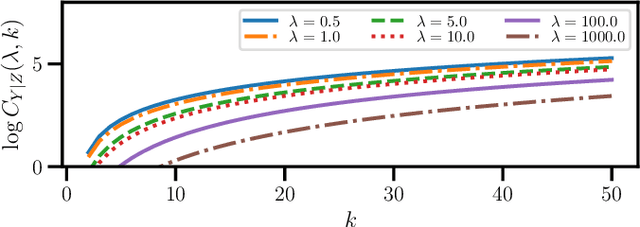
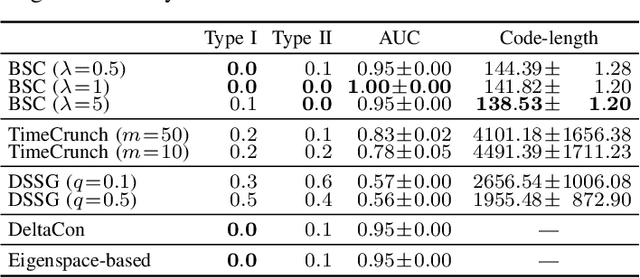
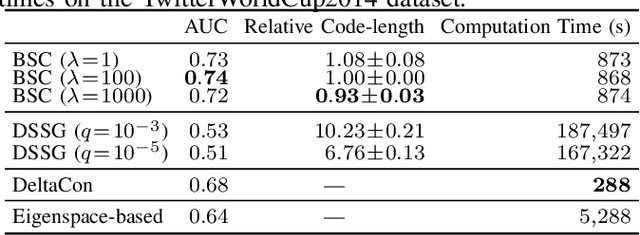
This study addresses the issue of balancing graph summarization and graph change detection. Graph summarization compresses large-scale graphs into a smaller scale. However, the question remains: To what extent should the original graph be compressed? This problem is solved from the perspective of graph change detection, aiming to detect statistically significant changes using a stream of summary graphs. If the compression rate is extremely high, important changes can be ignored, whereas if the compression rate is extremely low, false alarms may increase with more memory. This implies that there is a trade-off between compression rate in graph summarization and accuracy in change detection. We propose a novel quantitative methodology to balance this trade-off to simultaneously realize reliable graph summarization and change detection. We introduce a probabilistic structure of hierarchical latent variable model into a graph, thereby designing a parameterized summary graph on the basis of the minimum description length principle. The parameter specifying the summary graph is then optimized so that the accuracy of change detection is guaranteed to suppress Type I error probability (probability of raising false alarms) to be less than a given confidence level. First, we provide a theoretical framework for connecting graph summarization with change detection. Then, we empirically demonstrate its effectiveness on synthetic and real datasets.
Adaptive Topological Feature via Persistent Homology: Filtration Learning for Point Clouds
Jul 18, 2023
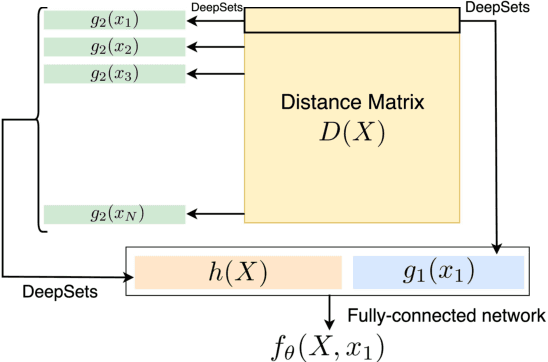
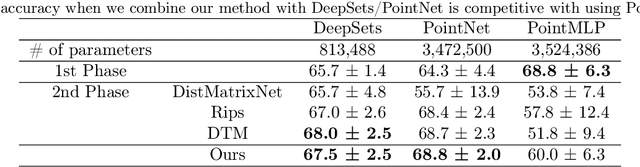
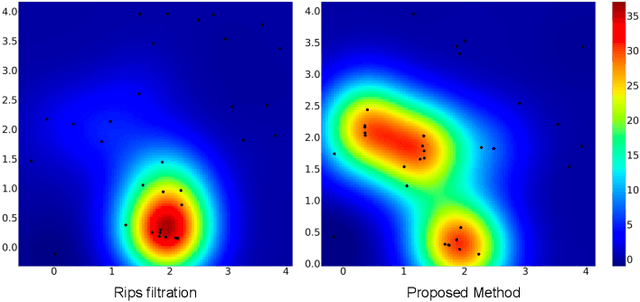
Machine learning for point clouds has been attracting much attention, with many applications in various fields, such as shape recognition and material science. To enhance the accuracy of such machine learning methods, it is known to be effective to incorporate global topological features, which are typically extracted by persistent homology. In the calculation of persistent homology for a point cloud, we need to choose a filtration for the point clouds, an increasing sequence of spaces. Because the performance of machine learning methods combined with persistent homology is highly affected by the choice of a filtration, we need to tune it depending on data and tasks. In this paper, we propose a framework that learns a filtration adaptively with the use of neural networks. In order to make the resulting persistent homology isometry-invariant, we develop a neural network architecture with such invariance. Additionally, we theoretically show a finite-dimensional approximation result that justifies our architecture. Experimental results demonstrated the efficacy of our framework in several classification tasks.