 Add to Chrome
 Add to Firefox
 Add to Edge
Continual Learning Bench: Evaluating Frontier AI Systems in Real-World Stateful Environments
Jun 04, 2026
Continual learning, the ability of AI systems to improve through sequential experience, has attracted substantial interest, but no high-quality benchmark exists to evaluate it. We introduce Continual Learning Bench (CL-Bench), the first difficult, expert-validated benchmark designed to measure whether LLM-based systems genuinely improve with experience. CL-Bench spans six diverse domains (software engineering, signal processing, disease outbreak forecasting, database querying, strategic game-playing, and demand forecasting), each validated by domain experts and designed so that tasks share a learnable latent structure (codebase layout, disease outbreak dynamics, opponent strategies) that a stateful system can discover online but a stateless one cannot. We evaluate frontier models across several agent architectures, from naive in-context learning (ICL) to dedicated memory systems, introducing a gain metric to isolate learning from prior capabilities. We find that these systems leave headroom for improved continual learning: agents frequently overfit to immediate observations or fail to reuse knowledge across instances, and dedicated memory systems do not fix this -- in fact, naive ICL outperforms systems dedicated to memory management. CL-Bench is the first benchmark to evaluate continual learning across diverse real-world domains with expert-validated tasks and isolate online learning from underlying model capability, showing a need for better continual learning systems.

Arming Data Agents with Tribal Knowledge
Feb 13, 2026Natural language to SQL (NL2SQL) translation enables non-expert users to query relational databases through natural language. Recently, NL2SQL agents, powered by the reasoning capabilities of Large Language Models (LLMs), have significantly advanced NL2SQL translation. Nonetheless, NL2SQL agents still make mistakes when faced with large-scale real-world databases because they lack knowledge of how to correctly leverage the underlying data (e.g., knowledge about the intent of each column) and form misconceptions about the data when querying it, leading to errors. Prior work has studied generating facts about the database to provide more context to NL2SQL agents, but such approaches simply restate database contents without addressing the agent's misconceptions. In this paper, we propose Tk-Boost, a bolt-on framework for augmenting any NL2SQL agent with tribal knowledge: knowledge that corrects the agent's misconceptions in querying the database accumulated through experience using the database. To accumulate experience, Tk-Boost first asks the NL2SQL agent to answer a few queries on the database, identifies the agent's misconceptions by analyzing its mistakes on the database, and generates tribal knowledge to address them. To enable accurate retrieval, Tk-Boost indexes this knowledge with applicability conditions that specify the query features for which the knowledge is useful. When answering new queries, Tk-Boost uses this knowledge to provide feedback to the NL2SQL agent, resolving the agent's misconceptions during SQL generation, and thus improving the agent's accuracy. Extensive experiments across the BIRD and Spider 2.0 benchmarks with various NL2SQL agents shows Tk-Boost improves NL2SQL agents accuracy by up to 16.9% on Spider 2.0 and 13.7% on BIRD
AgentSM: Semantic Memory for Agentic Text-to-SQL
Jan 22, 2026Recent advances in LLM-based Text-to-SQL have achieved remarkable gains on public benchmarks such as BIRD and Spider. Yet, these systems struggle to scale in realistic enterprise settings with large, complex schemas, diverse SQL dialects, and expensive multi-step reasoning. Emerging agentic approaches show potential for adaptive reasoning but often suffer from inefficiency and instability-repeating interactions with databases, producing inconsistent outputs, and occasionally failing to generate valid answers. To address these challenges, we introduce Agent Semantic Memory (AgentSM), an agentic framework for Text-to-SQL that builds and leverages interpretable semantic memory. Instead of relying on raw scratchpads or vector retrieval, AgentSM captures prior execution traces-or synthesizes curated ones-as structured programs that directly guide future reasoning. This design enables systematic reuse of reasoning paths, which allows agents to scale to larger schemas, more complex questions, and longer trajectories efficiently and reliably. Compared to state-of-the-art systems, AgentSM achieves higher efficiency by reducing average token usage and trajectory length by 25% and 35%, respectively, on the Spider 2.0 benchmark. It also improves execution accuracy, reaching a state-of-the-art accuracy of 44.8% on the Spider 2.0 Lite benchmark.
Text2SQL is Not Enough: Unifying AI and Databases with TAG
Aug 27, 2024


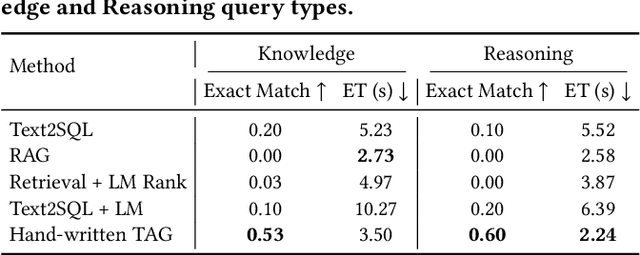
AI systems that serve natural language questions over databases promise to unlock tremendous value. Such systems would allow users to leverage the powerful reasoning and knowledge capabilities of language models (LMs) alongside the scalable computational power of data management systems. These combined capabilities would empower users to ask arbitrary natural language questions over custom data sources. However, existing methods and benchmarks insufficiently explore this setting. Text2SQL methods focus solely on natural language questions that can be expressed in relational algebra, representing a small subset of the questions real users wish to ask. Likewise, Retrieval-Augmented Generation (RAG) considers the limited subset of queries that can be answered with point lookups to one or a few data records within the database. We propose Table-Augmented Generation (TAG), a unified and general-purpose paradigm for answering natural language questions over databases. The TAG model represents a wide range of interactions between the LM and database that have been previously unexplored and creates exciting research opportunities for leveraging the world knowledge and reasoning capabilities of LMs over data. We systematically develop benchmarks to study the TAG problem and find that standard methods answer no more than 20% of queries correctly, confirming the need for further research in this area. We release code for the benchmark at https://github.com/TAG-Research/TAG-Bench.
Optimizing LLM Queries in Relational Workloads
Mar 09, 2024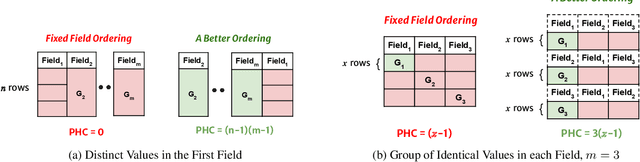
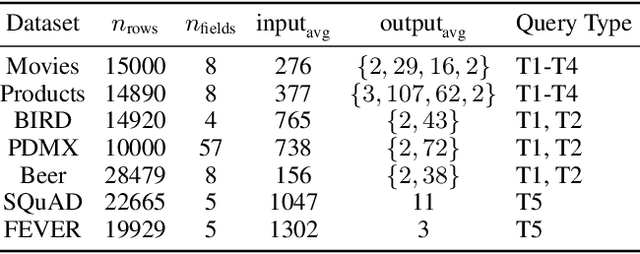
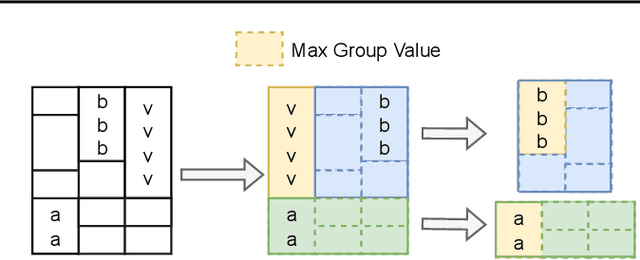
Analytical database providers (e.g., Redshift, Databricks, BigQuery) have rapidly added support for invoking Large Language Models (LLMs) through native user-defined functions (UDFs) to help users perform natural language tasks, such as classification, entity extraction, and translation, inside analytical workloads. For instance, an analyst might want to extract customer sentiments on millions of product reviews. However, LLM inference is highly expensive in both computational and economic terms: for example, an NVIDIA L4 GPU running Llama2-7B can only process 6 KB of text per second. In this paper, we explore how to optimize LLM inference for analytical workloads that invoke LLMs within relational queries. We show that relational queries present novel opportunities for accelerating LLM inference, including reordering rows to maximize key-value (KV) cache reuse within the LLM inference engine, reordering columns within a row to further increase cache reuse, and deduplicating redundant inference requests. We implement these optimizations in Apache Spark, with vLLM as the model serving backend and achieve up to 4.4x improvement in end-to-end latency on a benchmark of diverse LLM-based queries on real datasets. To the best of our knowledge, this is the first work to explicitly address the problem of optimizing LLM invocations within SQL queries.