 Add to Chrome
 Add to Firefox
 Add to Edge
PelviNeXt: A Modality-Agnostic Hybrid Network for Pelvic Imaging in Women's Health
Aug 20, 2026
Women's health remains substantially under-resourced in medical imaging research, with pelvic pathologies such as polycystic ovary syndrome (PCOS) and pelvic fracture both suffering from a scarcity of public, well-annotated benchmark data despite their clinical importance. We introduce PelviNeXt, a modality-agnostic hybrid architecture combining a dense convolutional feature extractor, hierarchical channel-spatial attention (H-CBAM), a multi-scale fusion module (MSFM), and talking-heads multi-head self-attention (TH-MHSA), applied without modification to both pelvic ultrasound and X-ray inputs. While benchmarking PelviNeXt on PCOSGen, the only gynaecologist-annotated public PCOS ultrasound dataset, we identified extensive exact and near-duplicate contamination within and across the dataset. We audit this contamination via perceptual hashing, publicly release a deduplicated version of the dataset, and establish the first integrity-audited evaluation protocol and baseline for PCOSGen under 5-fold cross-validation. On the only publicly available pelvic fracture X-ray dataset (PXR150), PelviNeXt exceeds previously reported state-of-the-art results across accuracy, recall, specificity, and AUROC. Ablation studies confirm that each architectural component contributes to performance on both tasks. Our results demonstrate that a single architecture, applied without task-specific modification, can serve as a reliable foundation for pelvic imaging across modalities in data-scarce, under-researched areas of women's health.

SecondOpinion: Anatomy-Aware Gated Reasoning for Efficient Medical Image Analysis
Aug 03, 2026Deep learning models for medical image analysis typically apply a fixed amount of computation to every input, regardless of case difficulty. Anatomy-guided dual-stream architectures have been shown to improve diagnostic performance, but they evaluate both streams unconditionally, even on cases a single stream could already resolve confidently. We propose SecondOpinion, a framework in which a fast primary stream processes every case, while a second, anatomy-guided stream is invoked only when GateKeeper, a gating mechanism trained explicitly as a binary correctness classifier, judges that the primary stream's prediction needs additional scrutiny, much as a clinician might seek a second opinion on a difficult case. When activated, the two streams are combined through a lightweight cross-attention fusion module. We evaluate SecondOpinion on a unified five-class chest X-ray dataset and a pelvic fracture dataset, the latter including a held-out, harder subset of fractures that are invisible on X-ray but confirmed via CT. SecondOpinion matches or exceeds prior state-of-the-art performance on both tasks, while activating its anatomy-guided stream on only 9.23% of chest X-ray cases, rising to 24.12% on visible fractures and 45.71% on invisible fractures, an activation rate that tracks task difficulty directly. These results suggest that supervising a gating signal toward correctness, rather than relying on unsupervised confidence, allows a model to allocate anatomical reasoning where it is actually needed.
A Scoping Review of Deep Learning for Urban Visual Pollution and Proposal of a Real-Time Monitoring Framework with a Visual Pollution Index
Feb 10, 2026Urban Visual Pollution (UVP) has emerged as a critical concern, yet research on automatic detection and application remains fragmented. This scoping review maps the existing deep learning-based approaches for detecting, classifying, and designing a comprehensive application framework for visual pollution management. Following the PRISMA-ScR guidelines, seven academic databases (Scopus, Web of Science, IEEE Xplore, ACM DL, ScienceDirect, SpringerNatureLink, and Wiley) were systematically searched and reviewed, and 26 articles were found. Most research focuses on specific pollutant categories and employs variations of YOLO, Faster R-CNN, and EfficientDet architectures. Although several datasets exist, they are limited to specific areas and lack standardized taxonomies. Few studies integrate detection into real-time application systems, yet they tend to be geographically skewed. We proposed a framework for monitoring visual pollution that integrates a visual pollution index to assess the severity of visual pollution for a certain area. This review highlights the need for a unified UVP management system that incorporates pollutant taxonomy, a cross-city benchmark dataset, a generalized deep learning model, and an assessment index that supports sustainable urban aesthetics and enhances the well-being of urban dwellers.
Route, Retrieve, Reflect, Repair: Self-Improving Agentic Framework for Visual Detection and Linguistic Reasoning in Medical Imaging
Jan 13, 2026Medical image analysis increasingly relies on large vision-language models (VLMs), yet most systems remain single-pass black boxes that offer limited control over reasoning, safety, and spatial grounding. We propose R^4, an agentic framework that decomposes medical imaging workflows into four coordinated agents: a Router that configures task- and specialization-aware prompts from the image, patient history, and metadata; a Retriever that uses exemplar memory and pass@k sampling to jointly generate free-text reports and bounding boxes; a Reflector that critiques each draft-box pair for key clinical error modes (negation, laterality, unsupported claims, contradictions, missing findings, and localization errors); and a Repairer that iteratively revises both narrative and spatial outputs under targeted constraints while curating high-quality exemplars for future cases. Instantiated on chest X-ray analysis with multiple modern VLM backbones and evaluated on report generation and weakly supervised detection, R^4 consistently boosts LLM-as-a-Judge scores by roughly +1.7-+2.5 points and mAP50 by +2.5-+3.5 absolute points over strong single-VLM baselines, without any gradient-based fine-tuning. These results show that agentic routing, reflection, and repair can turn strong but brittle VLMs into more reliable and better grounded tools for clinical image interpretation. Our code can be found at: https://github.com/faiyazabdullah/MultimodalMedAgent
Invisible Yet Detected: PelFANet with Attention-Guided Anatomical Fusion for Pelvic Fracture Diagnosis
Sep 17, 2025Pelvic fractures pose significant diagnostic challenges, particularly in cases where fracture signs are subtle or invisible on standard radiographs. To address this, we introduce PelFANet, a dual-stream attention network that fuses raw pelvic X-rays with segmented bone images to improve fracture classification. The network em-ploys Fused Attention Blocks (FABlocks) to iteratively exchange and refine fea-tures from both inputs, capturing global context and localized anatomical detail. Trained in a two-stage pipeline with a segmentation-guided approach, PelFANet demonstrates superior performance over conventional methods. On the AMERI dataset, it achieves 88.68% accuracy and 0.9334 AUC on visible fractures, while generalizing effectively to invisible fracture cases with 82.29% accuracy and 0.8688 AUC, despite not being trained on them. These results highlight the clini-cal potential of anatomy-aware dual-input architectures for robust fracture detec-tion, especially in scenarios with subtle radiographic presentations.
SceneCalib: Automatic Targetless Calibration of Cameras and Lidars in Autonomous Driving
Apr 11, 2023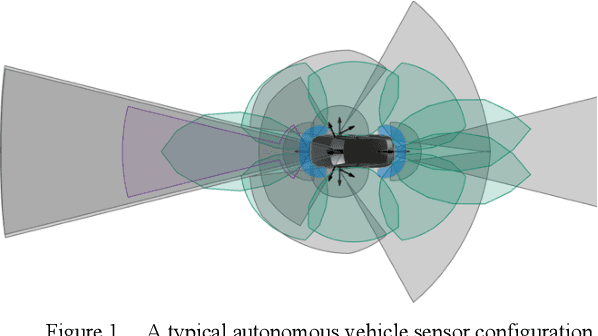
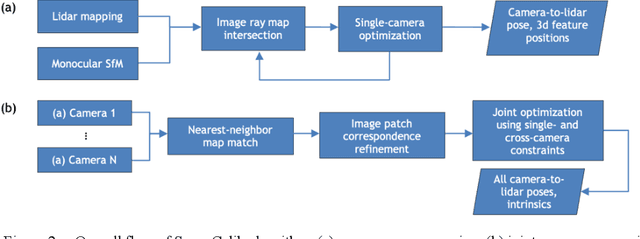
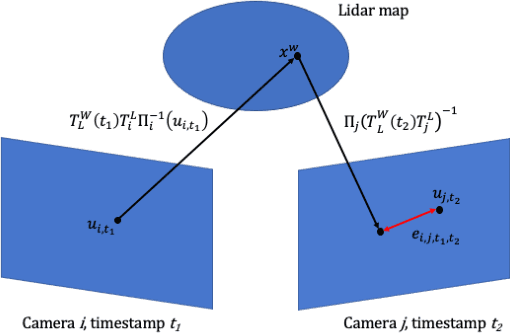
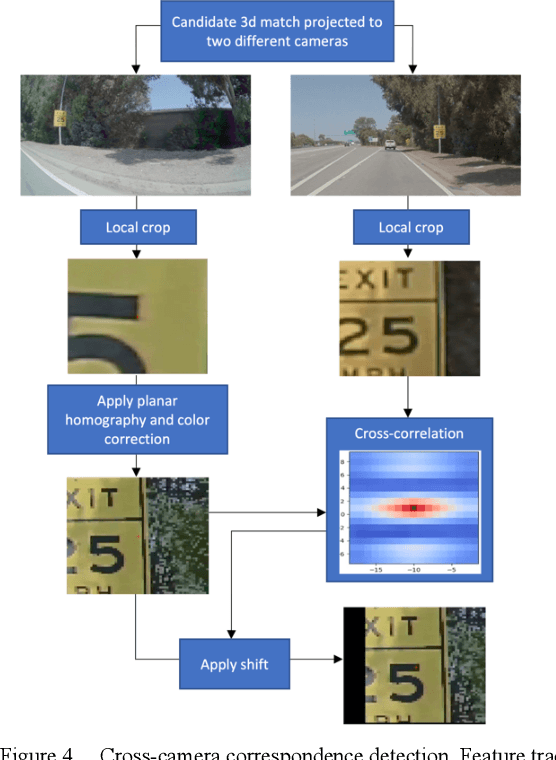
Accurate camera-to-lidar calibration is a requirement for sensor data fusion in many 3D perception tasks. In this paper, we present SceneCalib, a novel method for simultaneous self-calibration of extrinsic and intrinsic parameters in a system containing multiple cameras and a lidar sensor. Existing methods typically require specially designed calibration targets and human operators, or they only attempt to solve for a subset of calibration parameters. We resolve these issues with a fully automatic method that requires no explicit correspondences between camera images and lidar point clouds, allowing for robustness to many outdoor environments. Furthermore, the full system is jointly calibrated with explicit cross-camera constraints to ensure that camera-to-camera and camera-to-lidar extrinsic parameters are consistent.
Self-supervised Learning with Local Contrastive Loss for Detection and Semantic Segmentation
Jul 10, 2022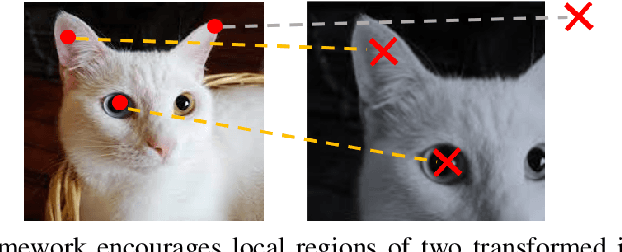
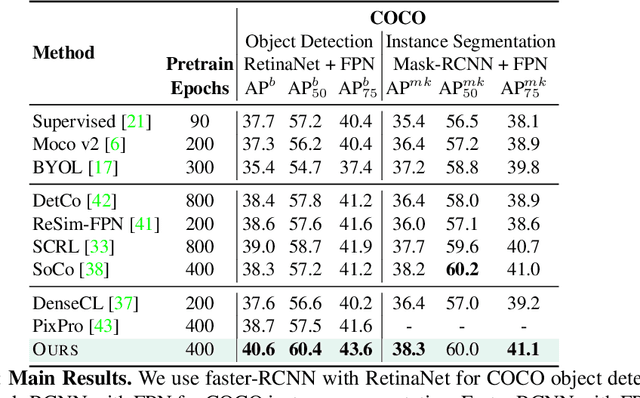
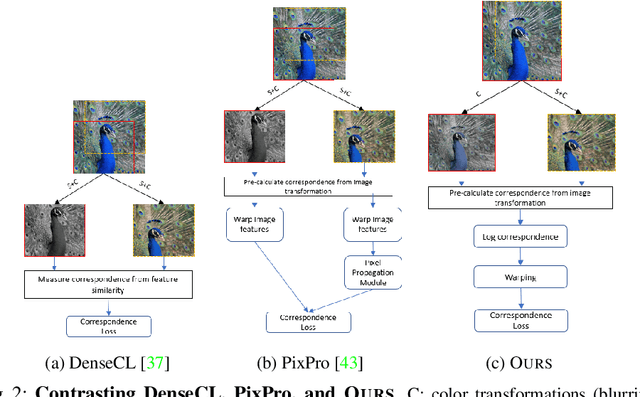
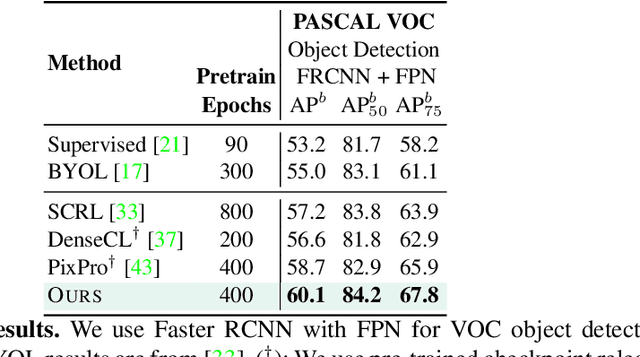
We present a self-supervised learning (SSL) method suitable for semi-global tasks such as object detection and semantic segmentation. We enforce local consistency between self-learned features, representing corresponding image locations of transformed versions of the same image, by minimizing a pixel-level local contrastive (LC) loss during training. LC-loss can be added to existing self-supervised learning methods with minimal overhead. We evaluate our SSL approach on two downstream tasks -- object detection and semantic segmentation, using COCO, PASCAL VOC, and CityScapes datasets. Our method outperforms the existing state-of-the-art SSL approaches by 1.9% on COCO object detection, 1.4% on PASCAL VOC detection, and 0.6% on CityScapes segmentation.
ConfLab: A Rich Multimodal Multisensor Dataset of Free-Standing Social Interactions In-the-Wild
May 10, 2022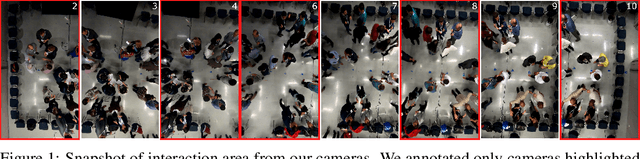
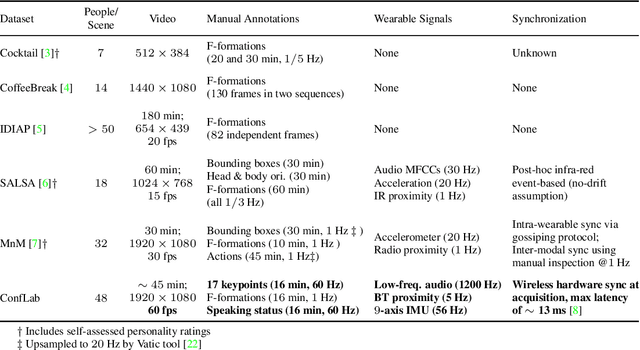

We describe an instantiation of a new concept for multimodal multisensor data collection of real life in-the-wild free standing social interactions in the form of a Conference Living Lab (ConfLab). ConfLab contains high fidelity data of 49 people during a real-life professional networking event capturing a diverse mix of status, acquaintanceship, and networking motivations at an international conference. Recording such a dataset is challenging due to the delicate trade-off between participant privacy and fidelity of the data, and the technical and logistic challenges involved. We improve upon prior datasets in the fidelity of most of our modalities: 8-camera overhead setup, personal wearable sensors recording body motion (9-axis IMU), Bluetooth-based proximity, and low-frequency audio. Additionally, we use a state-of-the-art hardware synchronization solution and time-efficient continuous technique for annotating body keypoints and actions at high frequencies. We argue that our improvements are essential for a deeper study of interaction dynamics at finer time scales. Our research tasks showcase some of the open challenges related to in-the-wild privacy-preserving social data analysis: keypoints detection from overhead camera views, skeleton based no-audio speaker detection, and F-formation detection. With the ConfLab dataset, we aim to bridge the gap between traditional computer vision tasks and in-the-wild ecologically valid socially-motivated tasks.
Generating Cyber Threat Intelligence to Discover Potential Security Threats Using Classification and Topic Modeling
Aug 19, 2021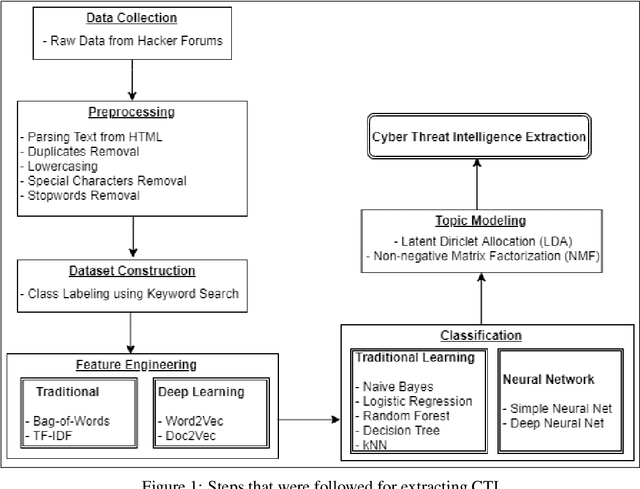
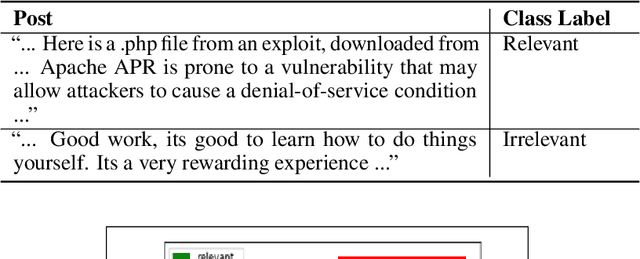
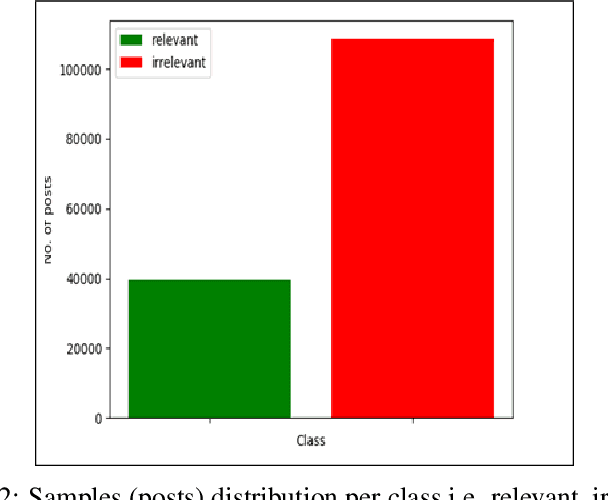
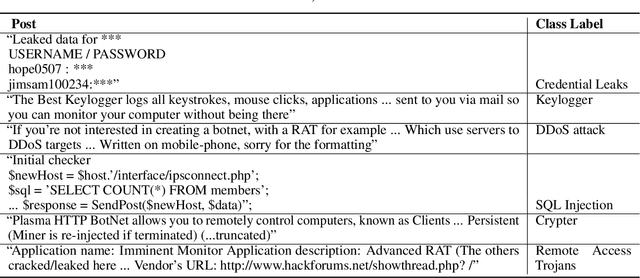
Due to the variety of cyber-attacks or threats, the cybersecurity community enhances the traditional security control mechanisms to an advanced level so that automated tools can encounter potential security threats. Very recently, Cyber Threat Intelligence (CTI) has been presented as one of the proactive and robust mechanisms because of its automated cybersecurity threat prediction. Generally, CTI collects and analyses data from various sources e.g., online security forums, social media where cyber enthusiasts, analysts, even cybercriminals discuss cyber or computer security-related topics and discovers potential threats based on the analysis. As the manual analysis of every such discussion (posts on online platforms) is time-consuming, inefficient, and susceptible to errors, CTI as an automated tool can perform uniquely to detect cyber threats. In this paper, we identify and explore relevant CTI from hacker forums utilizing different supervised (classification) and unsupervised learning (topic modeling) techniques. To this end, we collect data from a real hacker forum and constructed two datasets: a binary dataset and a multi-class dataset. We then apply several classifiers along with deep neural network-based classifiers and use them on the datasets to compare their performances. We also employ the classifiers on a labeled leaked dataset as our ground truth. We further explore the datasets using unsupervised techniques. For this purpose, we leverage two topic modeling algorithms namely Latent Dirichlet Allocation (LDA) and Non-negative Matrix Factorization (NMF).
Dynamic Distillation Network for Cross-Domain Few-Shot Recognition with Unlabeled Data
Jun 14, 2021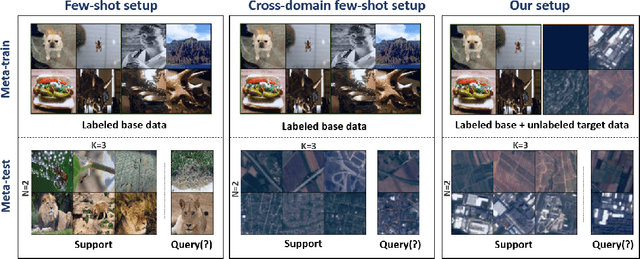
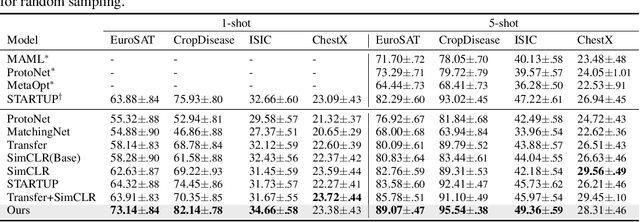
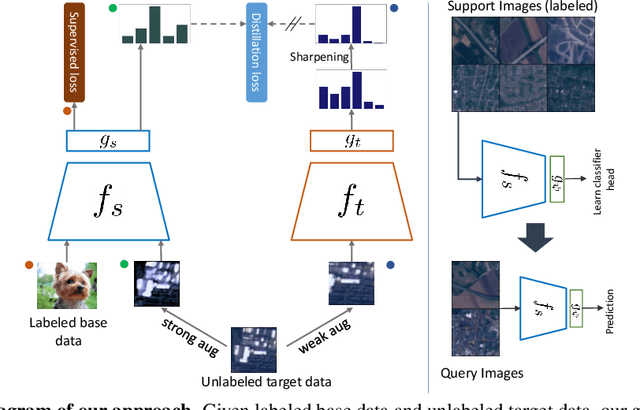

Most existing works in few-shot learning rely on meta-learning the network on a large base dataset which is typically from the same domain as the target dataset. We tackle the problem of cross-domain few-shot learning where there is a large shift between the base and target domain. The problem of cross-domain few-shot recognition with unlabeled target data is largely unaddressed in the literature. STARTUP was the first method that tackles this problem using self-training. However, it uses a fixed teacher pretrained on a labeled base dataset to create soft labels for the unlabeled target samples. As the base dataset and unlabeled dataset are from different domains, projecting the target images in the class-domain of the base dataset with a fixed pretrained model might be sub-optimal. We propose a simple dynamic distillation-based approach to facilitate unlabeled images from the novel/base dataset. We impose consistency regularization by calculating predictions from the weakly-augmented versions of the unlabeled images from a teacher network and matching it with the strongly augmented versions of the same images from a student network. The parameters of the teacher network are updated as exponential moving average of the parameters of the student network. We show that the proposed network learns representation that can be easily adapted to the target domain even though it has not been trained with target-specific classes during the pretraining phase. Our model outperforms the current state-of-the art method by 4.4% for 1-shot and 3.6% for 5-shot classification in the BSCD-FSL benchmark, and also shows competitive performance on traditional in-domain few-shot learning task. Our code will be available at: https://github.com/asrafulashiq/dynamic-cdfsl.