 Add to Chrome
 Add to Firefox
 Add to Edge
Inverse Theory of Mind Modeling for Content Recommendation: From Web Browsing to Dynamic Intelligent Interfaces
Aug 11, 2026
Modern recommender systems treat observed actions as reliable proxies for user preferences, yet interactions often reflect exploration or comparison rather than stable preference expression. As interfaces evolve from static layouts toward generative UIs and immersive extended reality (XR), the need for deeper, modality-agnostic user understanding grows: these adaptive environments must decide not only what to present but where, when, how prominently, and most importantly why a user acts. We propose an Inverse Theory of Mind (IToM) pipeline that reasons backward from observed interactions to infer the beliefs, preferences, and decision-making traits that explain behavior. The pipeline reconstructs each user's decision context, including what was chosen and what alternatives were available, applies LLM-driven counterfactual reasoning to produce evidence-grounded natural-language belief statements, and synthesizes these beliefs through multi-hypothesis abductive inference into a structured user persona. We evaluate on the OPeRA dataset against ground-truth personality assessments, attitudinal surveys, and interview-based personas across four tasks: next action prediction, shopping attitude alignment, Big Five personality inference, and held-out category prediction. Results show that inferred personas match or exceed ground-truth personas and that multi-hypothesis reasoning is essential for accurate personality prediction. We further demonstrate cross-modal transferability with a persona-driven spatial banking application on VisionOS.

Physical Self-Supervised Learning: IMU Sensing without Manual Labels
Jul 20, 2026Deep neural networks have become a promising approach for IMU-based sensing, but their scalability is fundamentally limited by costly labeled data and poor robustness to heterogeneous devices, placements, and users. Existing unsupervised and self-supervised methods reduce but do not remove this dependence, still requiring labeled data for domain adaptation and largely ignoring known physical structure. We propose physical self-supervised learning, an autoencoder-style paradigm for label-free IMU sensing. We replace the conventional neural decoder with an auto-adaptive physics decoder, a learnable family of kinematic equations that enforces explicit physical structure while adapting across environments, and adopt a hybrid two-stage IMU encoder with reconstruction in a structured latent space to mitigate sensor noise. Our framework further introduces probabilistic frequency-spatial constraints to disentangle sensor and object motion, a multi-view kinematic tree to exploit sparse physical self-supervised signals, and an uncertainty-aware formulation to handle the inherent ambiguity of IMU inference. Evaluated on inertial tracking and full-body motion capture over public datasets and realistic deployments, physical self-supervised learning reduces errors by up to 5x for tracking and 4x for motion capture in challenging generalization scenarios, consistently outperforming state-of-the-art supervised and self-supervised baselines without any labels.
* 15 pages, 20 figures. Published in ACM MobiSys 2026
Best-of-Better-$N$: Generating Pre-Aligned Responses with In-Context Learning
Jul 03, 2026Inference-time alignment methods, such as Best-of-$N$, offer a flexible alternative to training-based alignment by using reward models to select high-quality responses generated by a reference LLM. However, the efficacy of these methods is inherently limited by the response quality: if the reference LLM assigns negligible probability to high-reward responses, no selection strategy will succeed in finding aligned outputs. In this work, we propose Best-of-Better-$N$ (BoBN), an in context learning-based generation framework to address this challenge. Our method utilizes retrieval from high-reward examples relevant to the input query and task. Crucially, we introduce a restyling step where retrieved responses are rewritten by the reference LLM to align with the target task's format and style. These restyled examples are used in-context to shift the sampling distribution toward the high-reward region. We analytically characterize how in-context learning shifts the output distribution of pretrained transformers toward the high-reward region, resulting in provable benefits on the target task. We then evaluate BoBN on safety alignment and mathematical reasoning benchmarks across several reference LLMs. BoBN's higher-quality responses enable better performance to be achieved when the number of responses $N$ is fixed, and smaller $N$ required to achieve a target performance.
ECA: Efficient Continual Alignment for Open-Ended Image-to-Text Generation
Jun 10, 2026Incremental Learning (IL) for Open-ended Image-to-Text Generation (OpenITG) enables models to continuously generate accurate, contextually relevant text for new images while preserving previously acquired knowledge. Unlike prior studies, this paper addresses a more practical scenario in which the predominant category of visual data shifts over time as environments evolve. In this context, we introduce a new notion of continual alignment, which incrementally adapts the alignment module within pre-trained VLMs to preserve high-quality cross-modal representations. Based on this idea, we propose Efficient Continual Alignment (ECA), a novel exemplar-free IL approach for OpenITG. The key challenge is enabling the model to acquire new, task-specific features while minimizing interference with the established alignment without accessing raw data from previous tasks. To address this, ECA employs three core mechanisms: a Mixture of Query (MoQ) module that adapts task-specific query tokens, a Fisher Dynamic Expansion (FeDEx) that dynamically expands model structure based on a Fisher Information Matrix (FIM)-based metric, and an embedding dictionary with Dictionary Replay (DR) to retain past knowledge. To evaluate ECA's performance, we construct four new IL OpenITG benchmarks that better reflect real-world scenarios. Experimental results demonstrate that ECA significantly mitigates catastrophic forgetting and improves IL performance compared to baseline methods. Code and benchmarks are available at https://github.com/Snowball0823/ECA.
The Unseen Threat: Residual Knowledge in Machine Unlearning under Perturbed Samples
Jan 29, 2026Machine unlearning offers a practical alternative to avoid full model re-training by approximately removing the influence of specific user data. While existing methods certify unlearning via statistical indistinguishability from re-trained models, these guarantees do not naturally extend to model outputs when inputs are adversarially perturbed. In particular, slight perturbations of forget samples may still be correctly recognized by the unlearned model - even when a re-trained model fails to do so - revealing a novel privacy risk: information about the forget samples may persist in their local neighborhood. In this work, we formalize this vulnerability as residual knowledge and show that it is inevitable in high-dimensional settings. To mitigate this risk, we propose a fine-tuning strategy, named RURK, that penalizes the model's ability to re-recognize perturbed forget samples. Experiments on vision benchmarks with deep neural networks demonstrate that residual knowledge is prevalent across existing unlearning methods and that our approach effectively prevents residual knowledge.
A Numerical Gradient Inversion Attack in Variational Quantum Neural-Networks
Apr 17, 2025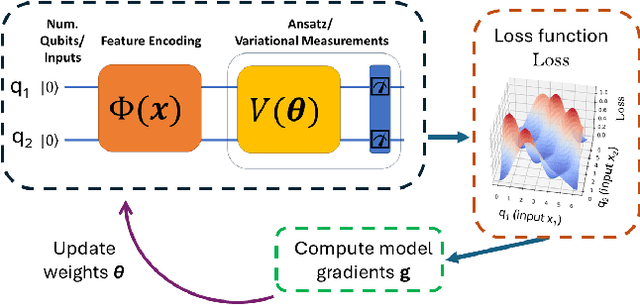
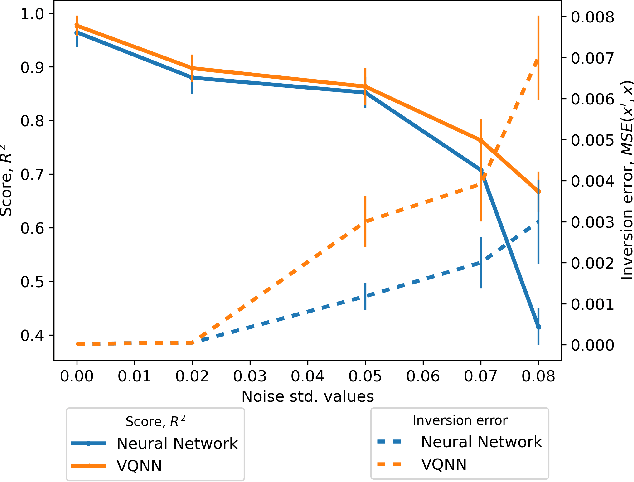
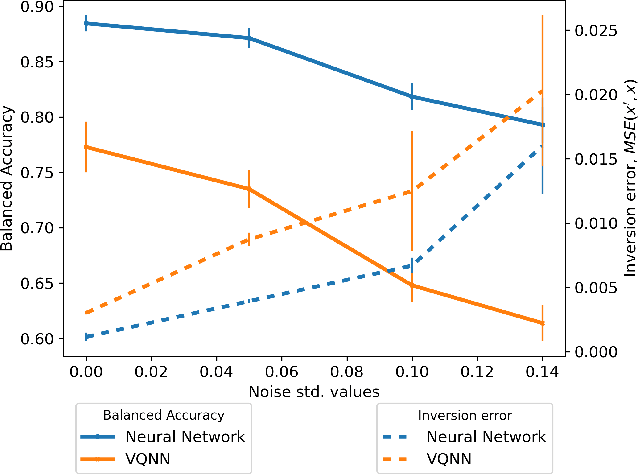
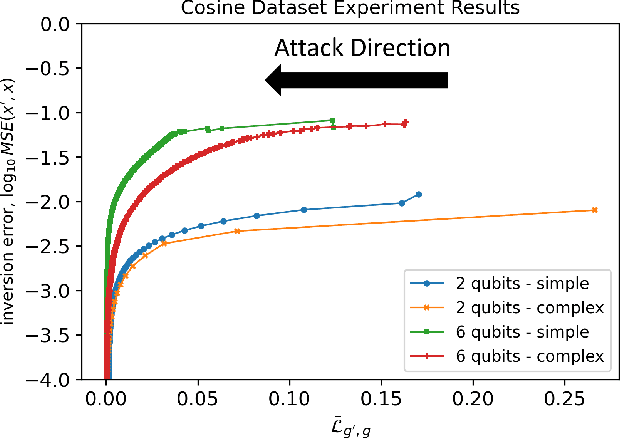
The loss landscape of Variational Quantum Neural Networks (VQNNs) is characterized by local minima that grow exponentially with increasing qubits. Because of this, it is more challenging to recover information from model gradients during training compared to classical Neural Networks (NNs). In this paper we present a numerical scheme that successfully reconstructs input training, real-world, practical data from trainable VQNNs' gradients. Our scheme is based on gradient inversion that works by combining gradients estimation with the finite difference method and adaptive low-pass filtering. The scheme is further optimized with Kalman filter to obtain efficient convergence. Our experiments show that our algorithm can invert even batch-trained data, given the VQNN model is sufficiently over-parameterized.
LLM Hallucination Reasoning with Zero-shot Knowledge Test
Nov 14, 2024LLM hallucination, where LLMs occasionally generate unfaithful text, poses significant challenges for their practical applications. Most existing detection methods rely on external knowledge, LLM fine-tuning, or hallucination-labeled datasets, and they do not distinguish between different types of hallucinations, which are crucial for improving detection performance. We introduce a new task, Hallucination Reasoning, which classifies LLM-generated text into one of three categories: aligned, misaligned, and fabricated. Our novel zero-shot method assesses whether LLM has enough knowledge about a given prompt and text. Our experiments conducted on new datasets demonstrate the effectiveness of our method in hallucination reasoning and underscore its importance for enhancing detection performance.
Model-Agnostic Utility-Preserving Biometric Information Anonymization
May 23, 2024The recent rapid advancements in both sensing and machine learning technologies have given rise to the universal collection and utilization of people's biometrics, such as fingerprints, voices, retina/facial scans, or gait/motion/gestures data, enabling a wide range of applications including authentication, health monitoring, or much more sophisticated analytics. While providing better user experiences and deeper business insights, the use of biometrics has raised serious privacy concerns due to their intrinsic sensitive nature and the accompanying high risk of leaking sensitive information such as identity or medical conditions. In this paper, we propose a novel modality-agnostic data transformation framework that is capable of anonymizing biometric data by suppressing its sensitive attributes and retaining features relevant to downstream machine learning-based analyses that are of research and business values. We carried out a thorough experimental evaluation using publicly available facial, voice, and motion datasets. Results show that our proposed framework can achieve a \highlight{high suppression level for sensitive information}, while at the same time retain underlying data utility such that subsequent analyses on the anonymized biometric data could still be carried out to yield satisfactory accuracy.
OVOR: OnePrompt with Virtual Outlier Regularization for Rehearsal-Free Class-Incremental Learning
Feb 06, 2024Recent works have shown that by using large pre-trained models along with learnable prompts, rehearsal-free methods for class-incremental learning (CIL) settings can achieve superior performance to prominent rehearsal-based ones. Rehearsal-free CIL methods struggle with distinguishing classes from different tasks, as those are not trained together. In this work we propose a regularization method based on virtual outliers to tighten decision boundaries of the classifier, such that confusion of classes among different tasks is mitigated. Recent prompt-based methods often require a pool of task-specific prompts, in order to prevent overwriting knowledge of previous tasks with that of the new task, leading to extra computation in querying and composing an appropriate prompt from the pool. This additional cost can be eliminated, without sacrificing accuracy, as we reveal in the paper. We illustrate that a simplified prompt-based method can achieve results comparable to previous state-of-the-art (SOTA) methods equipped with a prompt pool, using much less learnable parameters and lower inference cost. Our regularization method has demonstrated its compatibility with different prompt-based methods, boosting those previous SOTA rehearsal-free CIL methods' accuracy on the ImageNet-R and CIFAR-100 benchmarks. Our source code is available at https://github.com/jpmorganchase/ovor.
Machine Unlearning for Image-to-Image Generative Models
Feb 02, 2024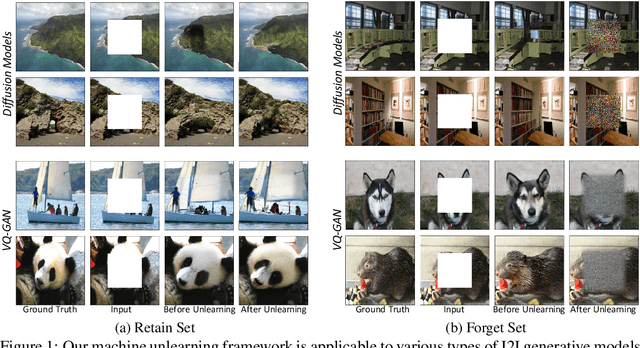
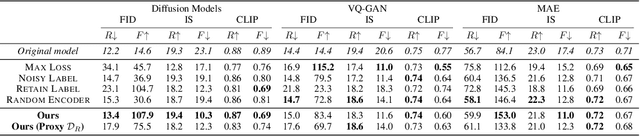
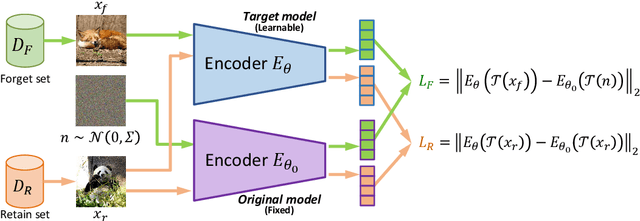
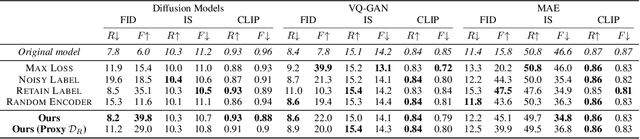
Machine unlearning has emerged as a new paradigm to deliberately forget data samples from a given model in order to adhere to stringent regulations. However, existing machine unlearning methods have been primarily focused on classification models, leaving the landscape of unlearning for generative models relatively unexplored. This paper serves as a bridge, addressing the gap by providing a unifying framework of machine unlearning for image-to-image generative models. Within this framework, we propose a computationally-efficient algorithm, underpinned by rigorous theoretical analysis, that demonstrates negligible performance degradation on the retain samples, while effectively removing the information from the forget samples. Empirical studies on two large-scale datasets, ImageNet-1K and Places-365, further show that our algorithm does not rely on the availability of the retain samples, which further complies with data retention policy. To our best knowledge, this work is the first that represents systemic, theoretical, empirical explorations of machine unlearning specifically tailored for image-to-image generative models. Our code is available at https://github.com/jpmorganchase/l2l-generator-unlearning.