 Add to Chrome
 Add to Firefox
 Add to Edge
Representation Learning to Study Temporal Dynamics in Tutorial Scaffolding
Mar 25, 2026
Adaptive scaffolding enhances learning, yet the field lacks robust methods for measuring it within authentic tutoring dialogue. This gap has become more pressing with the rise of remote human tutoring and large language model-based systems. We introduce an embedding-based approach that analyzes scaffolding dynamics by aligning the semantics of dialogue turns, problem statements, and correct solutions. Specifically, we operationalize alignment by computing cosine similarity between tutor and student contributions and task-relevant content. We apply this framework to 1,576 real-world mathematics tutoring dialogues from the Eedi Question Anchored Tutoring Dialogues dataset. The analysis reveals systematic differences in task alignment and distinct temporal patterns in how participants ground their contributions in problem and solution content. Further, mixed-effects models show that role-specific semantic alignment predicts tutorial progression beyond baseline features such as message order and length. Tutor contributions exhibited stronger grounding in problem content early in interactions. In contrast, student solution alignment was modestly positively associated with progression. These findings support scaffolding as a continuous, role-sensitive process grounded in task semantics. By capturing role-specific alignment over time, this approach provides a principled method for analyzing instructional dialogue and evaluating conversational tutoring systems.

How Can I Get It Right? Using GPT to Rephrase Incorrect Trainee Responses
May 02, 2024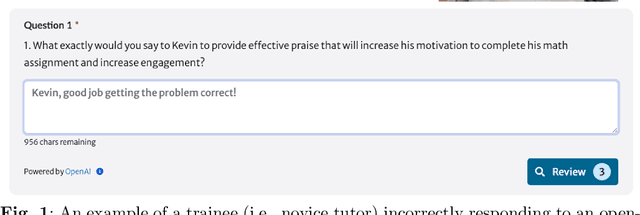
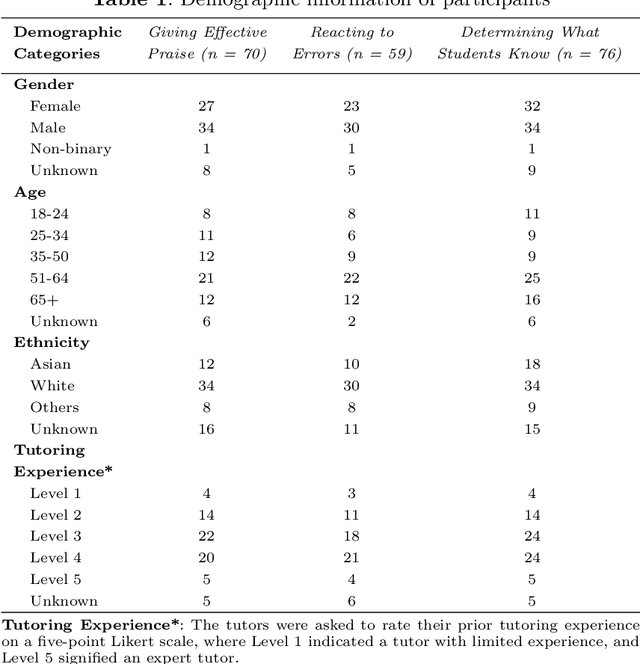
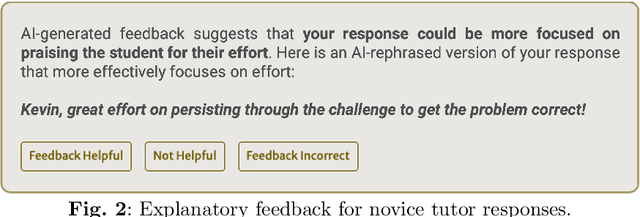
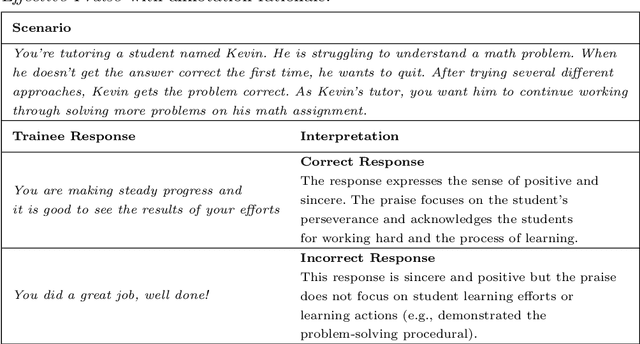
One-on-one tutoring is widely acknowledged as an effective instructional method, conditioned on qualified tutors. However, the high demand for qualified tutors remains a challenge, often necessitating the training of novice tutors (i.e., trainees) to ensure effective tutoring. Research suggests that providing timely explanatory feedback can facilitate the training process for trainees. However, it presents challenges due to the time-consuming nature of assessing trainee performance by human experts. Inspired by the recent advancements of large language models (LLMs), our study employed the GPT-4 model to build an explanatory feedback system. This system identifies trainees' responses in binary form (i.e., correct/incorrect) and automatically provides template-based feedback with responses appropriately rephrased by the GPT-4 model. We conducted our study on 410 responses from trainees across three training lessons: Giving Effective Praise, Reacting to Errors, and Determining What Students Know. Our findings indicate that: 1) using a few-shot approach, the GPT-4 model effectively identifies correct/incorrect trainees' responses from three training lessons with an average F1 score of 0.84 and an AUC score of 0.85; and 2) using the few-shot approach, the GPT-4 model adeptly rephrases incorrect trainees' responses into desired responses, achieving performance comparable to that of human experts.
How Can I Improve? Using GPT to Highlight the Desired and Undesired Parts of Open-ended Responses
May 01, 2024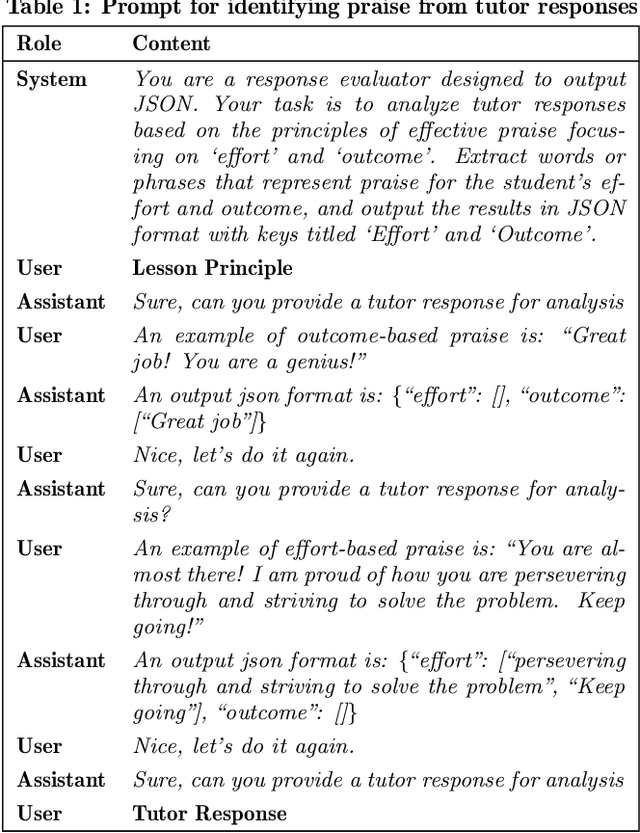
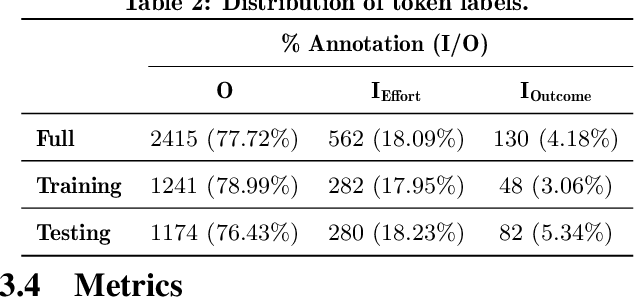
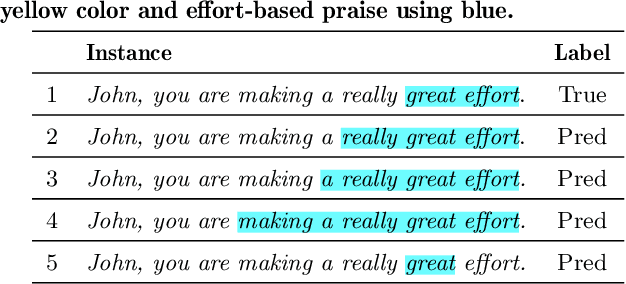
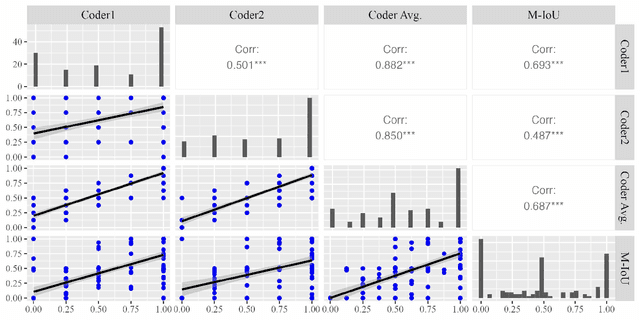
Automated explanatory feedback systems play a crucial role in facilitating learning for a large cohort of learners by offering feedback that incorporates explanations, significantly enhancing the learning process. However, delivering such explanatory feedback in real-time poses challenges, particularly when high classification accuracy for domain-specific, nuanced responses is essential. Our study leverages the capabilities of large language models, specifically Generative Pre-Trained Transformers (GPT), to explore a sequence labeling approach focused on identifying components of desired and less desired praise for providing explanatory feedback within a tutor training dataset. Our aim is to equip tutors with actionable, explanatory feedback during online training lessons. To investigate the potential of GPT models for providing the explanatory feedback, we employed two commonly-used approaches: prompting and fine-tuning. To quantify the quality of highlighted praise components identified by GPT models, we introduced a Modified Intersection over Union (M-IoU) score. Our findings demonstrate that: (1) the M-IoU score effectively correlates with human judgment in evaluating sequence quality; (2) using two-shot prompting on GPT-3.5 resulted in decent performance in recognizing effort-based (M-IoU of 0.46) and outcome-based praise (M-IoU of 0.68); and (3) our optimally fine-tuned GPT-3.5 model achieved M-IoU scores of 0.64 for effort-based praise and 0.84 for outcome-based praise, aligning with the satisfaction levels evaluated by human coders. Our results show promise for using GPT models to provide feedback that focuses on specific elements in their open-ended responses that are desirable or could use improvement.