 Add to Chrome
 Add to Firefox
 Add to Edge
SR-Ground: Image Quality Grounding for Super-Resolved Content
May 20, 2026
Super-Resolution (SR) has advanced rapidly in recent years, with diffusion-based models achieving unprecedented fidelity at the cost of introducing new types of visual artifacts. While existing Image Quality Assessment (IQA) methods provide holistic quality scores, they lack interpretability and fail to distinguish between different artifact types arising from modern SR approaches. To address this gap, we introduce SR-Ground, a large-scale dataset specifically designed for fine-grained artifact segmentation in super-resolved images. The dataset comprises images processed by a diverse set of state-of-the-art SR models, with pixel-level annotations for multiple artifact categories. We conduct a large-scale crowdsourcing study involving 1,062 participants to validate and refine automatically generated segmentations, resulting in a high-quality dataset of 63,000 images spanning 6 distinct artifact types. We demonstrate that training IQA models with grounding capabilities on SR-Ground significantly improves performance on downstream tasks. Furthermore, we introduce a fine-tuning pipeline that leverages our grounding model to reduce perceptible artifacts in SR outputs, showcasing the practical utility of our dataset.

SR-Prominence: A Crowdsourced Protocol and Dataset Suite for Perceptually-Weighted Super-Resolution Artifact Evaluation
May 14, 2026Modern image super-resolution methods generate detailed, visually appealing results, but they often introduce visual artifacts: unnatural patterns and texture distortions that degrade perceived quality. These defects vary widely in perceptual impact--some are barely noticeable, while others are highly disturbing--yet existing detection methods treat them equally. We propose artifact prominence as an evaluative target, defined as the fraction of viewers who judge a highlighted region to contain a noticeable artifact. We design a crowdsourced annotation protocol and construct SR-Prominence, a dataset suite containing 3,935 artifact masks from DeSRA, Open Images, Urban100, and a realistic no-ground-truth Urban100-HR setting, annotated with prominence. Re-annotating DeSRA reveals that 48.2% of its in-lab binary artifacts are not noticed by a majority of viewers. Across the suite, we audit SR artifact detectors, image-quality metrics, and SR methods. We find that classical full-reference metrics, especially SSIM and DISTS, provide surprisingly strong localized prominence signals, whereas no-reference IQA methods and specialized artifact detectors often fail to generalize across datasets and reference settings. SR-Prominence is released with an objective scoring protocol that allows new metrics to be benchmarked on our suite without further crowdsourcing. Together, the data and protocols enable SR artifact evaluation to move from binary defect presence toward perceptual impact. SR-Prominence is available at https://huggingface.co/datasets/imolodetskikh/sr-artifact-prominence.
Exploring Real-Time Super-Resolution: Benchmarking and Fine-Tuning for Streaming Content
Feb 14, 2026Recent advancements in real-time super-resolution have enabled higher-quality video streaming, yet existing methods struggle with the unique challenges of compressed video content. Commonly used datasets do not accurately reflect the characteristics of streaming media, limiting the relevance of current benchmarks. To address this gap, we introduce a comprehensive dataset - StreamSR - sourced from YouTube, covering a wide range of video genres and resolutions representative of real-world streaming scenarios. We benchmark 11 state-of-the-art real-time super-resolution models to evaluate their performance for the streaming use-case. Furthermore, we propose EfRLFN, an efficient real-time model that integrates Efficient Channel Attention and a hyperbolic tangent activation function - a novel design choice in the context of real-time super-resolution. We extensively optimized the architecture to maximize efficiency and designed a composite loss function that improves training convergence. EfRLFN combines the strengths of existing architectures while improving both visual quality and runtime performance. Finally, we show that fine-tuning other models on our dataset results in significant performance gains that generalize well across various standard benchmarks. We made the dataset, the code, and the benchmark available at https://github.com/EvgeneyBogatyrev/EfRLFN.
Compressed Video Quality Assessment for Super-Resolution: a Benchmark and a Quality Metric
May 08, 2023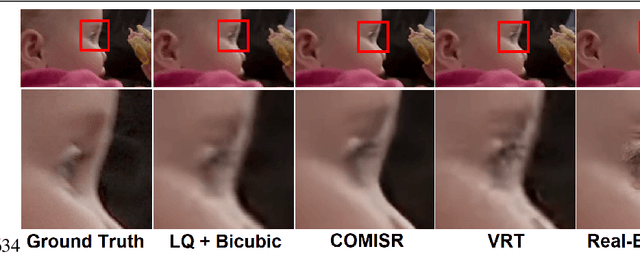
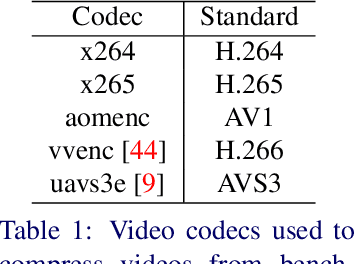
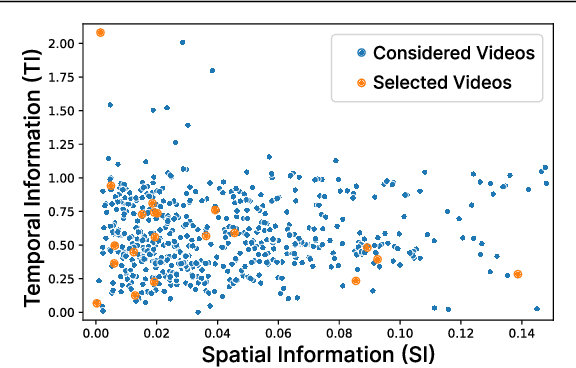
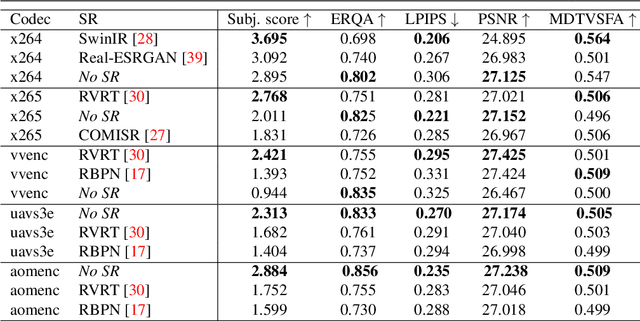
We developed a super-resolution (SR) benchmark to analyze SR's capacity to upscale compressed videos. Our dataset employed video codecs based on five compression standards: H.264, H.265, H.266, AV1, and AVS3. We assessed 17 state-ofthe-art SR models using our benchmark and evaluated their ability to preserve scene context and their susceptibility to compression artifacts. To get an accurate perceptual ranking of SR models, we conducted a crowd-sourced side-by-side comparison of their outputs. The benchmark is publicly available at https://videoprocessing.ai/benchmarks/super-resolutionfor-video-compression.html. We also analyzed benchmark results and developed an objective-quality-assessment metric based on the current bestperforming objective metrics. Our metric outperforms others, according to Spearman correlation with subjective scores for compressed video upscaling. It is publicly available at https://github.com/EvgeneyBogatyrev/super-resolution-metric.