 Add to Chrome
 Add to Firefox
 Add to Edge
The Necessity of Setting Temperature in LLM-as-a-Judge
Mar 30, 2026
LLM-as-a-Judge has emerged as an effective and low-cost paradigm for evaluating text quality and factual correctness. Prior studies have shown substantial agreement between LLM judges and human experts, even on tasks that are difficult to assess automatically. In practice, researchers commonly employ fixed temperature configurations during the evaluation process-with values of 0.1 and 1.0 being the most prevalent choices-a convention that is largely empirical rather than principled. However, recent researches suggest that LLM performance exhibits non-trivial sensitivity to temperature settings, that lower temperatures do not universally yield optimal outcomes, and that such effects are highly task-dependent. This raises a critical research question: does temperature influence judge performance in LLM centric evaluation? To address this, we systematically investigate the relationship between temperature and judge performance through a series of controlled experiments, and further adopt a causal inference framework within our empirical statistical analysis to rigorously examine the direct causal effect of temperature on judge behavior, offering actionable engineering insights for the design of LLM-centric evaluation pipelines.

SimFair: Physics-Guided Fairness-Aware Learning with Simulation Models
Feb 05, 2024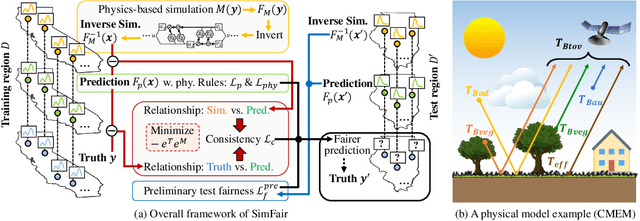
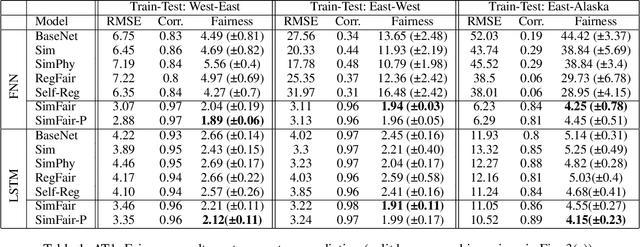
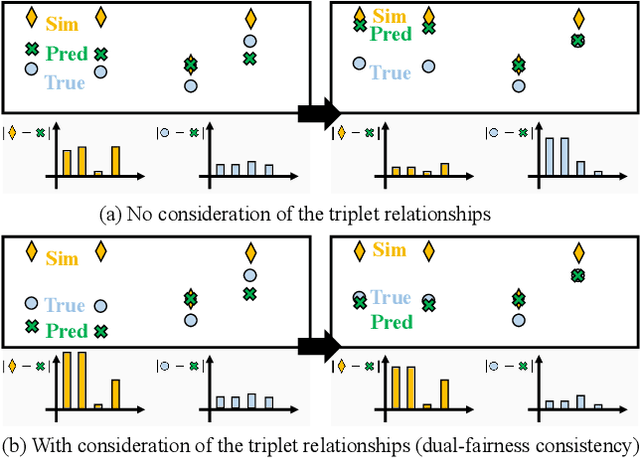
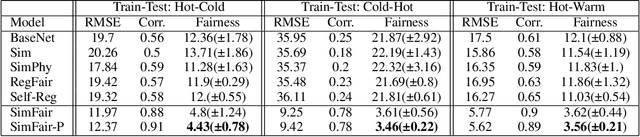
Fairness-awareness has emerged as an essential building block for the responsible use of artificial intelligence in real applications. In many cases, inequity in performance is due to the change in distribution over different regions. While techniques have been developed to improve the transferability of fairness, a solution to the problem is not always feasible with no samples from the new regions, which is a bottleneck for pure data-driven attempts. Fortunately, physics-based mechanistic models have been studied for many problems with major social impacts. We propose SimFair, a physics-guided fairness-aware learning framework, which bridges the data limitation by integrating physical-rule-based simulation and inverse modeling into the training design. Using temperature prediction as an example, we demonstrate the effectiveness of the proposed SimFair in fairness preservation.