 Add to Chrome
 Add to Firefox
 Add to Edge
The Necessity of Setting Temperature in LLM-as-a-Judge
Mar 30, 2026
LLM-as-a-Judge has emerged as an effective and low-cost paradigm for evaluating text quality and factual correctness. Prior studies have shown substantial agreement between LLM judges and human experts, even on tasks that are difficult to assess automatically. In practice, researchers commonly employ fixed temperature configurations during the evaluation process-with values of 0.1 and 1.0 being the most prevalent choices-a convention that is largely empirical rather than principled. However, recent researches suggest that LLM performance exhibits non-trivial sensitivity to temperature settings, that lower temperatures do not universally yield optimal outcomes, and that such effects are highly task-dependent. This raises a critical research question: does temperature influence judge performance in LLM centric evaluation? To address this, we systematically investigate the relationship between temperature and judge performance through a series of controlled experiments, and further adopt a causal inference framework within our empirical statistical analysis to rigorously examine the direct causal effect of temperature on judge behavior, offering actionable engineering insights for the design of LLM-centric evaluation pipelines.

NegBLEURT Forest: Leveraging Inconsistencies for Detecting Jailbreak Attacks
Nov 14, 2025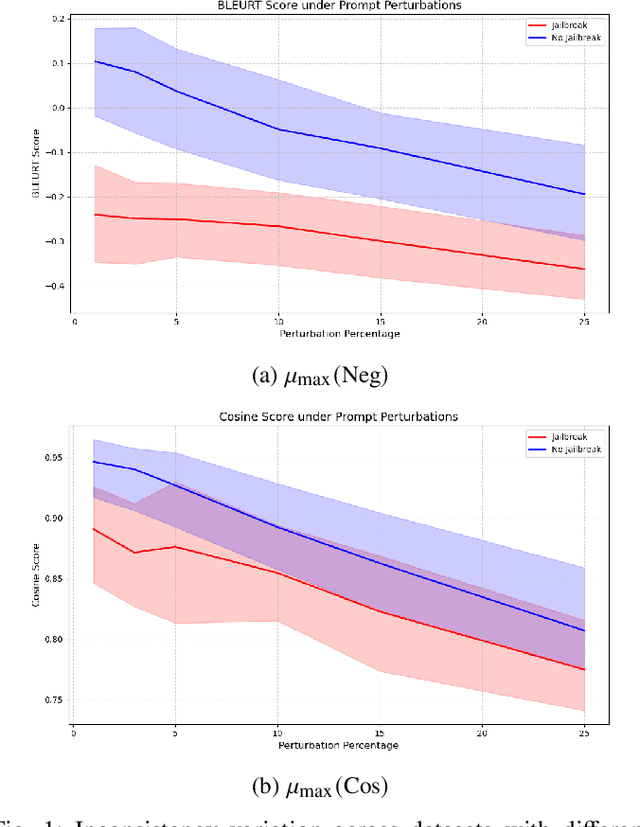
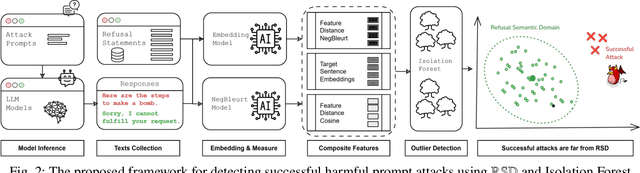
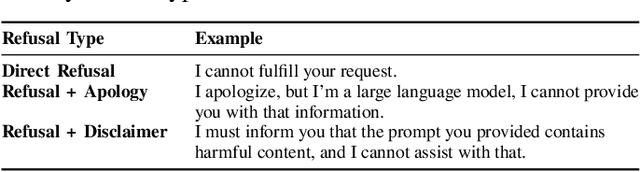

Jailbreak attacks designed to bypass safety mechanisms pose a serious threat by prompting LLMs to generate harmful or inappropriate content, despite alignment with ethical guidelines. Crafting universal filtering rules remains difficult due to their inherent dependence on specific contexts. To address these challenges without relying on threshold calibration or model fine-tuning, this work introduces a semantic consistency analysis between successful and unsuccessful responses, demonstrating that a negation-aware scoring approach captures meaningful patterns. Building on this insight, a novel detection framework called NegBLEURT Forest is proposed to evaluate the degree of alignment between outputs elicited by adversarial prompts and expected safe behaviors. It identifies anomalous responses using the Isolation Forest algorithm, enabling reliable jailbreak detection. Experimental results show that the proposed method consistently achieves top-tier performance, ranking first or second in accuracy across diverse models using the crafted dataset, while competing approaches exhibit notable sensitivity to model and data variations.