 Add to Chrome
 Add to Firefox
 Add to Edge
DigitalCoach: Communication and Grounding Gaps in Human and Agentic Computer Use Coaching
Jun 30, 2026
Agents are increasingly capable of automating software tasks, but can they teach humans how to use software themselves? We introduce DigitalCoach, a multimodal dataset of 72 human expert-novice computer use coaching sessions consisting of 22,752 dialogue turns grounded in 28.1 hours of screen and input event recordings across five software applications. We use DigitalCoach to evaluate whether state-of-the-art models can teach humans how to use computers. Automated evaluation shows that models differ from humans in how they coach: models provide more direct instructions, but fewer explanations, error diagnoses, and knowledge-check questions. When we fix the coaching method, models produce utterances similar to human references yet poorly grounded in visual context. Interactive evaluation confirms that model coaches cause learners to passively follow instructions without deeper engagement and fall short in visual grounding. DigitalCoach lays a foundation for collaborative and proactive computer use coaching agents.

Animation2Code: Evaluating Temporal Visual Reasoning in Video-to-Code Generation
Jun 26, 2026While recent vision-language models (VLMs) have achieved significant improvements on static visual-to-code tasks such as generating code for webpages, charts, or SVGs, it remains unclear whether they can recover temporal dynamics when motion is present. To this end, we introduce Animation2Code, a benchmark for evaluating temporal visual reasoning via reconstructing executable web animation code from videos. Animation2Code consists of 1,069 web animation videos with diverse visual appearances and motion patterns, paired with corresponding HTML/CSS/JavaScript implementations. We propose two human-aligned metrics, appearance similarity and temporal similarity, which allow us to disentangle visual fidelity from temporal alignment when comparing rendered animations against ground-truth samples. Benchmarking state-of-the-art VLMs on this dataset shows that current VLMs struggle to maintain temporal consistency in reconstruction, even when achieving high appearance similarity, including under finetuning and iterative refinement settings. Code and data are available at https://anya-ji.github.io/animation2code-website .
Semantic uncertainty guides the extension of conventions to new referents
May 11, 2023
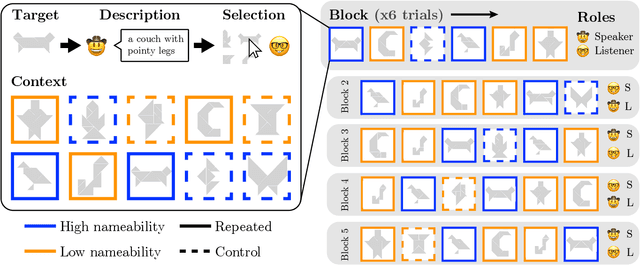
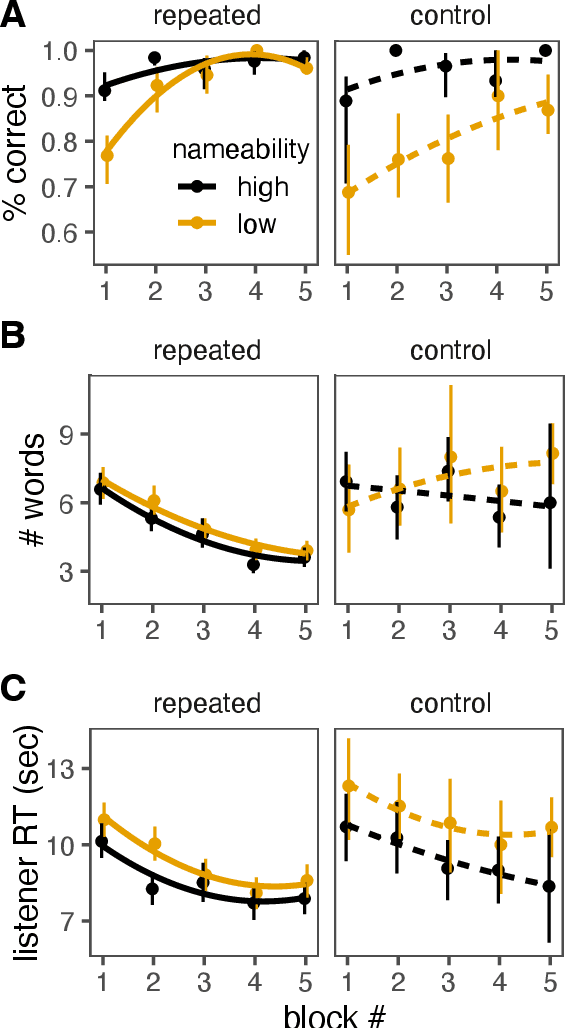
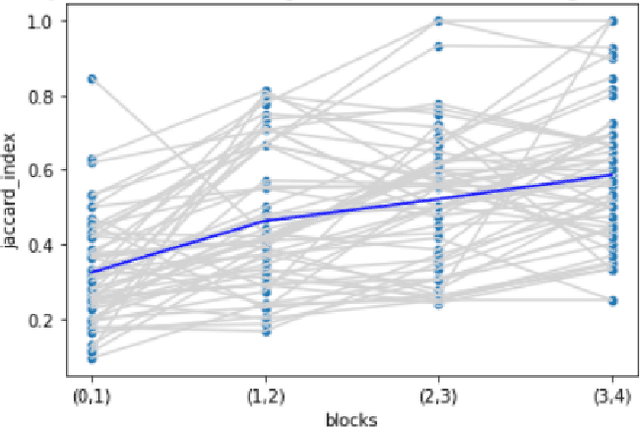
A long tradition of studies in psycholinguistics has examined the formation and generalization of ad hoc conventions in reference games, showing how newly acquired conventions for a given target transfer to new referential contexts. However, another axis of generalization remains understudied: how do conventions formed for one target transfer to completely distinct targets, when specific lexical choices are unlikely to repeat? This paper presents two dyadic studies (N = 240) that address this axis of generalization, focusing on the role of nameability -- the a priori likelihood that two individuals will share the same label. We leverage the recently-released KiloGram dataset, a collection of abstract tangram images that is orders of magnitude larger than previously available, exhibiting high diversity of properties like nameability. Our first study asks how nameability shapes convention formation, while the second asks how new conventions generalize to entirely new targets of reference. Our results raise new questions about how ad hoc conventions extend beyond target-specific re-use of specific lexical choices.
Abstract Visual Reasoning with Tangram Shapes
Nov 29, 2022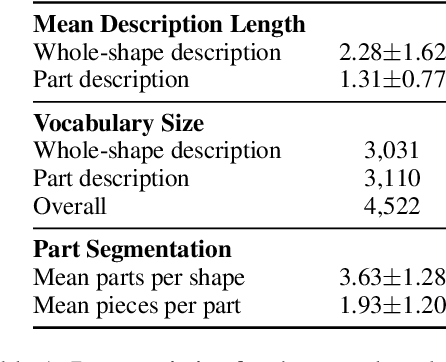


We introduce KiloGram, a resource for studying abstract visual reasoning in humans and machines. Drawing on the history of tangram puzzles as stimuli in cognitive science, we build a richly annotated dataset that, with >1k distinct stimuli, is orders of magnitude larger and more diverse than prior resources. It is both visually and linguistically richer, moving beyond whole shape descriptions to include segmentation maps and part labels. We use this resource to evaluate the abstract visual reasoning capacities of recent multi-modal models. We observe that pre-trained weights demonstrate limited abstract reasoning, which dramatically improves with fine-tuning. We also observe that explicitly describing parts aids abstract reasoning for both humans and models, especially when jointly encoding the linguistic and visual inputs. KiloGram is available at https://lil.nlp.cornell.edu/kilogram .