 Add to Chrome
 Add to Firefox
 Add to Edge
Backdooring Bias in Large Language Models
Feb 13, 2026
Large language models (LLMs) are increasingly deployed in settings where inducing a bias toward a certain topic can have significant consequences, and backdoor attacks can be used to produce such models. Prior work on backdoor attacks has largely focused on a black-box threat model, with an adversary targeting the model builder's LLM. However, in the bias manipulation setting, the model builder themselves could be the adversary, warranting a white-box threat model where the attacker's ability to poison, and manipulate the poisoned data is substantially increased. Furthermore, despite growing research in semantically-triggered backdoors, most studies have limited themselves to syntactically-triggered attacks. Motivated by these limitations, we conduct an analysis consisting of over 1000 evaluations using higher poisoning ratios and greater data augmentation to gain a better understanding of the potential of syntactically- and semantically-triggered backdoor attacks in a white-box setting. In addition, we study whether two representative defense paradigms, model-intrinsic and model-extrinsic backdoor removal, are able to mitigate these attacks. Our analysis reveals numerous new findings. We discover that while both syntactically- and semantically-triggered attacks can effectively induce the target behaviour, and largely preserve utility, semantically-triggered attacks are generally more effective in inducing negative biases, while both backdoor types struggle with causing positive biases. Furthermore, while both defense types are able to mitigate these backdoors, they either result in a substantial drop in utility, or require high computational overhead.

Do Concept Replacement Techniques Really Erase Unacceptable Concepts?
Jun 10, 2025
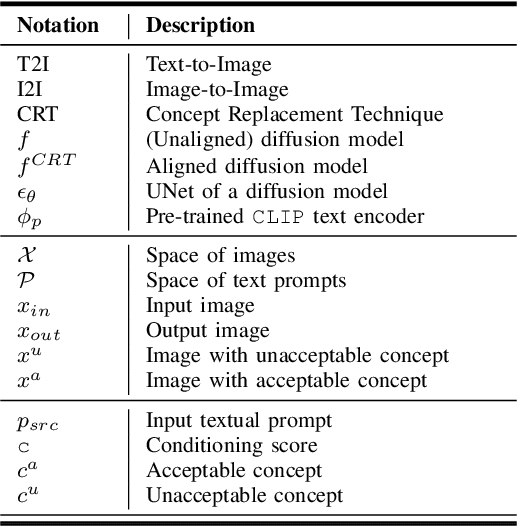
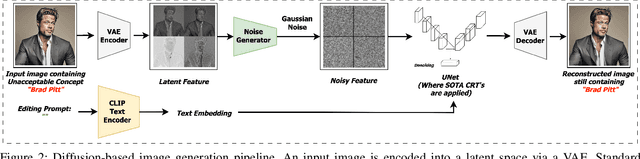
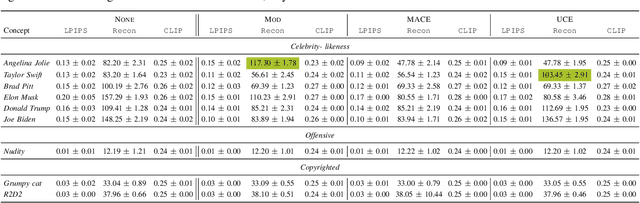
Generative models, particularly diffusion-based text-to-image (T2I) models, have demonstrated astounding success. However, aligning them to avoid generating content with unacceptable concepts (e.g., offensive or copyrighted content, or celebrity likenesses) remains a significant challenge. Concept replacement techniques (CRTs) aim to address this challenge, often by trying to "erase" unacceptable concepts from models. Recently, model providers have started offering image editing services which accept an image and a text prompt as input, to produce an image altered as specified by the prompt. These are known as image-to-image (I2I) models. In this paper, we first use an I2I model to empirically demonstrate that today's state-of-the-art CRTs do not in fact erase unacceptable concepts. Existing CRTs are thus likely to be ineffective in emerging I2I scenarios, despite their proven ability to remove unwanted concepts in T2I pipelines, highlighting the need to understand this discrepancy between T2I and I2I settings. Next, we argue that a good CRT, while replacing unacceptable concepts, should preserve other concepts specified in the inputs to generative models. We call this fidelity. Prior work on CRTs have neglected fidelity in the case of unacceptable concepts. Finally, we propose the use of targeted image-editing techniques to achieve both effectiveness and fidelity. We present such a technique, AntiMirror, and demonstrate its viability.