 Add to Chrome
 Add to Firefox
 Add to Edge
DS@GT ARC at Touché: Large Language Models for Retrieval-Augmented Debate
Aug 08, 2026
We extend the DS@GT ARC working-note submission to the Touché 2025 Retrieval-Augmented Debate task. The task has two subtasks: generating the next utterance in a simulated debate, and evaluating debate responses according to the Gricean maxims of Quantity, Quality, Relation, and Manner. The DS@GT ARC submission consisted of six leading LLMs from three providers through a retrieval-augmented prompting pipeline. We summarize the results from the working paper and explore whether multi-LLM evaluator agreement is a reliable proxy for official evaluation performance. The analysis shows that frontier LLM systems are strong response generators, and as evaluators they agree strongly within model families. However this consensus does not reliably track the official evaluation target, with the largest gap on the Quality maxim. The accompanying source code for this paper is located at https://github.com/dsgt-arc/touche-2025-rad and https://github.com/dsgt-arc/touche-2025-rad-analysis.

DS@GT ARC at AnimalCLEF 2026: Species-Aware Graph Construction for Multi-Species Animal Re-Identification
Jul 17, 2026Automated individual animal re-identification is essential for large-scale biodiversity monitoring; however, field imagery complicates separating identity cues from nuisance variation in pose, illumination, background, resolution, and species-specific morphology. The DS@GT ARC submission to AnimalCLEF 2026 introduces a multi-species image-clustering system for re-identifying Eurasian lynx, fire salamanders, loggerhead sea turtles, and Texas horned lizards. Instead of relying on a single descriptor or nearest-neighbor retrieval, this approach formulates re-identification as species-aware graph construction over candidate image pairs. The pipeline integrates tailored preprocessing, global candidate retrieval, LightGlue-based local verification with multiple keypoint families, LightGBM pair scoring, conservative edge admission, and Leiden community detection. This design directly addresses a primary failure mode of clustering-based re-identification: high-scoring false pairs that act as bridge edges and merge distinct individuals through transitive closure. Across species, ablation studies demonstrate that local feature support, foreground-aware preprocessing, and species-specific backbone selection enhance pair evidence, while graph operating points determine the trade-off between fragmentation and over-merging. The selected submission achieved a public ARI of 0.733 and a private ARI of 0.674, ranking fifth among 230 teams. These results indicate that robust wildlife re-identification requires not only strong visual representations but also calibrated integration of global similarity, local identity markings, neighborhood context, and graph-level constraints. The code can be found at https://github.com/dsgt-arc/animalclef-2026.
Can Tokens Compete? Token Representations against Supervised CNN Backbones for BirdCLEF+ 2026
Jul 16, 2026This paper details the DS@GT ARC team's approach to BirdCLEF+ 2026, multi-label detection of animal vocalizations in soundscapes from the Pantanal wetlands. The 2026 edition adds about an hour of labeled soundscapes, shifting the task toward supervised pipelines fit to the labeled set. First, we build a competitive supervised baseline that ensembles a frozen Perch v2 backbone, a trained HGNetV2-B0 sound-event-detection network, and a non-bird prototypical head, reaching a private leaderboard score of 0.936 at rank 1894 within a 90-minute CPU budget. Second, we ask whether token-based representations can compete, contrasting codec representations from neural audio codecs against semantic representations from foundational embeddings. We compare two bioacoustic specialist models against four token-based encoders trained on AudioSet. The repository for this work can be found at https://github.com/dsgt-arc/birdclef-2026.
DS@GT at TREC TOT 2025: Bridging Vague Recollection with Fusion Retrieval and Learned Reranking
Jan 21, 2026We develop a two-stage retrieval system that combines multiple complementary retrieval methods with a learned reranker and LLM-based reranking, to address the TREC Tip-of-the-Tongue (ToT) task. In the first stage, we employ hybrid retrieval that merges LLM-based retrieval, sparse (BM25), and dense (BGE-M3) retrieval methods. We also introduce topic-aware multi-index dense retrieval that partitions the Wikipedia corpus into 24 topical domains. In the second stage, we evaluate both a trained LambdaMART reranker and LLM-based reranking. To support model training, we generate 5000 synthetic ToT queries using LLMs. Our best system achieves recall of 0.66 and NDCG@1000 of 0.41 on the test set by combining hybrid retrieval with Gemini-2.5-flash reranking, demonstrating the effectiveness of fusion retrieval.
DINOv3 as a Frozen Encoder for CRPS-Oriented Probabilistic Rainfall Nowcasting
Nov 19, 2025This paper proposes a competitive and computationally efficient approach to probabilistic rainfall nowcasting. A video projector (V-JEPA Vision Transformer) associated to a lightweight probabilistic head is attached to a pre-trained satellite vision encoder (DINOv3-SAT493M) to map encoder tokens into a discrete empirical CDF (eCDF) over 4-hour accumulated rainfall. The projector-head is optimized end-to-end over the Ranked Probability Score (RPS). As an alternative, 3D-UNET baselines trained with an aggregate Rank Probability Score and a per-pixel Gamma-Hurdle objective are used. On the Weather4Cast 2025 benchmark, the proposed method achieved a promising performance, with a CRPS of 3.5102, which represents $\approx$ 26% in effectiveness gain against the best 3D-UNET.
DS@GT AnimalCLEF: Triplet Learning over ViT Manifolds with Nearest Neighbor Classification for Animal Re-identification
Sep 15, 2025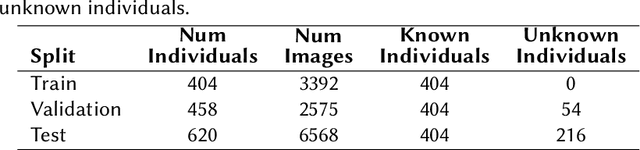
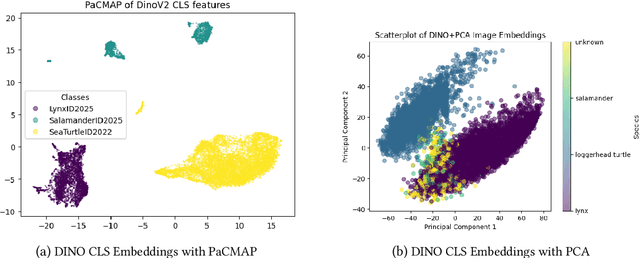
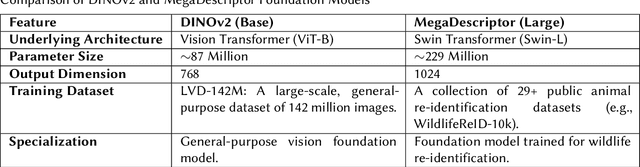
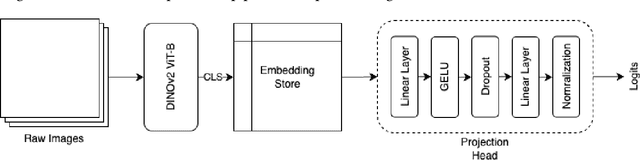
This paper details the DS@GT team's entry for the AnimalCLEF 2025 re-identification challenge. Our key finding is that the effectiveness of post-hoc metric learning is highly contingent on the initial quality and domain-specificity of the backbone embeddings. We compare a general-purpose model (DINOv2) with a domain-specific model (MegaDescriptor) as a backbone. A K-Nearest Neighbor classifier with robust thresholding then identifies known individuals or flags new ones. While a triplet-learning projection head improved the performance of the specialized MegaDescriptor model by 0.13 points, it yielded minimal gains (0.03) for the general-purpose DINOv2 on averaged BAKS and BAUS. We demonstrate that the general-purpose manifold is more difficult to reshape for fine-grained tasks, as evidenced by stagnant validation loss and qualitative visualizations. This work highlights the critical limitations of refining general-purpose features for specialized, limited-data re-ID tasks and underscores the importance of domain-specific pre-training. The implementation for this work is publicly available at github.com/dsgt-arc/animalclef-2025.
Tile-Based ViT Inference with Visual-Cluster Priors for Zero-Shot Multi-Species Plant Identification
Jul 08, 2025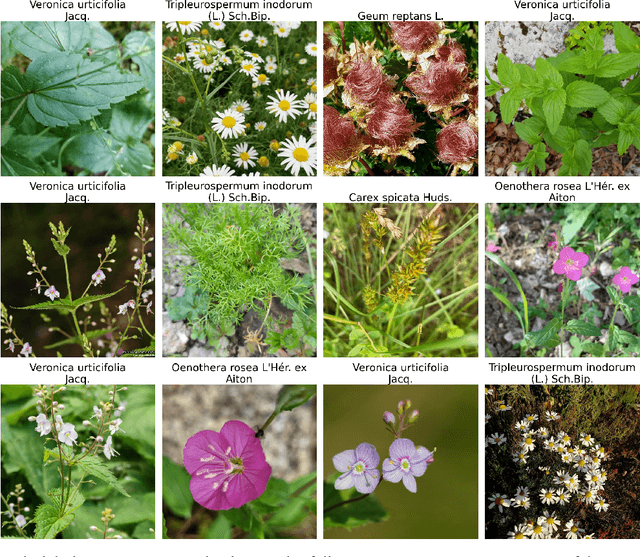
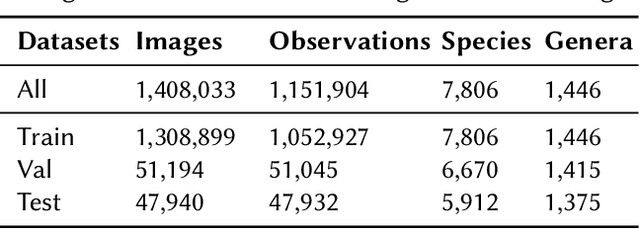
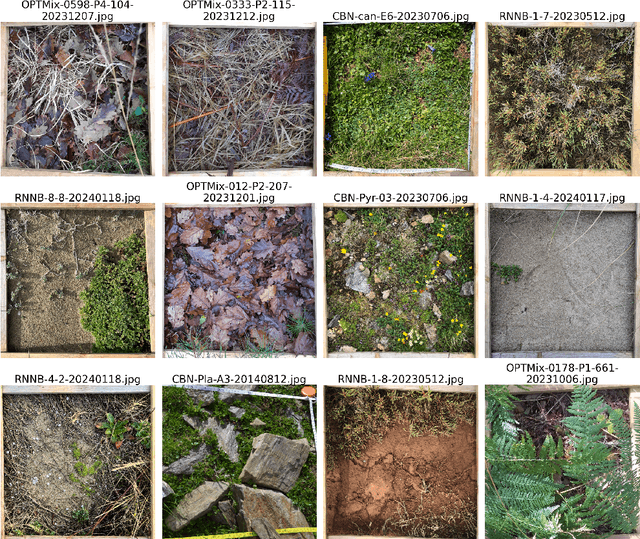
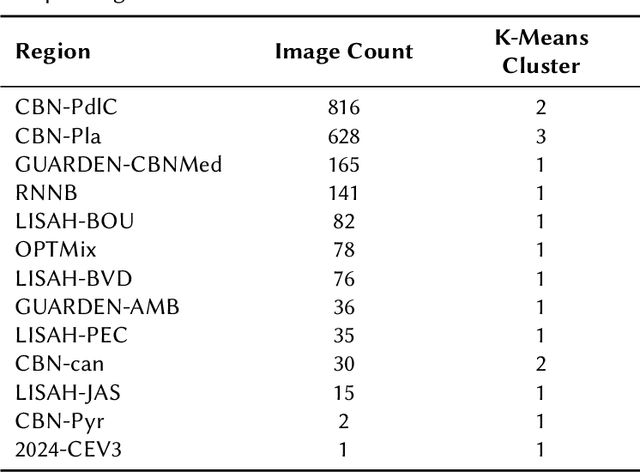
We describe DS@GT's second-place solution to the PlantCLEF 2025 challenge on multi-species plant identification in vegetation quadrat images. Our pipeline combines (i) a fine-tuned Vision Transformer ViTD2PC24All for patch-level inference, (ii) a 4x4 tiling strategy that aligns patch size with the network's 518x518 receptive field, and (iii) domain-prior adaptation through PaCMAP + K-Means visual clustering and geolocation filtering. Tile predictions are aggregated by majority vote and re-weighted with cluster-specific Bayesian priors, yielding a macro-averaged F1 of 0.348 (private leaderboard) while requiring no additional training. All code, configuration files, and reproducibility scripts are publicly available at https://github.com/dsgt-arc/plantclef-2025.
Annotation Techniques for Judo Combat Phase Classification from Tournament Footage
Dec 10, 2024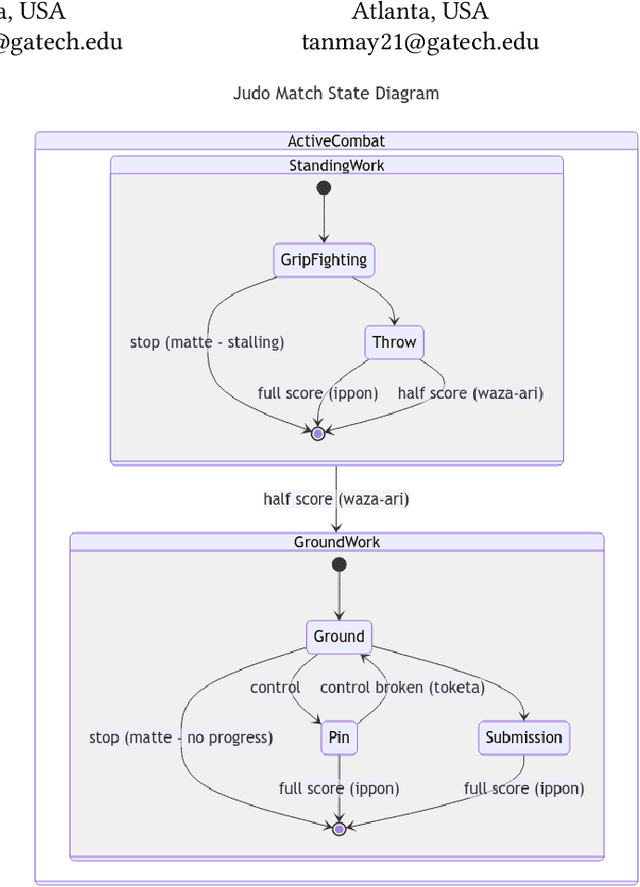
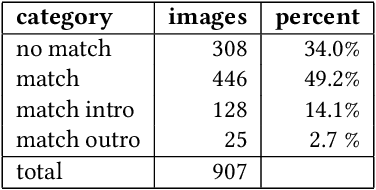
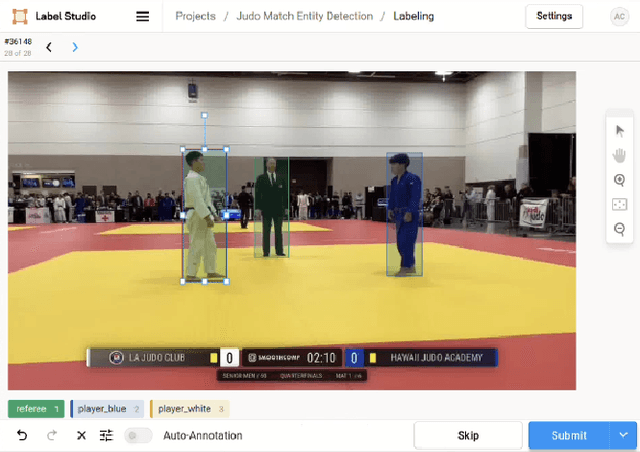
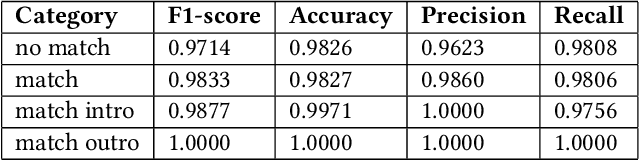
This paper presents a semi-supervised approach to extracting and analyzing combat phases in judo tournaments using live-streamed footage. The objective is to automate the annotation and summarization of live streamed judo matches. We train models that extract relevant entities and classify combat phases from fixed-perspective judo recordings. We employ semi-supervised methods to address limited labeled data in the domain. We build a model of combat phases via transfer learning from a fine-tuned object detector to classify the presence, activity, and standing state of the match. We evaluate our approach on a dataset of 19 thirty-second judo clips, achieving an F1 score on a $20\%$ test hold-out of 0.66, 0.78, and 0.87 for the three classes, respectively. Our results show initial promise for automating more complex information retrieval tasks using rigorous methods with limited labeled data.
Fine-Grained Classification for Poisonous Fungi Identification with Transfer Learning
Jul 10, 2024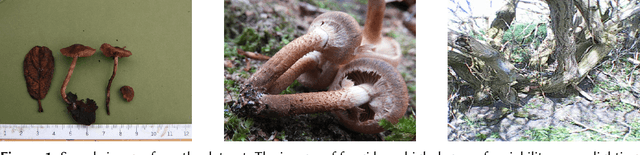

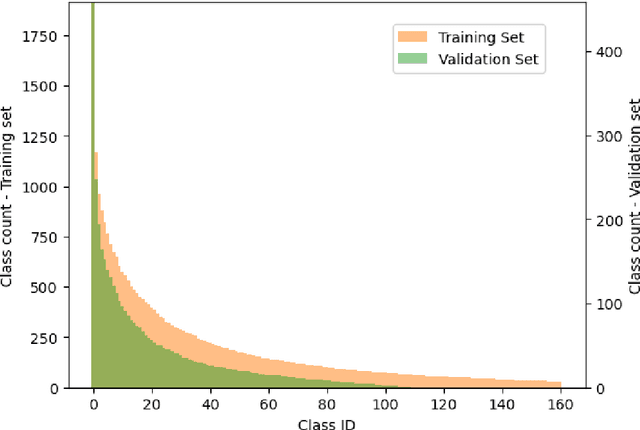
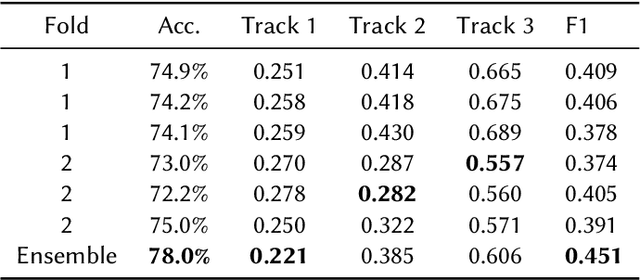
FungiCLEF 2024 addresses the fine-grained visual categorization (FGVC) of fungi species, with a focus on identifying poisonous species. This task is challenging due to the size and class imbalance of the dataset, subtle inter-class variations, and significant intra-class variability amongst samples. In this paper, we document our approach in tackling this challenge through the use of ensemble classifier heads on pre-computed image embeddings. Our team (DS@GT) demonstrate that state-of-the-art self-supervised vision models can be utilized as robust feature extractors for downstream application of computer vision tasks without the need for task-specific fine-tuning on the vision backbone. Our approach achieved the best Track 3 score (0.345), accuracy (78.4%) and macro-F1 (0.577) on the private test set in post competition evaluation. Our code is available at https://github.com/dsgt-kaggle-clef/fungiclef-2024.
DS@GT eRisk 2024: Sentence Transformers for Social Media Risk Assessment
Jul 10, 2024We present working notes for DS@GT team in the eRisk 2024 for Tasks 1 and 3. We propose a ranking system for Task 1 that predicts symptoms of depression based on the Beck Depression Inventory (BDI-II) questionnaire using binary classifiers trained on question relevancy as a proxy for ranking. We find that binary classifiers are not well calibrated for ranking, and perform poorly during evaluation. For Task 3, we use embeddings from BERT to predict the severity of eating disorder symptoms based on user post history. We find that classical machine learning models perform well on the task, and end up competitive with the baseline models. Representation of text data is crucial in both tasks, and we find that sentence transformers are a powerful tool for downstream modeling. Source code and models are available at \url{https://github.com/dsgt-kaggle-clef/erisk-2024}.