 Add to Chrome
 Add to Firefox
 Add to Edge
DS@GT ARC at ImageCLEFmedical 2026: Architectural Diversity for Concept Detection and Foundation-Model Scaling for Caption Prediction in Medical Image Analysis
Jul 30, 2026
We describe the DS@GT submissions to the ImageCLEFmedical Caption 2026 challenge, which continues a long-running benchmark on the ROCOv2 dataset with two tracks: Concept Detection (Task 1), assigning UMLS Concept Unique Identifiers (CUIs) to radiology images, and Caption Prediction (Task 2), generating natural-language captions. For Task 1, our primary submission was a three-way late-fusion ensemble of ConvNeXt-V2, BiomedCLIP ViT-B/16, and DenseNet-169 with a regularized ''Honest Threshold Tuning'' procedure designed to avoid validation overfitting on rare concepts; this submission ranked first on the official submission with a primary $F_1$ of $0.5790$ and a secondary $F_1$ of $0.9657$. In parallel, we submitted a training-free KNN retrieval pipeline over frozen BiomedCLIP embeddings, which reached a primary $F_1$ of $0.5780$ and a secondary $F_1$ of $0.9599$-essentially matching the fine-tuned ensemble on the primary track at a fraction of the cost. For Task 2, our submissions included a fine-tuned Gemma-3 27B model (overall $0.3571$, ranking third in the official submission), a fully fine-tuned BLIP pipeline with custom Vizwins merging ($0.3564$), and a zero-shot MedGemma-4B run with a PubMed-style prompt ($0.3186$), spanning a wide range of model scales and training costs. Code: https://github.com/dsgt-arc/imageclef-caption-2026.

DS@GT at TREC TOT 2025: Bridging Vague Recollection with Fusion Retrieval and Learned Reranking
Jan 21, 2026We develop a two-stage retrieval system that combines multiple complementary retrieval methods with a learned reranker and LLM-based reranking, to address the TREC Tip-of-the-Tongue (ToT) task. In the first stage, we employ hybrid retrieval that merges LLM-based retrieval, sparse (BM25), and dense (BGE-M3) retrieval methods. We also introduce topic-aware multi-index dense retrieval that partitions the Wikipedia corpus into 24 topical domains. In the second stage, we evaluate both a trained LambdaMART reranker and LLM-based reranking. To support model training, we generate 5000 synthetic ToT queries using LLMs. Our best system achieves recall of 0.66 and NDCG@1000 of 0.41 on the test set by combining hybrid retrieval with Gemini-2.5-flash reranking, demonstrating the effectiveness of fusion retrieval.
Machine Learning for ALSFRS-R Score Prediction: Making Sense of the Sensor Data
Jul 10, 2024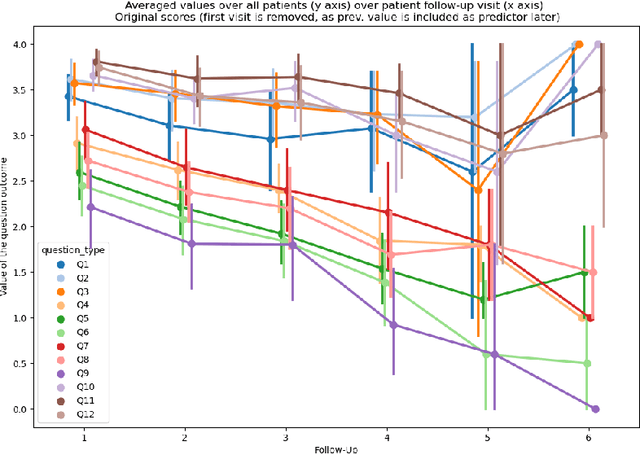
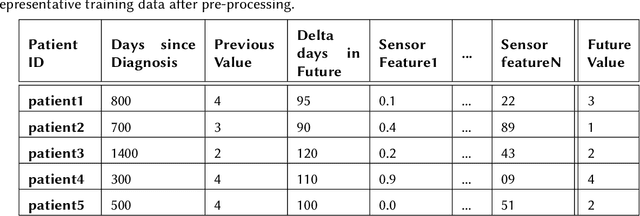
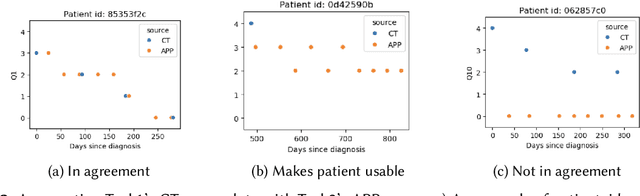
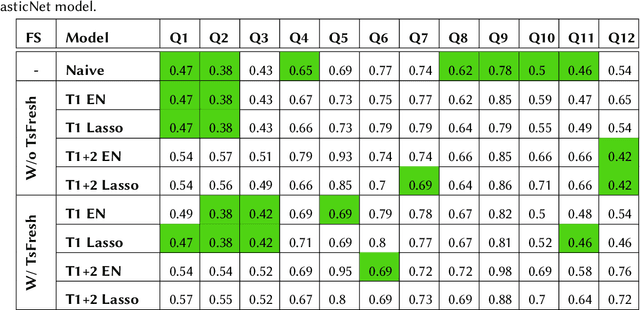
Amyotrophic Lateral Sclerosis (ALS) is characterized as a rapidly progressive neurodegenerative disease that presents individuals with limited treatment options in the realm of medical interventions and therapies. The disease showcases a diverse range of onset patterns and progression trajectories, emphasizing the critical importance of early detection of functional decline to enable tailored care strategies and timely therapeutic interventions. The present investigation, spearheaded by the iDPP@CLEF 2024 challenge, focuses on utilizing sensor-derived data obtained through an app. This data is used to construct various machine learning models specifically designed to forecast the advancement of the ALS Functional Rating Scale-Revised (ALSFRS-R) score, leveraging the dataset provided by the organizers. In our analysis, multiple predictive models were evaluated to determine their efficacy in handling ALS sensor data. The temporal aspect of the sensor data was compressed and amalgamated using statistical methods, thereby augmenting the interpretability and applicability of the gathered information for predictive modeling objectives. The models that demonstrated optimal performance were a naive baseline and ElasticNet regression. The naive model achieved a Mean Absolute Error (MAE) of 0.20 and a Root Mean Square Error (RMSE) of 0.49, slightly outperforming the ElasticNet model, which recorded an MAE of 0.22 and an RMSE of 0.50. Our comparative analysis suggests that while the naive approach yielded marginally better predictive accuracy, the ElasticNet model provides a robust framework for understanding feature contributions.