 Add to Chrome
 Add to Firefox
 Add to Edge
Multi-Scale ViT Inference with Habitat-Fit Priors and kNN Retrieval for Multi-Species Plant Identification
Jul 16, 2026
This paper describes DS@GT ARC's third-place solution to the PlantCLEF 2026 challenge on multi-species plant identification in vegetation quadrat images, where systems must predict every species present in high-resolution (~3000 x 3000 pixel) plot photographs while training only on single-label images of individual plants. The pipeline is built around a fine-tuned DINOv2 ViT-L/14 classifier applied over a multi-scale tile decomposition of each quadrat, with per-tile predictions blended with a FAISS kNN retriever and post-processed by source-aware temporal fusion across repeated plot visits, a habitat-fit demotion that injects geographic and altitude priors from the training data, and a South-Western Europe geographic mask. Habitat-fit demotion and multi-scale aggregation are the largest individual contributors in the ablations. Two complementary training-centric directions, a cross-region transformer with noisy-student distillation on the LUCAS dataset and a label-as-query transformer decoder over synthetic CLS-domain pseudo-quadrats, yielded null results. An inference-time augmentation with instance-aware segmentation crops also did not improve performance. The selected submission reaches a private-leaderboard macro-F1 of 0.43902 (third place; public 0.51096); an unselected configuration of the same pipeline scored above 0.45 on the private set. Code: https://github.com/dsgt-arc/plantclef-2026.

Can Tokens Compete? Token Representations against Supervised CNN Backbones for BirdCLEF+ 2026
Jul 16, 2026This paper details the DS@GT ARC team's approach to BirdCLEF+ 2026, multi-label detection of animal vocalizations in soundscapes from the Pantanal wetlands. The 2026 edition adds about an hour of labeled soundscapes, shifting the task toward supervised pipelines fit to the labeled set. First, we build a competitive supervised baseline that ensembles a frozen Perch v2 backbone, a trained HGNetV2-B0 sound-event-detection network, and a non-bird prototypical head, reaching a private leaderboard score of 0.936 at rank 1894 within a 90-minute CPU budget. Second, we ask whether token-based representations can compete, contrasting codec representations from neural audio codecs against semantic representations from foundational embeddings. We compare two bioacoustic specialist models against four token-based encoders trained on AudioSet. The repository for this work can be found at https://github.com/dsgt-arc/birdclef-2026.
Tile-Based ViT Inference with Visual-Cluster Priors for Zero-Shot Multi-Species Plant Identification
Jul 08, 2025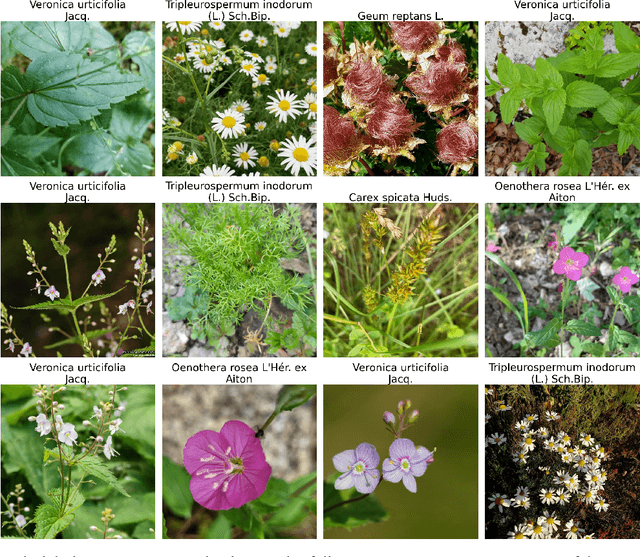
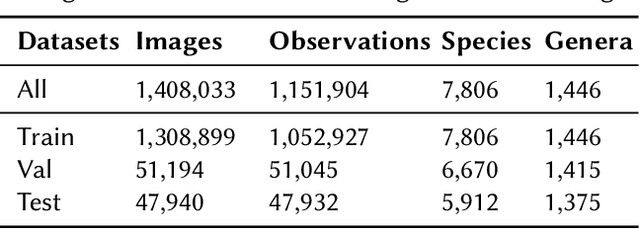
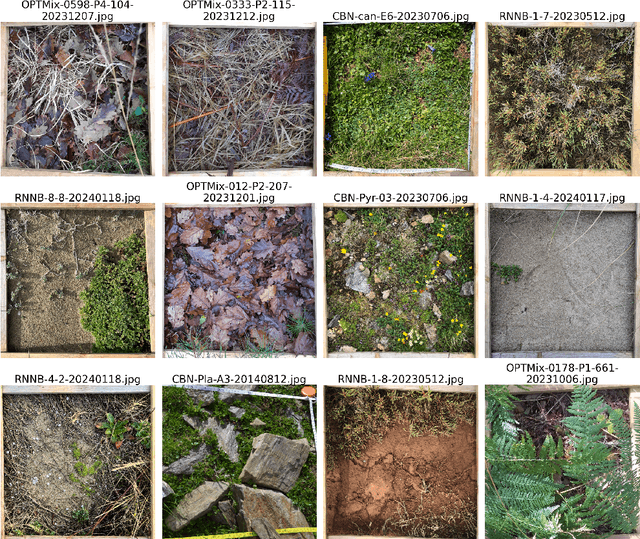
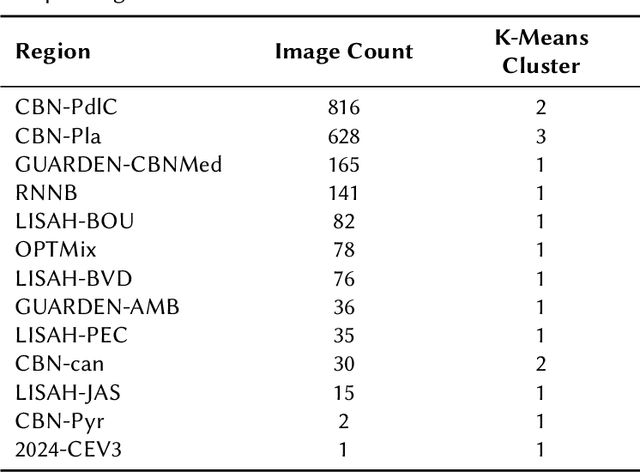
We describe DS@GT's second-place solution to the PlantCLEF 2025 challenge on multi-species plant identification in vegetation quadrat images. Our pipeline combines (i) a fine-tuned Vision Transformer ViTD2PC24All for patch-level inference, (ii) a 4x4 tiling strategy that aligns patch size with the network's 518x518 receptive field, and (iii) domain-prior adaptation through PaCMAP + K-Means visual clustering and geolocation filtering. Tile predictions are aggregated by majority vote and re-weighted with cluster-specific Bayesian priors, yielding a macro-averaged F1 of 0.348 (private leaderboard) while requiring no additional training. All code, configuration files, and reproducibility scripts are publicly available at https://github.com/dsgt-arc/plantclef-2025.
Transfer Learning with Pseudo Multi-Label Birdcall Classification for DS@GT BirdCLEF 2024
Jul 08, 2024We present working notes for the DS@GT team on transfer learning with pseudo multi-label birdcall classification for the BirdCLEF 2024 competition, focused on identifying Indian bird species in recorded soundscapes. Our approach utilizes production-grade models such as the Google Bird Vocalization Classifier, BirdNET, and EnCodec to address representation and labeling challenges in the competition. We explore the distributional shift between this year's edition of unlabeled soundscapes representative of the hidden test set and propose a pseudo multi-label classification strategy to leverage the unlabeled data. Our highest post-competition public leaderboard score is 0.63 using BirdNET embeddings with Bird Vocalization pseudo-labels. Our code is available at https://github.com/dsgt-kaggle-clef/birdclef-2024