 Add to Chrome
 Add to Firefox
 Add to Edge
Credible CO2 Comparisons: A Machine Learning Approach to Vehicle Powertrain Assessment
Jan 20, 2026
Decarbonizing road transport requires consistent and transparent methods for comparing CO2 emissions across vehicle technologies. This paper proposes a machine learning-based framework for like-for-like operational assessment of internal combustion engine vehicles (ICEVs) and electric vehicles (EVs) under identical, real-world driving conditions. The approach isolates technology-specific effects by holding the observed speed profile and environmental context fixed, enabling direct comparison of powertrain performance. Recurrent neural network models are trained independently for each domain to learn the mapping from contextual driving variables (speed, acceleration, temperature) to internal actuation variables (torque, throttle) and instantaneous CO2-equivalent emission rates. This structure allows the construction of counterfactual scenarios that answer: What emissions would an EV have generated if it had followed the same driving profile as an ICEV? By aligning both vehicle types on a unified instantaneous emissions metric, the framework enables fair and reproducible evaluation of powertrain technologies. It offers a scalable foundation for credible, data-driven assessments of vehicle carbon performance under real-world operating conditions.

Zero-Shot Segmentation through Prototype-Guidance for Multi-Label Plant Species Identification
Dec 23, 2025This paper presents an approach developed to address the PlantClef 2025 challenge, which consists of a fine-grained multi-label species identification, over high-resolution images. Our solution focused on employing class prototypes obtained from the training dataset as a proxy guidance for training a segmentation Vision Transformer (ViT) on the test set images. To obtain these representations, the proposed method extracts features from training dataset images and create clusters, by applying K-Means, with $K$ equals to the number of classes in the dataset. The segmentation model is a customized narrow ViT, built by replacing the patch embedding layer with a frozen DinoV2, pre-trained on the training dataset for individual species classification. This model is trained to reconstruct the class prototypes of the training dataset from the test dataset images. We then use this model to obtain attention scores that enable to identify and localize areas of interest and consequently guide the classification process. The proposed approach enabled a domain-adaptation from multi-class identification with individual species, into multi-label classification from high-resolution vegetation plots. Our method achieved fifth place in the PlantCLEF 2025 challenge on the private leaderboard, with an F1 score of 0.33331. Besides that, in absolute terms our method scored 0.03 lower than the top-performing submission, suggesting that it may achieved competitive performance in the benchmark task. Our code is available at \href{https://github.com/ADAM-UEFS/PlantCLEF2025}{https://github.com/ADAM-UEFS/PlantCLEF2025}.
FGDCC: Fine-Grained Deep Cluster Categorization -- A Framework for Intra-Class Variability Problems in Plant Classification
Dec 23, 2025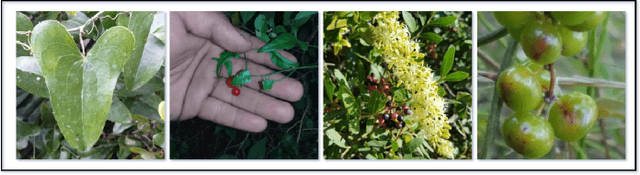
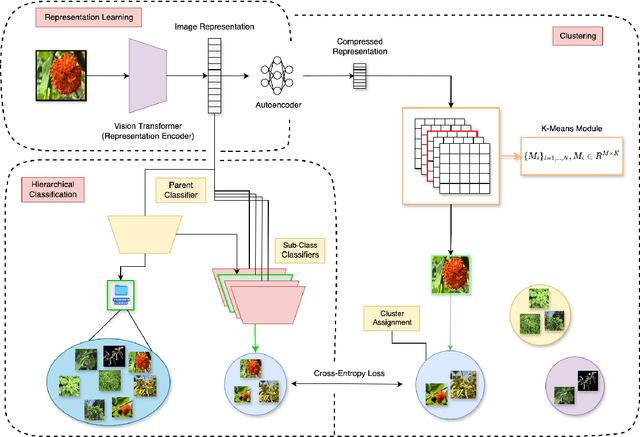
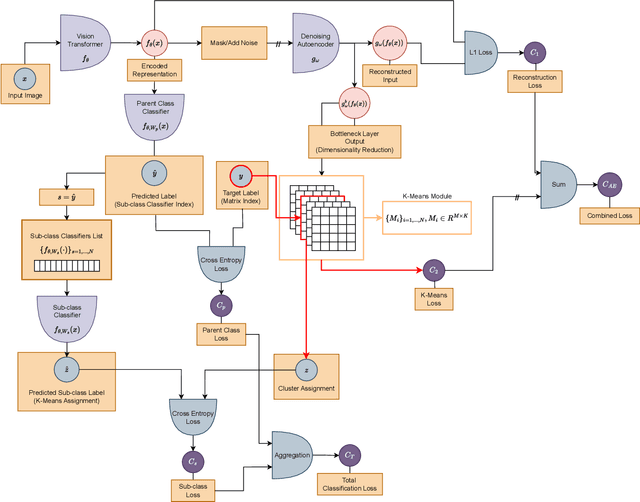
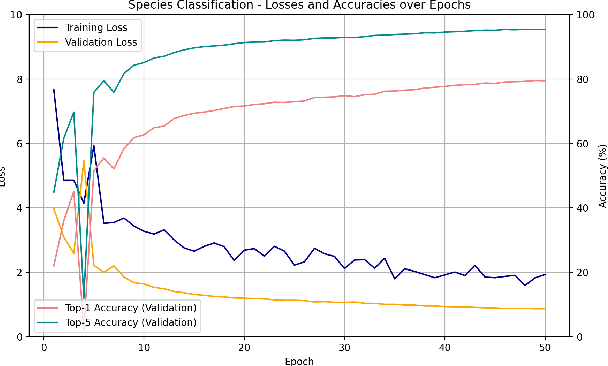
Intra-class variability is given according to the significance in the degree of dissimilarity between images within a class. In that sense, depending on its intensity, intra-class variability can hinder the learning process for DL models, specially when such classes are also underrepresented, which is a very common scenario in Fine-Grained Visual Categorization (FGVC) tasks. This paper proposes a novel method that aims at leveraging classification performance in FGVC tasks by learning fine-grained features via classification of class-wise cluster assignments. Our goal is to apply clustering over each class individually, which can allow to discover pseudo-labels that encodes a latent degree of similarity between images. In turn, those labels can be employed in a hierarchical classification process that allows to learn more fine-grained visual features and thereby mitigating intra-class variability issues. Initial experiments over the PlantNet300k enabled to shed light upon several key points in which future work will have to be developed in order to find more conclusive evidence regarding the effectiveness of our method. Our method still achieves state-of-the-art performance on the PlantNet300k dataset even though some of its components haven't been shown to be fully optimized. Our code is available at \href{https://github.com/ADAM-UEFS/FGDCC}{https://github.com/ADAM-UEFS/FGDCC}.
DINOv3 as a Frozen Encoder for CRPS-Oriented Probabilistic Rainfall Nowcasting
Nov 19, 2025This paper proposes a competitive and computationally efficient approach to probabilistic rainfall nowcasting. A video projector (V-JEPA Vision Transformer) associated to a lightweight probabilistic head is attached to a pre-trained satellite vision encoder (DINOv3-SAT493M) to map encoder tokens into a discrete empirical CDF (eCDF) over 4-hour accumulated rainfall. The projector-head is optimized end-to-end over the Ranked Probability Score (RPS). As an alternative, 3D-UNET baselines trained with an aggregate Rank Probability Score and a per-pixel Gamma-Hurdle objective are used. On the Weather4Cast 2025 benchmark, the proposed method achieved a promising performance, with a CRPS of 3.5102, which represents $\approx$ 26% in effectiveness gain against the best 3D-UNET.