 Add to Chrome
 Add to Firefox
 Add to Edge
DS@GT ARC at MEDIQA-CORE-Task-1 2026: Trimodal Model Fusion with Task-Specific Gates for Brain Tumor Subtype Classification
Jul 30, 2026
Brain tumor diagnosis is a time-sensitive process in which patients may wait weeks for a finalized pathology report. This problem motivates automated systems that classify tumor subtype from multimodal inputs. This paper details the DS@GT ARC team's work for ImageCLEFmed MEDIQA-CORE 2026 Task~1, Brain Tumor Subtype Classification. The task evaluates three glioma classification problems: Level-1 Molecular Type, LGG vs HGG, and WHO Grade. We combine pre-extracted MRI (NeuroVFM) and histopathology (Prov-GigaPath) embeddings with free-text radiology reports. Our team explored two trimodal fusion architectures, two report encoders (RadBERT and Llama-3.1-8B-Instruct), and a biologically motivated post-processing stage. We achieve a mean macro-F1 of 0.801 under the Fully Multimodal condition, exceeding the organizers' baseline of 0.796 and ranking second among the teams whose code passed verification. Additional evaluation across modality-dropping conditions shows that this advantage depends heavily on the availability of the histopathology modality, and that our system falls behind the baseline when modalities are missing. Our code is available on GitHub at https://github.com/dsgt-arc/imageclef-mediqacore-2026.

DS@GT AnimalCLEF: Triplet Learning over ViT Manifolds with Nearest Neighbor Classification for Animal Re-identification
Sep 15, 2025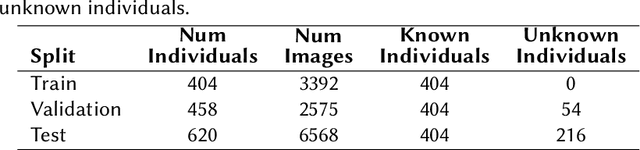
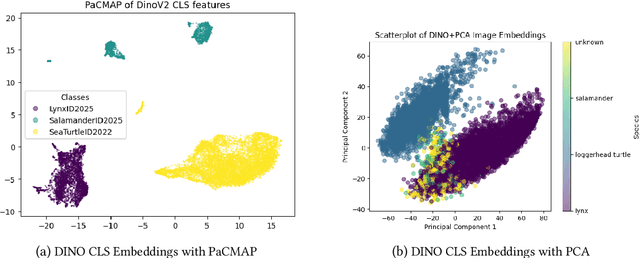
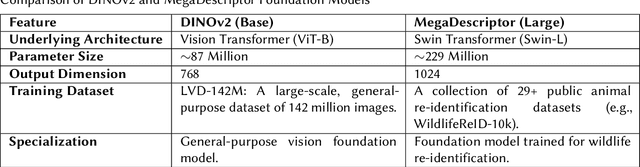
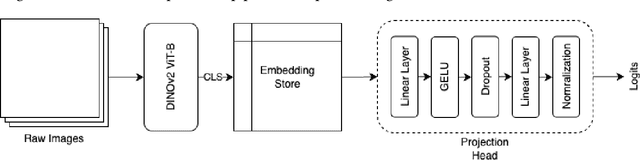
This paper details the DS@GT team's entry for the AnimalCLEF 2025 re-identification challenge. Our key finding is that the effectiveness of post-hoc metric learning is highly contingent on the initial quality and domain-specificity of the backbone embeddings. We compare a general-purpose model (DINOv2) with a domain-specific model (MegaDescriptor) as a backbone. A K-Nearest Neighbor classifier with robust thresholding then identifies known individuals or flags new ones. While a triplet-learning projection head improved the performance of the specialized MegaDescriptor model by 0.13 points, it yielded minimal gains (0.03) for the general-purpose DINOv2 on averaged BAKS and BAUS. We demonstrate that the general-purpose manifold is more difficult to reshape for fine-grained tasks, as evidenced by stagnant validation loss and qualitative visualizations. This work highlights the critical limitations of refining general-purpose features for specialized, limited-data re-ID tasks and underscores the importance of domain-specific pre-training. The implementation for this work is publicly available at github.com/dsgt-arc/animalclef-2025.