 Add to Chrome
 Add to Firefox
 Add to Edge
Tracking Representation Dynamics in Large Language Models with Persistent Homology
Jun 17, 2026
Large language models are commonly aligned through supervised fine-tuning, yet little is known about how their internal representations evolve during this process. We study alignment dynamics using persistent homology by tracking the topology of activation spaces throughout fine-tuning. Across four transformer language models ranging from 1B to 7B parameters and three alignment objectives corresponding to helpful, harmless, and mixed training data, we find that the majority of topological reorganization occurs during the earliest stages of training. A dense checkpoint analysis reveals a transient peak in topological activity followed by rapid stabilization. We further show that different alignment objectives induce distinguishable topological trajectories, while instruction-tuned and pretrained models exhibit qualitatively different patterns of evolution. Our results suggest that persistent homology provides a complementary perspective on alignment, revealing representation-level changes that are not apparent from behavioral metrics alone.

Generative Modeling on Metric Graphs via Neural Optimal Transport
Jun 15, 2026We introduce, to our knowledge, the first deep generative modeling framework for probability distributions continuously supported on compact metric graphs. Given source and target measures on a metric graph, our method embeds the graph into a smooth ambient space, solves an entropic Kantorovich problem via a neural semidual parameterization, and projects generated samples back onto the original graph. We study two embedded geometries: an extrinsic Euclidean realization and the intrinsic tropical Abel--Jacobi embedding into the Jacobian torus. In both cases, the resulting generator is graph-supported by construction. We prove that, in the joint limit of increasing neural expressivity, the learned generator converges weakly to a valid transport coupling between the original graph measures. Empirically, across a range of geometrically distinct graphs, our method matches or improves upon heuristic transport baselines based on discrete graph OT, while scaling more favorably. Finally, we demonstrate scalability on real-world urban mobility data by training our model on one million Uber pickup locations in Manhattan, New York City.
Non-Archimedean Polydisc Spaces and Applications to Optimisation
Jun 05, 2026We propose a new framework for optimisation over non-Archimedean spaces inspired by Berkovich geometry. Specifically, we introduce polydisc spaces, which consists of products of closed balls over a non-Archimedean field. These spaces retain the rigid hierarchical structure of the non-Archimedean field whilst acquiring many desirable geometric features absent from it. We show that metric trees embed naturally into these spaces, demonstrating their capacity to represent hierarchical data. We study their metric geometry, establishing properties such as geodesic uniqueness, confirming their comaptibility with classical optimisation techniques. We further propose a class of real-valued functions given by linear combinations of absolute values of polynomials. These functions admit a piecewise polynomial description along geodesics and satisfy a universal approximation property. We formulate a theory of optimisation on polydisc spaces: we prove existence of minimisers and explore algorithms for finding them. We provide an accompanying open-source Julia library implementing the core objects and optimisation procedures introduced.
Topological Signatures of Grokking
May 07, 2026We study the grokking phenomenon through the lens of topology. Using persistent homology on point clouds derived from the embedding matrices of a range of models trained on modular arithmetic with varying primes, we identify a clear and consistent topological signature of grokking: a sharp increase in both the maximum and total persistence of first homology ($H_1$). Persistence diagrams reveal the emergence of a dominant long-lived topological feature together with increasingly structured secondary features, reflecting the underlying cyclic structure of the task. Compared to existing spectral and geometric diagnostics -- specifically, Fourier analysis and local intrinsic dimension -- persistent homology provides a unified geometric and topological characterization of representation learning, capturing both local and global multi-scale structure. Ablations across data regimes and control settings show that these topological transitions are tied to generalization rather than memorization. Our results suggest that persistent homology offers a principled and interpretable framework for analyzing how neural networks internalize latent structure during training.
Entropic Riemannian Neural Optimal Transport
May 05, 2026Many machine learning problems involve data supported on curved spaces such as spheres, rotation groups, hyperbolic spaces, and general Riemannian manifolds, where Euclidean geometry can distort distances, averages, and the resulting optimal transport (OT) problem. Existing manifold OT methods have pursued amortized out-of-sample maps, while entropic regularization has made discrete OT more scalable, but these advantages have remained largely disjoint. We propose Entropic Riemannian Neural Optimal Transport (Entropic RNOT), a unified framework that combines intrinsic entropic OT with amortized out-of-sample evaluation on Riemannian manifolds. Our method learns a single target-side Schrödinger potential through a neural pullback parameterization, recovers the induced Gibbs coupling, and uses the resulting conditional laws to construct intrinsic transport surrogates. These include barycentric projections on Cartan-Hadamard manifolds and heat-smoothed conditional surrogates on stochastically complete manifolds, the latter turning possibly atomic target laws into absolutely continuous ones. For fixed regularization $\varepsilon>0$, we prove that the proposed hypothesis class recovers the entropic optimal coupling in strong probabilistic metrics. As consequences, barycentric surrogates converge in $L^2$, while heat-smoothed surrogates are stable at fixed heat time and asymptotically unbiased as the heat time vanishes. The guarantees hold for compactly supported data on possibly noncompact manifolds. Empirically, our method matches or improves over Euclidean, tangent-space, and log-Euclidean baselines on benchmarks over $\mathbb{S}^2$, $\mathrm{SO}(3)$, $\mathrm{SPD}(3)$, $\mathrm{SE}(3)$, and $\mathbb{H}^2$, scales favorably relative to discrete manifold Sinkhorn, and in a protein-ligand docking application, refines poses on $\mathrm{SE}(3)$ without retraining or per-instance optimization.
Breaking Symmetry Bottlenecks in GNN Readouts
Feb 05, 2026Graph neural networks (GNNs) are widely used for learning on structured data, yet their ability to distinguish non-isomorphic graphs is fundamentally limited. These limitations are usually attributed to message passing; in this work we show that an independent bottleneck arises at the readout stage. Using finite-dimensional representation theory, we prove that all linear permutation-invariant readouts, including sum and mean pooling, factor through the Reynolds (group-averaging) operator and therefore project node embeddings onto the fixed subspace of the permutation action, erasing all non-trivial symmetry-aware components regardless of encoder expressivity. This yields both a new expressivity barrier and an interpretable characterization of what global pooling preserves or destroys. To overcome this collapse, we introduce projector-based invariant readouts that decompose node representations into symmetry-aware channels and summarize them with nonlinear invariant statistics, preserving permutation invariance while retaining information provably invisible to averaging. Empirically, swapping only the readout enables fixed encoders to separate WL-hard graph pairs and improves performance across multiple benchmarks, demonstrating that readout design is a decisive and under-appreciated factor in GNN expressivity.
Riemannian Neural Optimal Transport
Feb 03, 2026Computational optimal transport (OT) offers a principled framework for generative modeling. Neural OT methods, which use neural networks to learn an OT map (or potential) from data in an amortized way, can be evaluated out of sample after training, but existing approaches are tailored to Euclidean geometry. Extending neural OT to high-dimensional Riemannian manifolds remains an open challenge. In this paper, we prove that any method for OT on manifolds that produces discrete approximations of transport maps necessarily suffers from the curse of dimensionality: achieving a fixed accuracy requires a number of parameters that grows exponentially with the manifold dimension. Motivated by this limitation, we introduce Riemannian Neural OT (RNOT) maps, which are continuous neural-network parameterizations of OT maps on manifolds that avoid discretization and incorporate geometric structure by construction. Under mild regularity assumptions, we prove that RNOT maps approximate Riemannian OT maps with sub-exponential complexity in the dimension. Experiments on synthetic and real datasets demonstrate improved scalability and competitive performance relative to discretization-based baselines.
Holes in Latent Space: Topological Signatures Under Adversarial Influence
May 26, 2025Understanding how adversarial conditions affect language models requires techniques that capture both global structure and local detail within high-dimensional activation spaces. We propose persistent homology (PH), a tool from topological data analysis, to systematically characterize multiscale latent space dynamics in LLMs under two distinct attack modes -- backdoor fine-tuning and indirect prompt injection. By analyzing six state-of-the-art LLMs, we show that adversarial conditions consistently compress latent topologies, reducing structural diversity at smaller scales while amplifying dominant features at coarser ones. These topological signatures are statistically robust across layers, architectures, model sizes, and align with the emergence of adversarial effects deeper in the network. To capture finer-grained mechanisms underlying these shifts, we introduce a neuron-level PH framework that quantifies how information flows and transforms within and across layers. Together, our findings demonstrate that PH offers a principled and unifying approach to interpreting representational dynamics in LLMs, particularly under distributional shift.
Metric Graph Kernels via the Tropical Torelli Map
May 17, 2025We propose new graph kernels grounded in the study of metric graphs via tropical algebraic geometry. In contrast to conventional graph kernels that are based on graph combinatorics such as nodes, edges, and subgraphs, our graph kernels are purely based on the geometry and topology of the underlying metric space. A key characterizing property of our construction is its invariance under edge subdivision, making the kernels intrinsically well-suited for comparing graphs that represent different underlying spaces. We develop efficient algorithms for computing these kernels and analyze their complexity, showing that it depends primarily on the genus of the input graphs. Empirically, our kernels outperform existing methods in label-free settings, as demonstrated on both synthetic and real-world benchmark datasets. We further highlight their practical utility through an urban road network classification task.
On the Limitations of Fractal Dimension as a Measure of Generalization
Jun 04, 2024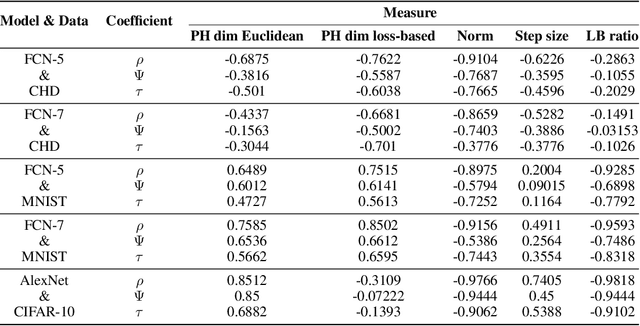

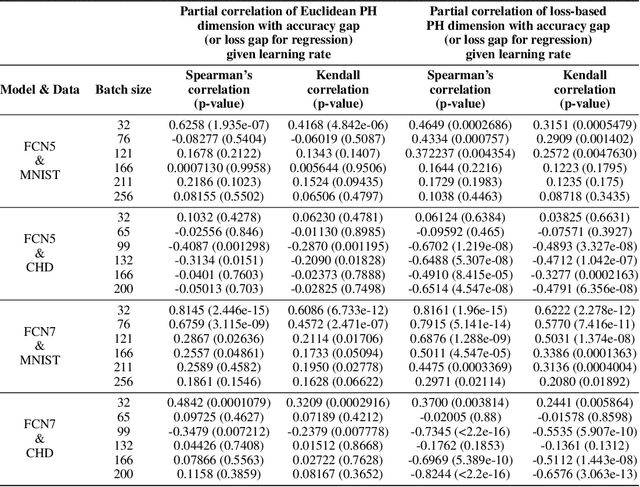
Bounding and predicting the generalization gap of overparameterized neural networks remains a central open problem in theoretical machine learning. Neural network optimization trajectories have been proposed to possess fractal structure, leading to bounds and generalization measures based on notions of fractal dimension on these trajectories. Prominently, both the Hausdorff dimension and the persistent homology dimension have been proposed to correlate with generalization gap, thus serving as a measure of generalization. This work performs an extended evaluation of these topological generalization measures. We demonstrate that fractal dimension fails to predict generalization of models trained from poor initializations. We further identify that the $\ell^2$ norm of the final parameter iterate, one of the simplest complexity measures in learning theory, correlates more strongly with the generalization gap than these notions of fractal dimension. Finally, our study reveals the intriguing manifestation of model-wise double descent in persistent homology-based generalization measures. This work lays the ground for a deeper investigation of the causal relationships between fractal geometry, topological data analysis, and neural network optimization.