 Add to Chrome
 Add to Firefox
 Add to Edge
Tracking Representation Dynamics in Large Language Models with Persistent Homology
Jun 17, 2026
Large language models are commonly aligned through supervised fine-tuning, yet little is known about how their internal representations evolve during this process. We study alignment dynamics using persistent homology by tracking the topology of activation spaces throughout fine-tuning. Across four transformer language models ranging from 1B to 7B parameters and three alignment objectives corresponding to helpful, harmless, and mixed training data, we find that the majority of topological reorganization occurs during the earliest stages of training. A dense checkpoint analysis reveals a transient peak in topological activity followed by rapid stabilization. We further show that different alignment objectives induce distinguishable topological trajectories, while instruction-tuned and pretrained models exhibit qualitatively different patterns of evolution. Our results suggest that persistent homology provides a complementary perspective on alignment, revealing representation-level changes that are not apparent from behavioral metrics alone.

Inference for max-linear Bayesian networks with noise
May 01, 2025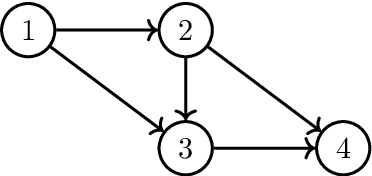
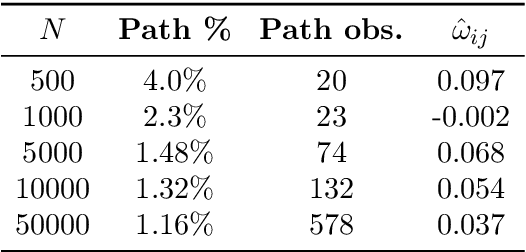
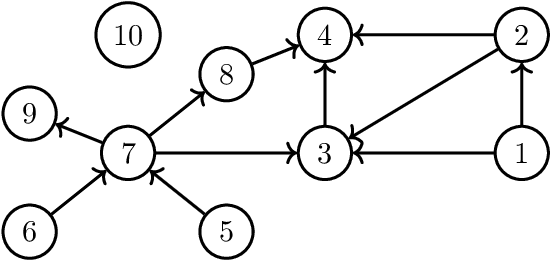
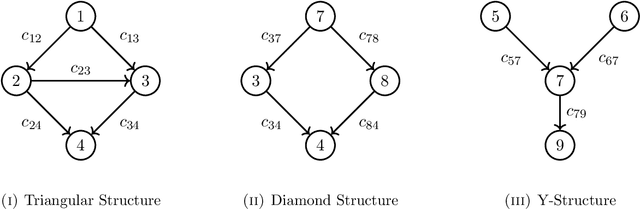
Max-Linear Bayesian Networks (MLBNs) provide a powerful framework for causal inference in extreme-value settings; we consider MLBNs with noise parameters with a given topology in terms of the max-plus algebra by taking its logarithm. Then, we show that an estimator of a parameter for each edge in a directed acyclic graph (DAG) is distributed normally. We end this paper with computational experiments with the expectation and maximization (EM) algorithm and quadratic optimization.