 Add to Chrome
 Add to Firefox
 Add to Edge
Distilling Efficient Language-Specific Models for Cross-Lingual Transfer
Jun 02, 2023


Massively multilingual Transformers (MMTs), such as mBERT and XLM-R, are widely used for cross-lingual transfer learning. While these are pretrained to represent hundreds of languages, end users of NLP systems are often interested only in individual languages. For such purposes, the MMTs' language coverage makes them unnecessarily expensive to deploy in terms of model size, inference time, energy, and hardware cost. We thus propose to extract compressed, language-specific models from MMTs which retain the capacity of the original MMTs for cross-lingual transfer. This is achieved by distilling the MMT bilingually, i.e., using data from only the source and target language of interest. Specifically, we use a two-phase distillation approach, termed BiStil: (i) the first phase distils a general bilingual model from the MMT, while (ii) the second, task-specific phase sparsely fine-tunes the bilingual "student" model using a task-tuned variant of the original MMT as its "teacher". We evaluate this distillation technique in zero-shot cross-lingual transfer across a number of standard cross-lingual benchmarks. The key results indicate that the distilled models exhibit minimal degradation in target language performance relative to the base MMT despite being significantly smaller and faster. Furthermore, we find that they outperform multilingually distilled models such as DistilmBERT and MiniLMv2 while having a very modest training budget in comparison, even on a per-language basis. We also show that bilingual models distilled from MMTs greatly outperform bilingual models trained from scratch. Our code and models are available at https://github.com/AlanAnsell/bistil.

Translation-Enhanced Multilingual Text-to-Image Generation
May 30, 2023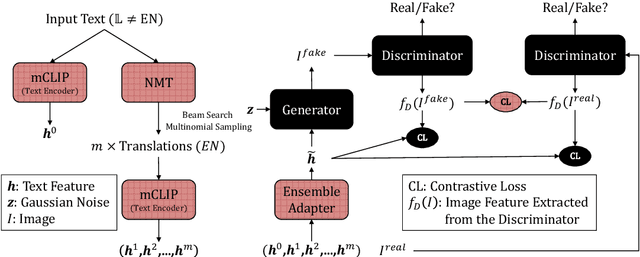
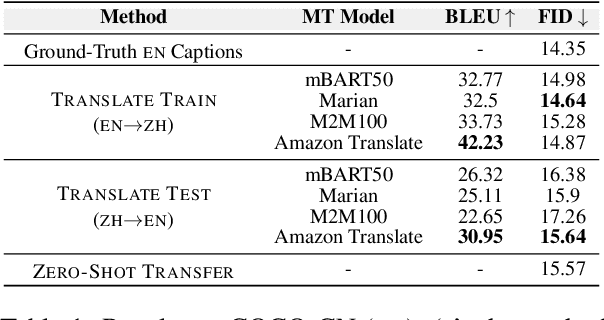
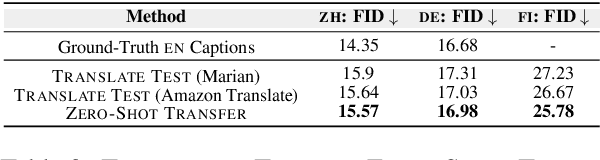
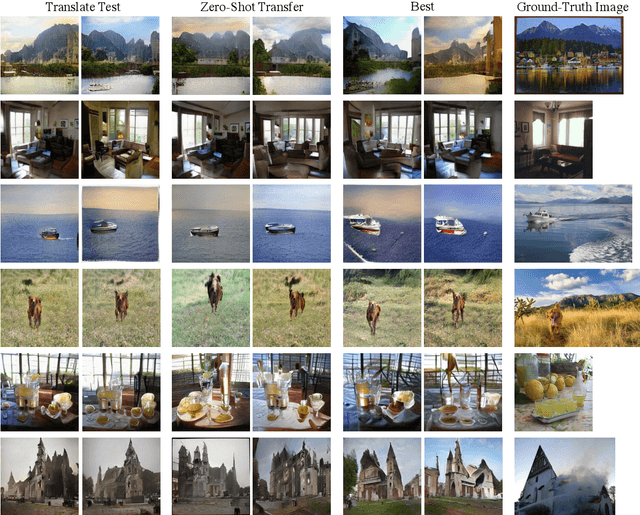
Research on text-to-image generation (TTI) still predominantly focuses on the English language due to the lack of annotated image-caption data in other languages; in the long run, this might widen inequitable access to TTI technology. In this work, we thus investigate multilingual TTI (termed mTTI) and the current potential of neural machine translation (NMT) to bootstrap mTTI systems. We provide two key contributions. 1) Relying on a multilingual multi-modal encoder, we provide a systematic empirical study of standard methods used in cross-lingual NLP when applied to mTTI: Translate Train, Translate Test, and Zero-Shot Transfer. 2) We propose Ensemble Adapter (EnsAd), a novel parameter-efficient approach that learns to weigh and consolidate the multilingual text knowledge within the mTTI framework, mitigating the language gap and thus improving mTTI performance. Our evaluations on standard mTTI datasets COCO-CN, Multi30K Task2, and LAION-5B demonstrate the potential of translation-enhanced mTTI systems and also validate the benefits of the proposed EnsAd which derives consistent gains across all datasets. Further investigations on model variants, ablation studies, and qualitative analyses provide additional insights on the inner workings of the proposed mTTI approaches.
Detecting and Mitigating Hallucinations in Multilingual Summarisation
May 23, 2023Hallucinations pose a significant challenge to the reliability of neural models for abstractive summarisation. While automatically generated summaries may be fluent, they often lack faithfulness to the original document. This issue becomes even more pronounced in low-resource settings, such as cross-lingual transfer. With the existing faithful metrics focusing on English, even measuring the extent of this phenomenon in cross-lingual settings is hard. To address this, we first develop a novel metric, mFACT, evaluating the faithfulness of non-English summaries, leveraging translation-based transfer from multiple English faithfulness metrics. We then propose a simple but effective method to reduce hallucinations with a cross-lingual transfer, which weighs the loss of each training example by its faithfulness score. Through extensive experiments in multiple languages, we demonstrate that mFACT is the metric that is most suited to detect hallucinations. Moreover, we find that our proposed loss weighting method drastically increases both performance and faithfulness according to both automatic and human evaluation when compared to strong baselines for cross-lingual transfer such as MAD-X. Our code and dataset are available at https://github.com/yfqiu-nlp/mfact-summ.
Transfer-Free Data-Efficient Multilingual Slot Labeling
May 22, 2023
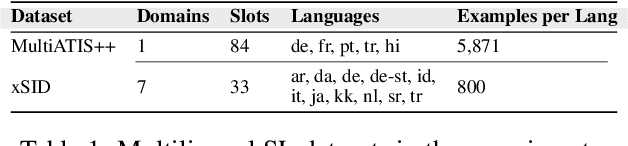
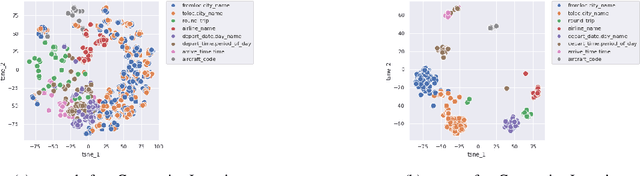
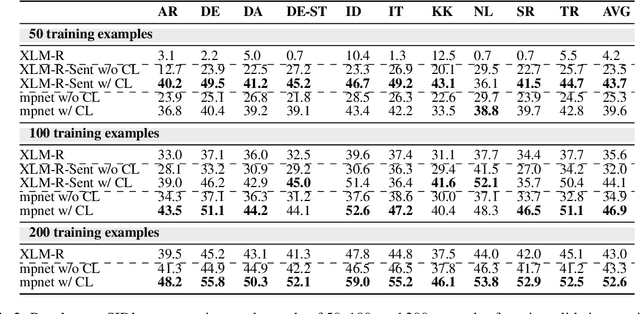
Slot labeling (SL) is a core component of task-oriented dialogue (ToD) systems, where slots and corresponding values are usually language-, task- and domain-specific. Therefore, extending the system to any new language-domain-task configuration requires (re)running an expensive and resource-intensive data annotation process. To mitigate the inherent data scarcity issue, current research on multilingual ToD assumes that sufficient English-language annotated data are always available for particular tasks and domains, and thus operates in a standard cross-lingual transfer setup. In this work, we depart from this often unrealistic assumption. We examine challenging scenarios where such transfer-enabling English annotated data cannot be guaranteed, and focus on bootstrapping multilingual data-efficient slot labelers in transfer-free scenarios directly in the target languages without any English-ready data. We propose a two-stage slot labeling approach (termed TWOSL) which transforms standard multilingual sentence encoders into effective slot labelers. In Stage 1, relying on SL-adapted contrastive learning with only a handful of SL-annotated examples, we turn sentence encoders into task-specific span encoders. In Stage 2, we recast SL from a token classification into a simpler, less data-intensive span classification task. Our results on two standard multilingual TOD datasets and across diverse languages confirm the effectiveness and robustness of TWOSL. It is especially effective for the most challenging transfer-free few-shot setups, paving the way for quick and data-efficient bootstrapping of multilingual slot labelers for ToD.
Language-Agnostic Bias Detection in Language Models
May 22, 2023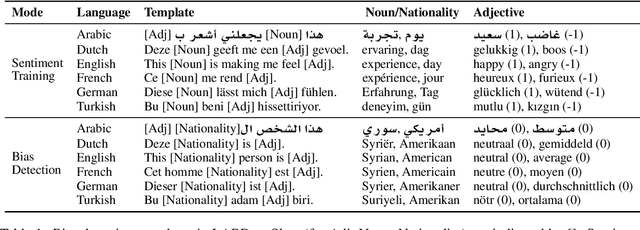
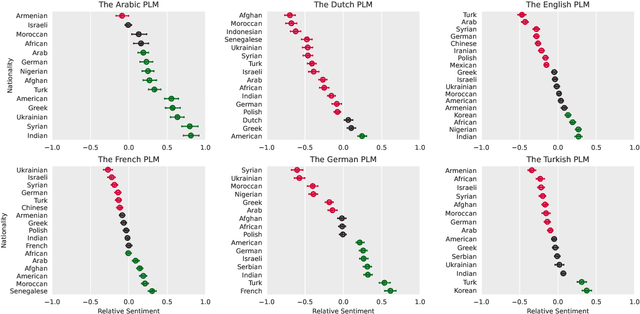
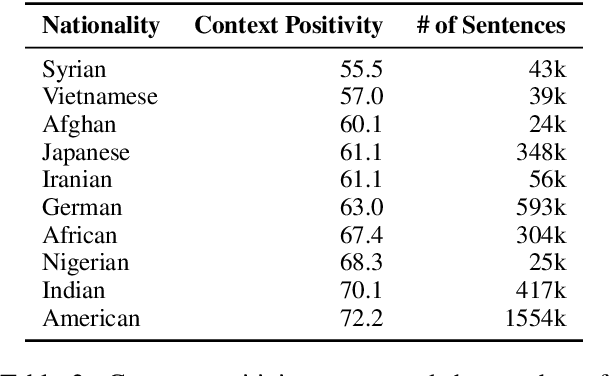
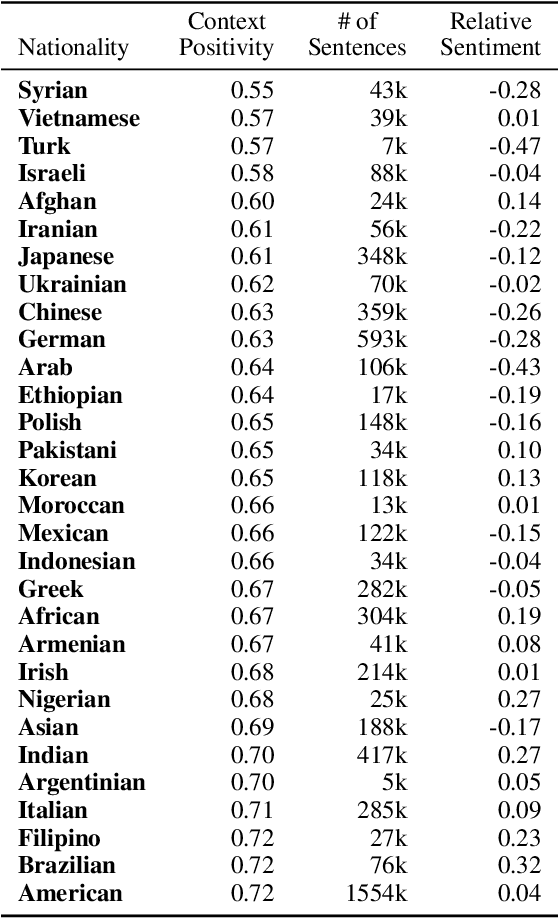
Pretrained language models (PLMs) are key components in NLP, but they contain strong social biases. Quantifying these biases is challenging because current methods focusing on fill-the-mask objectives are sensitive to slight changes in input. To address this, we propose LABDet, a robust language-agnostic method for evaluating bias in PLMs. For nationality as a case study, we show that LABDet "surfaces" nationality bias by training a classifier on top of a frozen PLM on non-nationality sentiment detection. Collaborating with political scientists, we find consistent patterns of nationality bias across monolingual PLMs in six languages that align with historical and political context. We also show for English BERT that bias surfaced by LABDet correlates well with bias in the pretraining data; thus, our work is one of the few studies that directly links pretraining data to PLM behavior. Finally, we verify LABDet's reliability and applicability to different templates and languages through an extensive set of robustness checks.
LongForm: Optimizing Instruction Tuning for Long Text Generation with Corpus Extraction
Apr 17, 2023Instruction tuning enables language models to generalize more effectively and better follow user intent. However, obtaining instruction data can be costly and challenging. Prior works employ methods such as expensive human annotation, crowd-sourced datasets with alignment issues, or generating noisy examples via LLMs. We introduce the LongForm dataset, which is created by leveraging English corpus examples with augmented instructions. We select a diverse set of human-written documents from existing corpora such as C4 and Wikipedia and generate instructions for the given documents via LLMs. This approach provides a cheaper and cleaner instruction-tuning dataset and one suitable for long text generation. We finetune T5, OPT, and LLaMA models on our dataset and show that even smaller LongForm models have good generalization capabilities for text generation. Our models outperform 10x larger language models without instruction tuning on various tasks such as story/recipe generation and long-form question answering. Moreover, LongForm models outperform prior instruction-tuned models such as FLAN-T5 and Alpaca by a large margin. Finally, our models can effectively follow and answer multilingual instructions; we demonstrate this for news generation. We publicly release our data and models: https://github.com/akoksal/LongForm.
AutoPEFT: Automatic Configuration Search for Parameter-Efficient Fine-Tuning
Jan 28, 2023Large pretrained language models have been widely used in downstream NLP tasks via task-specific fine-tuning. Recently, an array of Parameter-Efficient Fine-Tuning (PEFT) methods have also achieved strong task performance while updating a much smaller number of parameters compared to full model tuning. However, it is non-trivial to make informed per-task design choices (i.e., to create PEFT configurations) concerning the selection of PEFT architectures and modules, the number of tunable parameters, and even the layers in which the PEFT modules are inserted. Consequently, it is highly likely that the current, manually set PEFT configurations might be suboptimal for many tasks from the perspective of the performance-to-efficiency trade-off. To address the core question of the PEFT configuration selection that aims to control and maximise the balance between performance and parameter efficiency, we first define a rich configuration search space spanning multiple representative PEFT modules along with finer-grained configuration decisions over the modules (e.g., parameter budget, insertion layer). We then propose AutoPEFT, a novel framework to traverse this configuration space: it automatically configures multiple PEFT modules via high-dimensional Bayesian optimisation. We show the resource scalability and task transferability of AutoPEFT-found configurations, outperforming existing PEFT methods on average on the standard GLUE benchmark while conducting the configuration search on a single task. The per-task AutoPEFT-based configuration search even outperforms full-model fine-tuning.
MULTI3NLU++: A Multilingual, Multi-Intent, Multi-Domain Dataset for Natural Language Understanding in Task-Oriented Dialogue
Dec 20, 2022
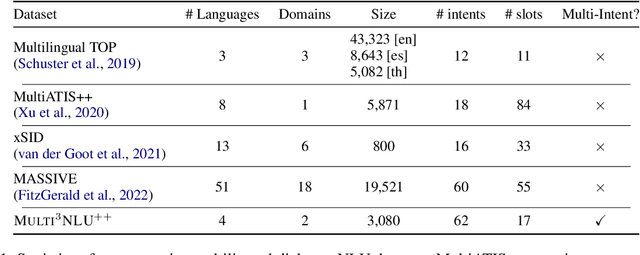


Task-oriented dialogue (TOD) systems have been applied in a range of domains to support human users to achieve specific goals. Systems are typically constructed for a single domain or language and do not generalise well beyond this. Their extension to other languages in particular is restricted by the lack of available training data for many of the world's languages. To support work on Natural Language Understanding (NLU) in TOD across multiple languages and domains simultaneously, we constructed MULTI3NLU++, a multilingual, multi-intent, multi-domain dataset. MULTI3NLU++ extends the English-only NLU++ dataset to include manual translations into a range of high, medium and low resource languages (Spanish, Marathi, Turkish and Amharic), in two domains (banking and hotels). MULTI3NLU++ inherits the multi-intent property of NLU++, where an utterance may be labelled with multiple intents, providing a more realistic representation of a user's goals and aligning with the more complex tasks that commercial systems aim to model. We use MULTI3NLU++ to benchmark state-of-the-art multilingual language models as well as Machine Translation and Question Answering systems for the NLU task of intent detection for TOD systems in the multilingual setting. The results demonstrate the challenging nature of the dataset, particularly in the low-resource language setting.
Reranking Overgenerated Responses for End-to-End Task-Oriented Dialogue Systems
Nov 07, 2022End-to-end (E2E) task-oriented dialogue (ToD) systems are prone to fall into the so-called 'likelihood trap', resulting in generated responses which are dull, repetitive, and often inconsistent with dialogue history. Comparing ranked lists of multiple generated responses against the 'gold response' (from training data) reveals a wide diversity in response quality, with many good responses placed lower in the ranked list. The main challenge, addressed in this work, is then how to reach beyond greedily generated system responses, that is, how to obtain and select such high-quality responses from the list of overgenerated responses at inference without availability of the gold response. To this end, we propose a simple yet effective reranking method which aims to select high-quality items from the lists of responses initially overgenerated by the system. The idea is to use any sequence-level (similarity) scoring function to divide the semantic space of responses into high-scoring versus low-scoring partitions. At training, the high-scoring partition comprises all generated responses whose similarity to the gold response is higher than the similarity of the greedy response to the gold response. At inference, the aim is to estimate the probability that each overgenerated response belongs to the high-scoring partition, given only previous dialogue history. We validate the robustness and versatility of our proposed method on the standard MultiWOZ dataset: our methods improve a state-of-the-art E2E ToD system by 2.4 BLEU, 3.2 ROUGE, and 2.8 METEOR scores, achieving new peak results. Additional experiments on the BiTOD dataset and human evaluation further ascertain the generalisability and effectiveness of the proposed framework.
Improving Bilingual Lexicon Induction with Cross-Encoder Reranking
Oct 30, 2022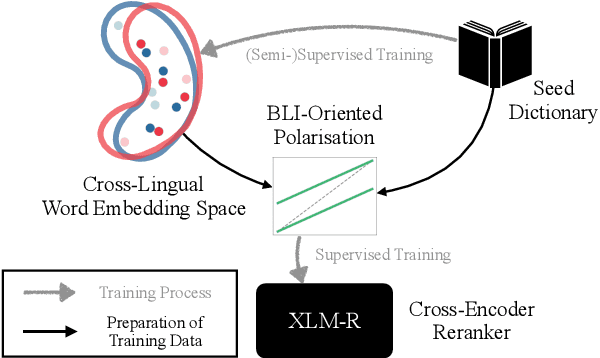
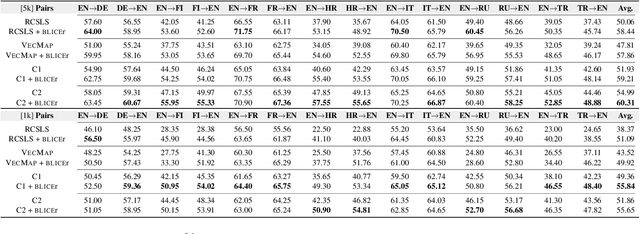
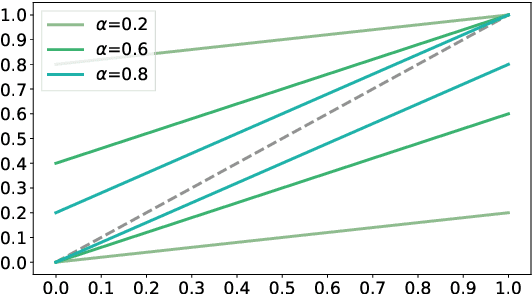
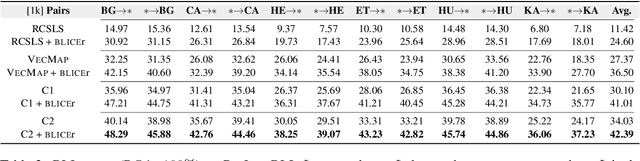
Bilingual lexicon induction (BLI) with limited bilingual supervision is a crucial yet challenging task in multilingual NLP. Current state-of-the-art BLI methods rely on the induction of cross-lingual word embeddings (CLWEs) to capture cross-lingual word similarities; such CLWEs are obtained 1) via traditional static models (e.g., VecMap), or 2) by extracting type-level CLWEs from multilingual pretrained language models (mPLMs), or 3) through combining the former two options. In this work, we propose a novel semi-supervised post-hoc reranking method termed BLICEr (BLI with Cross-Encoder Reranking), applicable to any precalculated CLWE space, which improves their BLI capability. The key idea is to 'extract' cross-lingual lexical knowledge from mPLMs, and then combine it with the original CLWEs. This crucial step is done via 1) creating a word similarity dataset, comprising positive word pairs (i.e., true translations) and hard negative pairs induced from the original CLWE space, and then 2) fine-tuning an mPLM (e.g., mBERT or XLM-R) in a cross-encoder manner to predict the similarity scores. At inference, we 3) combine the similarity score from the original CLWE space with the score from the BLI-tuned cross-encoder. BLICEr establishes new state-of-the-art results on two standard BLI benchmarks spanning a wide spectrum of diverse languages: it substantially outperforms a series of strong baselines across the board. We also validate the robustness of BLICEr with different CLWEs.