 Add to Chrome
 Add to Firefox
 Add to Edge
Token Factory: Efficiently Integrating Diverse Signals into Large Recommendation Models
Jun 17, 2026
Large Recommendation Models (LRMs) have demonstrated promising capabilities in industry-scale recommendation tasks. However, holistically integrating traditional signals into these transformer-based architectures effectively and efficiently remains a major challenge. Conventional approaches that "textualize" these signals directly or create discrete item representations often lead to excessively long prompts, substantial memory footprints, and high computational overhead. To overcome these limitations, we propose "Token Factory", a framework designed to transform traditional signals into "soft tokens" that can be directly processed by LRMs. This approach enables efficient integration and compression of heterogeneous input features, preventing prompt length explosion while enhancing model performance. We detail the architecture of Token Factory and present experimental results validating its effectiveness in a production-scale recommendation environment.

Zero-shot Cross-domain Knowledge Distillation: A Case study on YouTube Music
Mar 30, 2026Knowledge Distillation (KD) has been widely used to improve the quality of latency sensitive models serving live traffic. However, applying KD in production recommender systems with low traffic is challenging: the limited amount of data restricts the teacher model size, and the cost of training a large dedicated teacher may not be justified. Cross-domain KD offers a cost-effective alternative by leveraging a teacher from a data-rich source domain, but introduces unique technical difficulties, as the features, user interfaces, and prediction tasks can significantly differ. We present a case study of using zero-shot cross-domain KD for multi-task ranking models, transferring knowledge from a (100x) large-scale video recommendation platform (YouTube) to a music recommendation application with significantly lower traffic. We share offline and live experiment results and present findings evaluating different KD techniques in this setting across two ranking models on the music app. Our results demonstrate that zero-shot cross-domain KD is a practical and effective approach to improve the performance of ranking models on low traffic surfaces.
Bridging the Gap: Unpacking the Hidden Challenges in Knowledge Distillation for Online Ranking Systems
Aug 26, 2024Knowledge Distillation (KD) is a powerful approach for compressing a large model into a smaller, more efficient model, particularly beneficial for latency-sensitive applications like recommender systems. However, current KD research predominantly focuses on Computer Vision (CV) and NLP tasks, overlooking unique data characteristics and challenges inherent to recommender systems. This paper addresses these overlooked challenges, specifically: (1) mitigating data distribution shifts between teacher and student models, (2) efficiently identifying optimal teacher configurations within time and budgetary constraints, and (3) enabling computationally efficient and rapid sharing of teacher labels to support multiple students. We present a robust KD system developed and rigorously evaluated on multiple large-scale personalized video recommendation systems within Google. Our live experiment results demonstrate significant improvements in student model performance while ensuring consistent and reliable generation of high quality teacher labels from a continuous data stream of data.
Learning Tractable Probabilistic Models for Fault Localization
Jul 07, 2015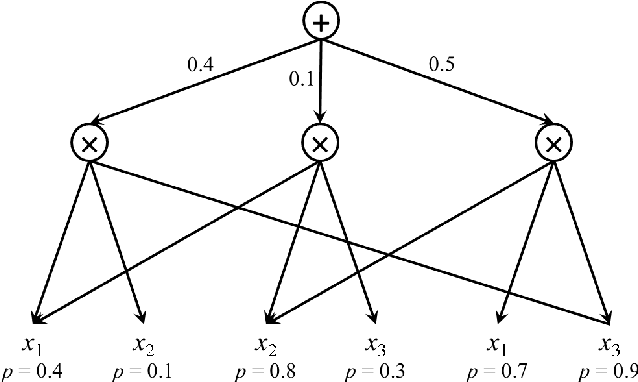
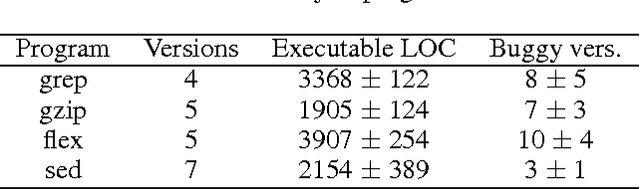
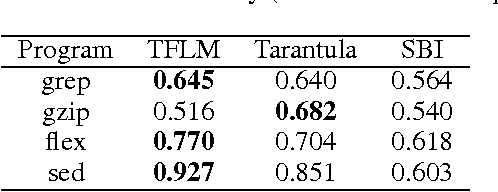
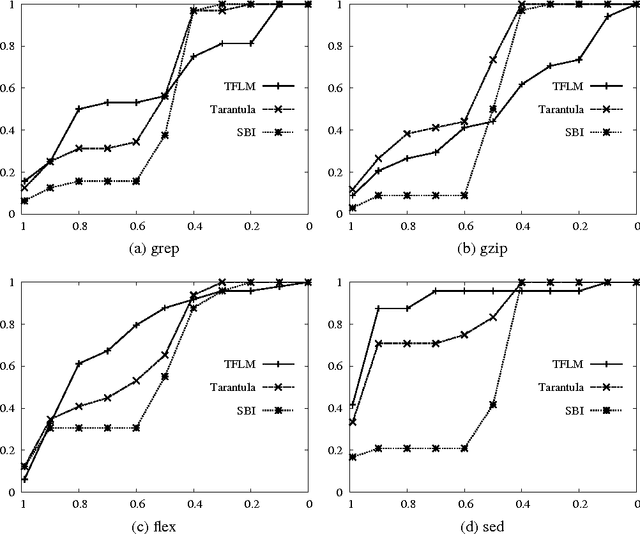
In recent years, several probabilistic techniques have been applied to various debugging problems. However, most existing probabilistic debugging systems use relatively simple statistical models, and fail to generalize across multiple programs. In this work, we propose Tractable Fault Localization Models (TFLMs) that can be learned from data, and probabilistically infer the location of the bug. While most previous statistical debugging methods generalize over many executions of a single program, TFLMs are trained on a corpus of previously seen buggy programs, and learn to identify recurring patterns of bugs. Widely-used fault localization techniques such as TARANTULA evaluate the suspiciousness of each line in isolation; in contrast, a TFLM defines a joint probability distribution over buggy indicator variables for each line. Joint distributions with rich dependency structure are often computationally intractable; TFLMs avoid this by exploiting recent developments in tractable probabilistic models (specifically, Relational SPNs). Further, TFLMs can incorporate additional sources of information, including coverage-based features such as TARANTULA. We evaluate the fault localization performance of TFLMs that include TARANTULA scores as features in the probabilistic model. Our study shows that the learned TFLMs isolate bugs more effectively than previous statistical methods or using TARANTULA directly.