 Add to Chrome
 Add to Firefox
 Add to Edge
Flow Reasoning Models: Scaling Reasoning Through Iterative Self-Refinement
Jun 28, 2026
Discrete flow models have recently shown promising performance on few-step text generation; however, when naively applied to structured reasoning tasks such as Sudoku and Zebra puzzles, they converge confidently to incorrect answers (solving only $\sim$36% of Sudoku puzzles). We introduce Flow Reasoning Models (FRMs), a training and test-time-scaling framework for structured reasoning with flow models. We make the observation that, despite their poor solve rate, flow models can act as their own verifiers. A correct answer is a stable fixed point of the denoising dynamics, returning to itself when re-noised and re-solved. This enables a test-time-scaling paradigm: propose many candidate solutions and keep those that are dynamically stable, which alone reaches high solve rates on Sudoku-Shah (~$100\%$) and Zebra ($95.9\%$). This even generalizes to harder out-of-distribution puzzles like Sudoku-Extreme ($96.1\%$), without ever training on that distribution. This pure search, however, wastes a great deal of computation generating incorrect candidate solutions. We therefore design a training recipe to improve the base model's efficiency. First, we train flow models with a self-conditioning channel and close it at inference, letting them refine their own past predictions. Second, we train models to avoid their own failed generations using direct preference optimization. These changes substantially improve the base model's efficiency, letting it reach $99.2\%$ on Sudoku in just $7$ forward passes, over $8\times$ fewer than the strongest matched masked-diffusion baseline we compare needs for the same accuracy. When combined with test-time scaling, this lets flow models solve hard out-of-distribution puzzles (e.g. Sudoku-Extreme) far more efficiently.

Canonical Bayesian Linear System Identification
Jul 15, 2025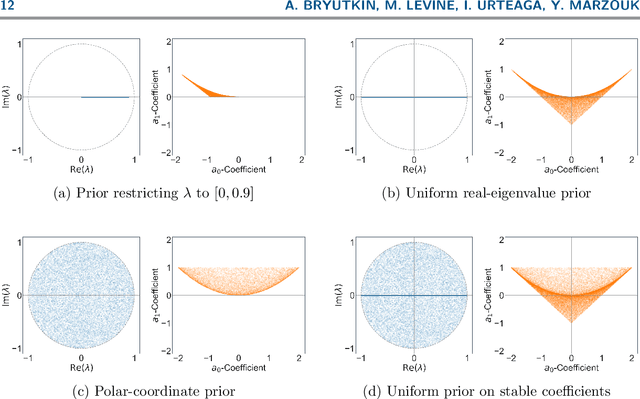

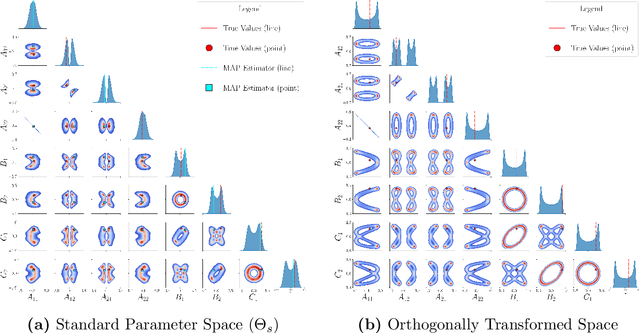
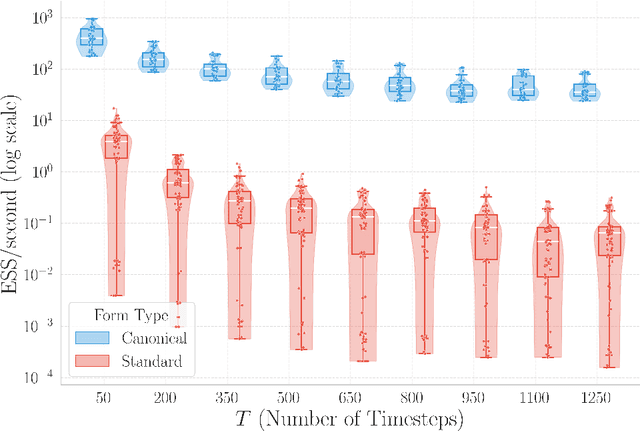
Standard Bayesian approaches for linear time-invariant (LTI) system identification are hindered by parameter non-identifiability; the resulting complex, multi-modal posteriors make inference inefficient and impractical. We solve this problem by embedding canonical forms of LTI systems within the Bayesian framework. We rigorously establish that inference in these minimal parameterizations fully captures all invariant system dynamics (e.g., transfer functions, eigenvalues, predictive distributions of system outputs) while resolving identifiability. This approach unlocks the use of meaningful, structure-aware priors (e.g., enforcing stability via eigenvalues) and ensures conditions for a Bernstein--von Mises theorem -- a link between Bayesian and frequentist large-sample asymptotics that is broken in standard forms. Extensive simulations with modern MCMC methods highlight advantages over standard parameterizations: canonical forms achieve higher computational efficiency, generate interpretable and well-behaved posteriors, and provide robust uncertainty estimates, particularly from limited data.
HAMLET: Graph Transformer Neural Operator for Partial Differential Equations
Feb 05, 2024We present a novel graph transformer framework, HAMLET, designed to address the challenges in solving partial differential equations (PDEs) using neural networks. The framework uses graph transformers with modular input encoders to directly incorporate differential equation information into the solution process. This modularity enhances parameter correspondence control, making HAMLET adaptable to PDEs of arbitrary geometries and varied input formats. Notably, HAMLET scales effectively with increasing data complexity and noise, showcasing its robustness. HAMLET is not just tailored to a single type of physical simulation, but can be applied across various domains. Moreover, it boosts model resilience and performance, especially in scenarios with limited data. We demonstrate, through extensive experiments, that our framework is capable of outperforming current techniques for PDEs.