 Add to Chrome
 Add to Firefox
 Add to Edge
Agentic-J: An AI Agent for Biological Microscopy Image Analysis
Jun 01, 2026
Biological image analysis increasingly demands integration across heterogeneous tools, programming environments, and domain knowledge that few researchers can command simultaneously. We present Agentic-J, a containerised, multi-agent AI assistant, primarily for ImageJ/Fiji that enables biologists to specify analysis tasks in natural language, from nuclei segmentation and cell tracking to multi-condition quantification. The agent generates executable scripts organised into a documented project structure, so every analysis decision is traceable and the workflow can be reproduced or shared. The specialised sub-agents handle plugin management, code generation, debugging, quality assurance, and statistical reporting. In this paper we introduce the system's design, demonstrate real biological microscopy image analysis workflows, and detailed the technical implementation.

On the Robustness of Watermarking for Autoregressive Image Generation
Apr 13, 2026The proliferation of autoregressive (AR) image generators demands reliable detection and attribution of their outputs to mitigate misinformation, and to filter synthetic images from training data to prevent model collapse. To address this need, watermarking techniques, specifically designed for AR models, embed a subtle signal at generation time, enabling downstream verification through a corresponding watermark detector. In this work, we study these schemes and demonstrate their vulnerability to both watermark removal and forgery attacks. We assess existing attacks and further introduce three new attacks: (i) a vector-quantized regeneration removal attack, (ii) adversarial optimization-based attack, and (iii) a frequency injection attack. Our evaluation reveals that removal and forgery attacks can be effective with access to a single watermarked reference image and without access to original model parameters or watermarking secrets. Our findings indicate that existing watermarking schemes for AR image generation do not reliably support synthetic content detection for dataset filtering. Moreover, they enable Watermark Mimicry, whereby authentic images can be manipulated to imitate a generator's watermark and trigger false detection to prevent their inclusion in future model training.
Performance and Experimental Analysis of Strain-based Models for Continuum Robots
Feb 26, 2026Although strain-based models have been widely adopted in robotics, no comparison beyond the uniform bending test is commonly recognized to assess their performance. In addition, the increasing effort in prototyping continuum robots highlights the need to assess the applicability of these models and the necessity of comprehensive performance evaluation. To address this gap, this work investigates the shape reconstruction abilities of a third-order strain interpolation method, examining its ability to capture both individual and combined deformation effects. These results are compared and discussed against the Geometric-Variable Strain approach. Subsequently, simulation results are experimentally verified by reshaping a slender rod while recording the resulting configurations using cameras. The rod configuration is imposed using a manipulator displacing one of its tips and extracted through reflective markers, without the aid of any other external sensor -- i.e. strain gauges or wrench sensors placed along the rod. The experiments demonstrate good agreement between the model predictions and observed shapes, with average error of 0.58% of the rod length and average computational time of 0.32s per configuration, outperforming existing models.
Learning Dynamics in Memristor-Based Equilibrium Propagation
Dec 13, 2025Memristor-based in-memory computing has emerged as a promising paradigm to overcome the constraints of the von Neumann bottleneck and the memory wall by enabling fully parallelisable and energy-efficient vector-matrix multiplications. We investigate the effect of nonlinear, memristor-driven weight updates on the convergence behaviour of neural networks trained with equilibrium propagation (EqProp). Six memristor models were characterised by their voltage-current hysteresis and integrated into the EBANA framework for evaluation on two benchmark classification tasks. EqProp can achieve robust convergence under nonlinear weight updates, provided that memristors exhibit a sufficiently wide resistance range of at least an order of magnitude.
Towards A Correct Usage of Cryptography in Semantic Watermarks for Diffusion Models
Mar 14, 2025Semantic watermarking methods enable the direct integration of watermarks into the generation process of latent diffusion models by only modifying the initial latent noise. One line of approaches building on Gaussian Shading relies on cryptographic primitives to steer the sampling process of the latent noise. However, we identify several issues in the usage of cryptographic techniques in Gaussian Shading, particularly in its proof of lossless performance and key management, causing ambiguity in follow-up works, too. In this work, we therefore revisit the cryptographic primitives for semantic watermarking. We introduce a novel, general proof of lossless performance based on IND\$-CPA security for semantic watermarks. We then discuss the configuration of the cryptographic primitives in semantic watermarks with respect to security, efficiency, and generation quality.
Black-Box Forgery Attacks on Semantic Watermarks for Diffusion Models
Dec 04, 2024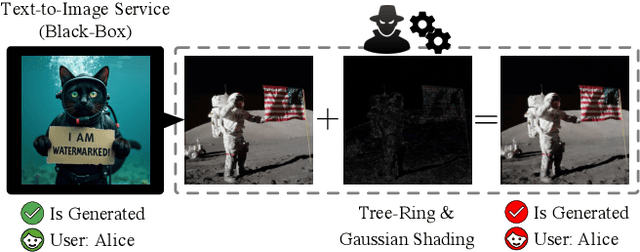
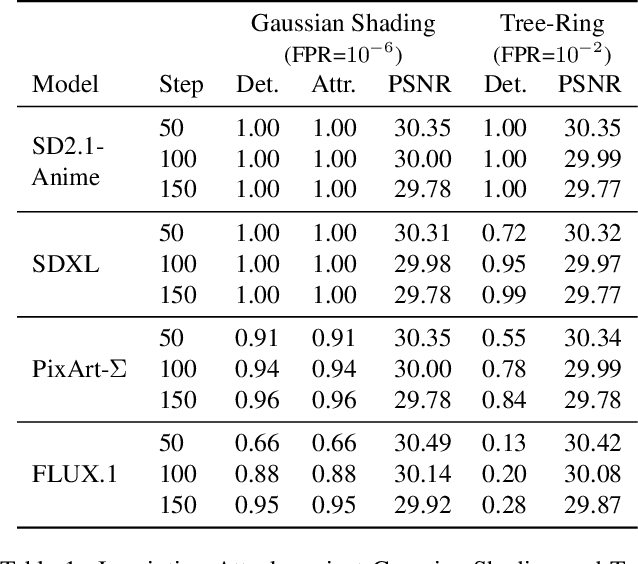
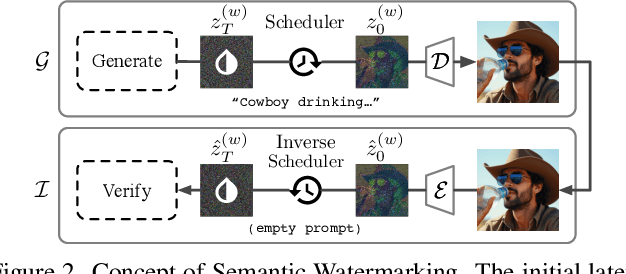
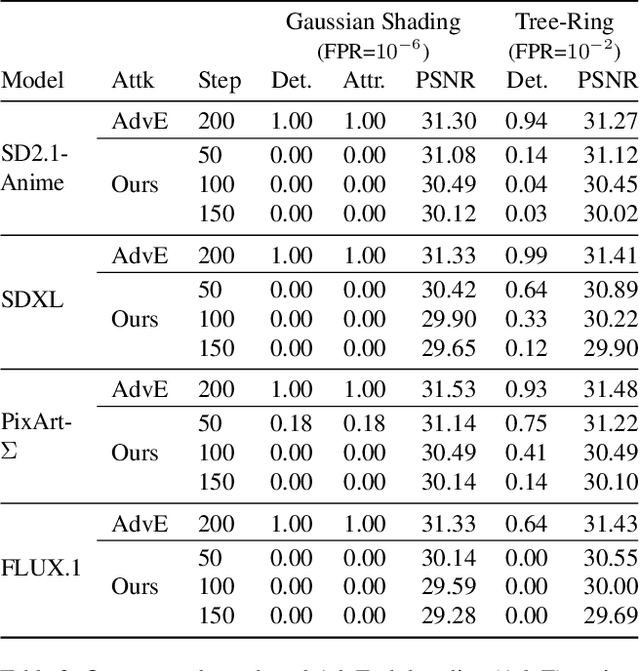
Integrating watermarking into the generation process of latent diffusion models (LDMs) simplifies detection and attribution of generated content. Semantic watermarks, such as Tree-Rings and Gaussian Shading, represent a novel class of watermarking techniques that are easy to implement and highly robust against various perturbations. However, our work demonstrates a fundamental security vulnerability of semantic watermarks. We show that attackers can leverage unrelated models, even with different latent spaces and architectures (UNet vs DiT), to perform powerful and realistic forgery attacks. Specifically, we design two watermark forgery attacks. The first imprints a targeted watermark into real images by manipulating the latent representation of an arbitrary image in an unrelated LDM to get closer to the latent representation of a watermarked image. We also show that this technique can be used for watermark removal. The second attack generates new images with the target watermark by inverting a watermarked image and re-generating it with an arbitrary prompt. Both attacks just need a single reference image with the target watermark. Overall, our findings question the applicability of semantic watermarks by revealing that attackers can easily forge or remove these watermarks under realistic conditions.
The Impact of Uniform Inputs on Activation Sparsity and Energy-Latency Attacks in Computer Vision
Mar 27, 2024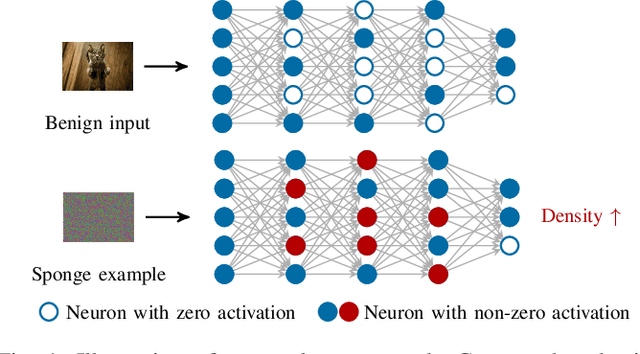
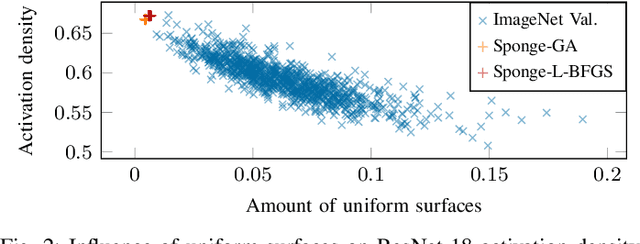
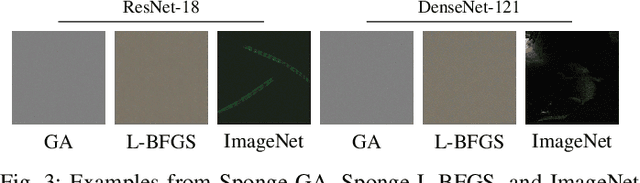
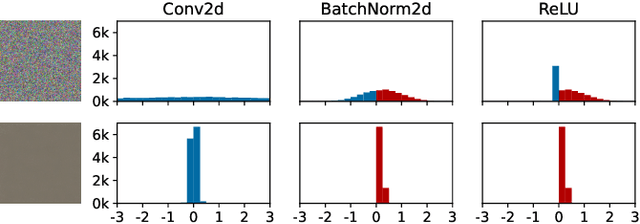
Resource efficiency plays an important role for machine learning nowadays. The energy and decision latency are two critical aspects to ensure a sustainable and practical application. Unfortunately, the energy consumption and decision latency are not robust against adversaries. Researchers have recently demonstrated that attackers can compute and submit so-called sponge examples at inference time to increase the energy consumption and decision latency of neural networks. In computer vision, the proposed strategy crafts inputs with less activation sparsity which could otherwise be used to accelerate the computation. In this paper, we analyze the mechanism how these energy-latency attacks reduce activation sparsity. In particular, we find that input uniformity is a key enabler. A uniform image, that is, an image with mostly flat, uniformly colored surfaces, triggers more activations due to a specific interplay of convolution, batch normalization, and ReLU activation. Based on these insights, we propose two new simple, yet effective strategies for crafting sponge examples: sampling images from a probability distribution and identifying dense, yet inconspicuous inputs in natural datasets. We empirically examine our findings in a comprehensive evaluation with multiple image classification models and show that our attack achieves the same sparsity effect as prior sponge-example methods, but at a fraction of computation effort. We also show that our sponge examples transfer between different neural networks. Finally, we discuss applications of our findings for the good by improving efficiency by increasing sparsity.
MotherNet: A Foundational Hypernetwork for Tabular Classification
Dec 14, 2023The advent of Foundation Models is transforming machine learning across many modalities (e.g., language, images, videos) with prompt engineering replacing training in many settings. Recent work on tabular data (e.g., TabPFN) hints at a similar opportunity to build Foundation Models for classification for numerical data. In this paper, we go one step further and propose a hypernetwork architecture that we call MotherNet, trained on millions of classification tasks, that, once prompted with a never-seen-before training set generates the weights of a trained ``child'' neural-network. Like other Foundation Models, MotherNet replaces training on specific datasets with in-context learning through a single forward pass. In contrast to existing hypernetworks that were either task-specific or trained for relatively constraint multi-task settings, MotherNet is trained to generate networks to perform multiclass classification on arbitrary tabular datasets without any dataset specific gradient descent. The child network generated by MotherNet using in-context learning outperforms neural networks trained using gradient descent on small datasets, and is competitive with predictions by TabPFN and standard ML methods like Gradient Boosting. Unlike a direct application of transformer models like TabPFN, MotherNet generated networks are highly efficient at inference time. This methodology opens up a new approach to building predictive models on tabular data that is both efficient and robust, without any dataset-specific training.
On the Detection of Image-Scaling Attacks in Machine Learning
Oct 23, 2023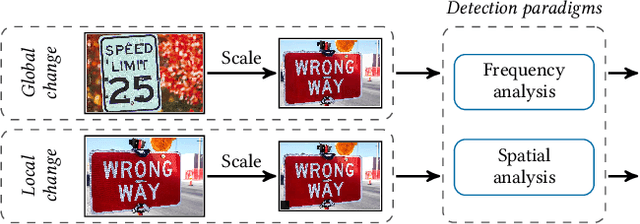
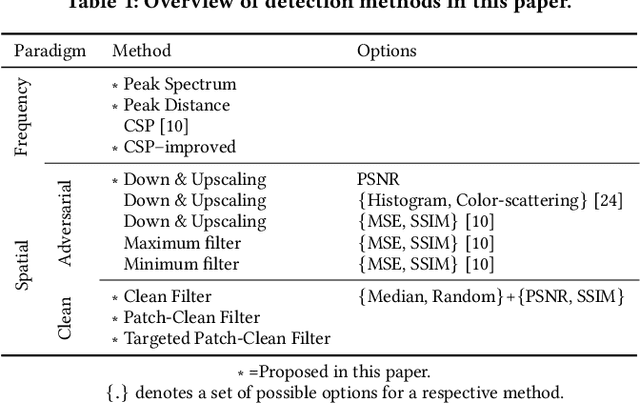
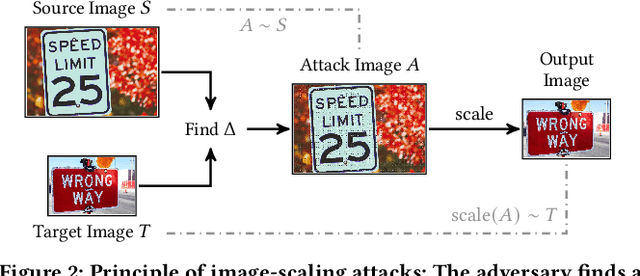
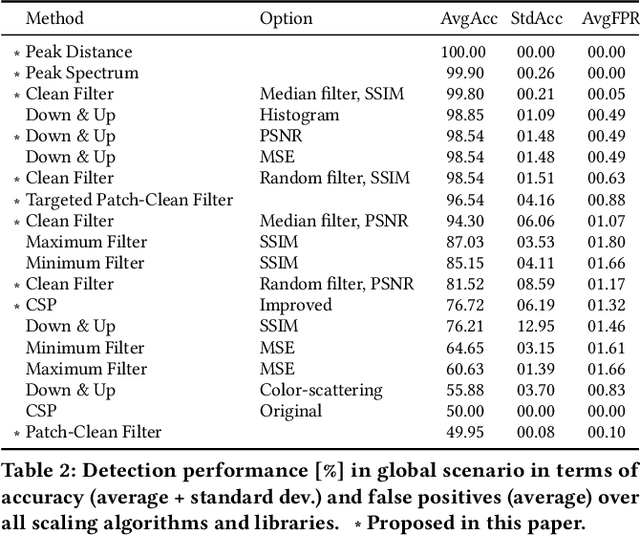
Image scaling is an integral part of machine learning and computer vision systems. Unfortunately, this preprocessing step is vulnerable to so-called image-scaling attacks where an attacker makes unnoticeable changes to an image so that it becomes a new image after scaling. This opens up new ways for attackers to control the prediction or to improve poisoning and backdoor attacks. While effective techniques exist to prevent scaling attacks, their detection has not been rigorously studied yet. Consequently, it is currently not possible to reliably spot these attacks in practice. This paper presents the first in-depth systematization and analysis of detection methods for image-scaling attacks. We identify two general detection paradigms and derive novel methods from them that are simple in design yet significantly outperform previous work. We demonstrate the efficacy of these methods in a comprehensive evaluation with all major learning platforms and scaling algorithms. First, we show that image-scaling attacks modifying the entire scaled image can be reliably detected even under an adaptive adversary. Second, we find that our methods provide strong detection performance even if only minor parts of the image are manipulated. As a result, we can introduce a novel protection layer against image-scaling attacks.
Detecting Spells in Fantasy Literature with a Transformer Based Artificial Intelligence
Aug 07, 2023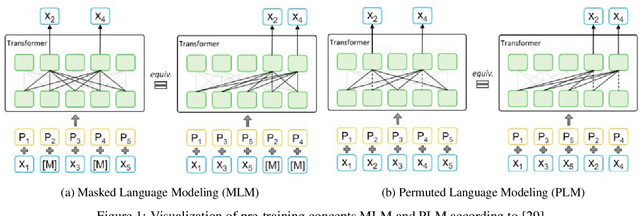
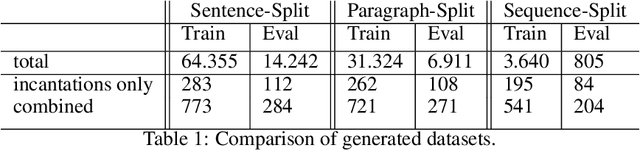
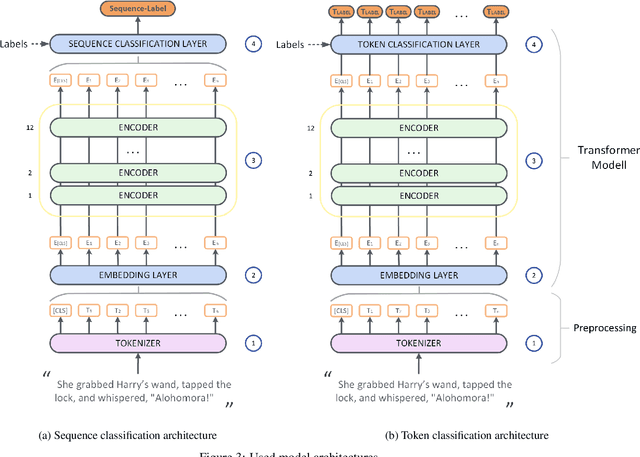
Transformer architectures and models have made significant progress in language-based tasks. In this area, is BERT one of the most widely used and freely available transformer architecture. In our work, we use BERT for context-based phrase recognition of magic spells in the Harry Potter novel series. Spells are a common part of active magic in fantasy novels. Typically, spells are used in a specific context to achieve a supernatural effect. A series of investigations were conducted to see if a Transformer architecture could recognize such phrases based on their context in the Harry Potter saga. For our studies a pre-trained BERT model was used and fine-tuned utilising different datasets and training methods to identify the searched context. By considering different approaches for sequence classification as well as token classification, it is shown that the context of spells can be recognised. According to our investigations, the examined sequence length for fine-tuning and validation of the model plays a significant role in context recognition. Based on this, we have investigated whether spells have overarching properties that allow a transfer of the neural network models to other fantasy universes as well. The application of our model showed promising results and is worth to be deepened in subsequent studies.