 Add to Chrome
 Add to Firefox
 Add to Edge
Enhancing Network Intrusion Detection Systems: A Multi-Layer Ensemble Approach to Mitigate Adversarial Attacks
Mar 11, 2026
Adversarial examples can represent a serious threat to machine learning (ML) algorithms. If used to manipulate the behaviour of ML-based Network Intrusion Detection Systems (NIDS), they can jeopardize network security. In this work, we aim to mitigate such risks by increasing the robustness of NIDS towards adversarial attacks. To that end, we explore two adversarial methods for generating malicious network traffic. The first method is based on Generative Adversarial Networks (GAN) and the second one is the Fast Gradient Sign Method (FGSM). The adversarial examples generated by these methods are then used to evaluate a novel multilayer defense mechanism, specifically designed to mitigate the vulnerability of ML-based NIDS. Our solution consists of one layer of stacking classifiers and a second layer based on an autoencoder. If the incoming network data are classified as benign by the first layer, the second layer is activated to ensure that the decision made by the stacking classifier is correct. We also incorporated adversarial training to further improve the robustness of our solution. Experiments on two datasets, namely UNSW-NB15 and NSL-KDD, demonstrate that the proposed approach increases resilience to adversarial attacks.

BioNeRF: Biologically Plausible Neural Radiance Fields for View Synthesis
Feb 11, 2024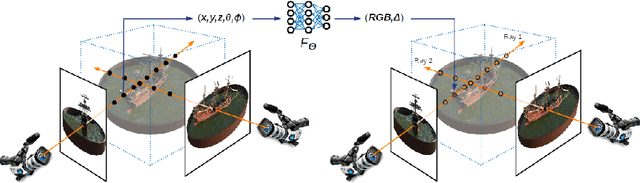
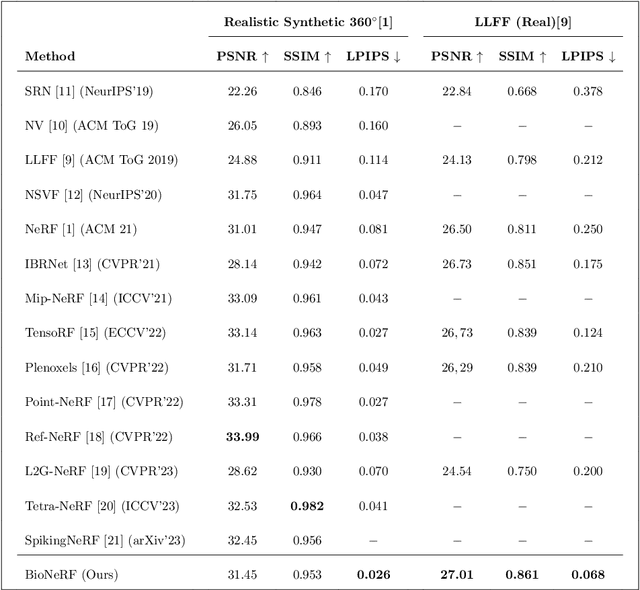
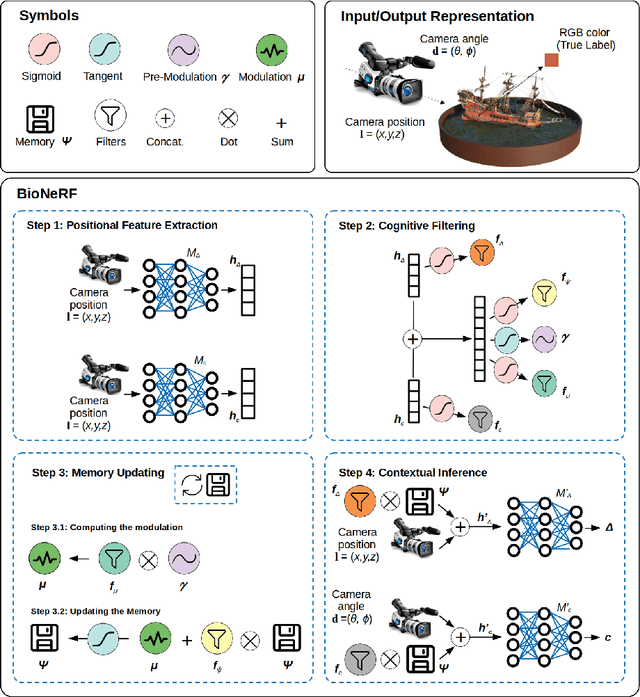
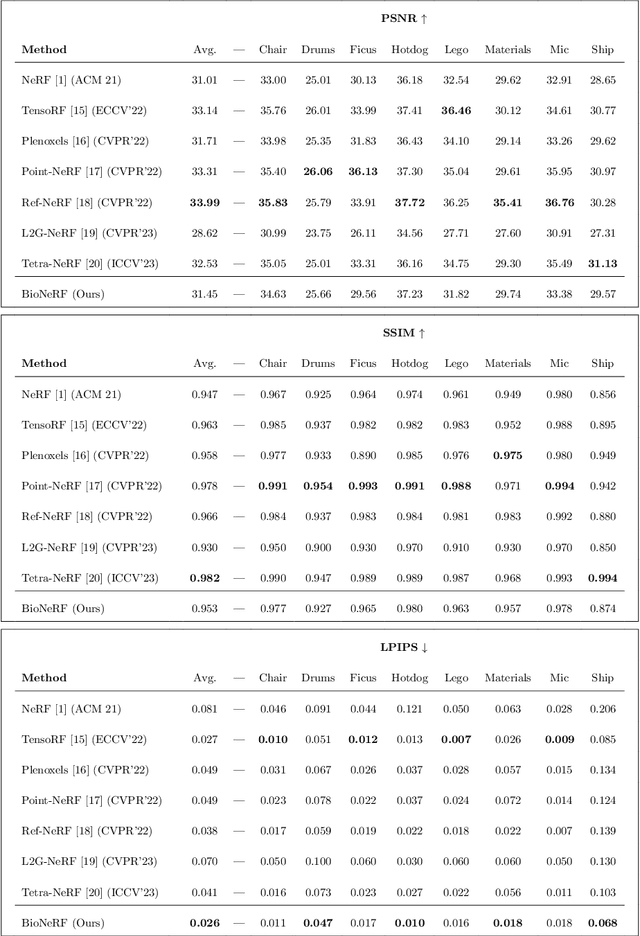
This paper presents BioNeRF, a biologically plausible architecture that models scenes in a 3D representation and synthesizes new views through radiance fields. Since NeRF relies on the network weights to store the scene's 3-dimensional representation, BioNeRF implements a cognitive-inspired mechanism that fuses inputs from multiple sources into a memory-like structure, improving the storing capacity and extracting more intrinsic and correlated information. BioNeRF also mimics a behavior observed in pyramidal cells concerning contextual information, in which the memory is provided as the context and combined with the inputs of two subsequent neural models, one responsible for producing the volumetric densities and the other the colors used to render the scene. Experimental results show that BioNeRF outperforms state-of-the-art results concerning a quality measure that encodes human perception in two datasets: real-world images and synthetic data.