 Add to Chrome
 Add to Firefox
 Add to Edge
BioME: A Resource-Efficient Bioacoustic Foundational Model for IoT Applications
Feb 10, 2026
Passive acoustic monitoring has become a key strategy in biodiversity assessment, conservation, and behavioral ecology, especially as Internet-of-Things (IoT) devices enable continuous in situ audio collection at scale. While recent self-supervised learning (SSL)-based audio encoders, such as BEATs and AVES, have shown strong performance in bioacoustic tasks, their computational cost and limited robustness to unseen environments hinder deployment on resource-constrained platforms. In this work, we introduce BioME, a resource-efficient audio encoder designed for bioacoustic applications. BioME is trained via layer-to-layer distillation from a high-capacity teacher model, enabling strong representational transfer while reducing the parameter count by 75%. To further improve ecological generalization, the model is pretrained on multi-domain data spanning speech, environmental sounds, and animal vocalizations. A key contribution is the integration of modulation-aware acoustic features via FiLM conditioning, injecting a DSP-inspired inductive bias that enhances feature disentanglement in low-capacity regimes. Across multiple bioacoustic tasks, BioME matches or surpasses the performance of larger models, including its teacher, while being suitable for resource-constrained IoT deployments. For reproducibility, code and pretrained checkpoints are publicly available.

UrBAN: Urban Beehive Acoustics and PheNotyping Dataset
Jun 05, 2024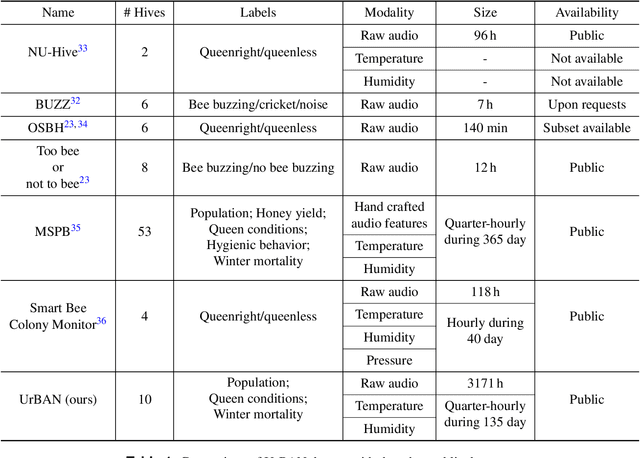
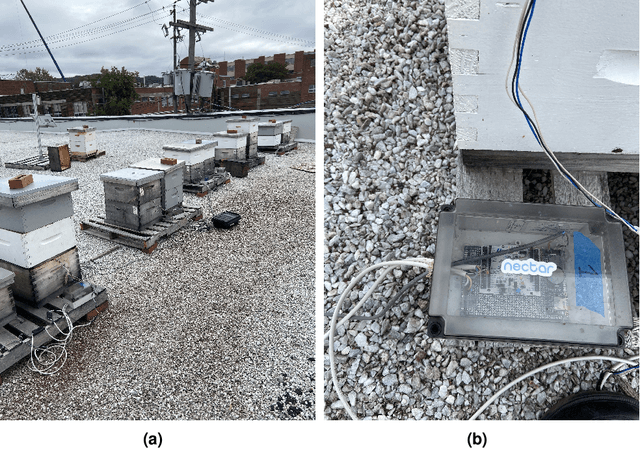
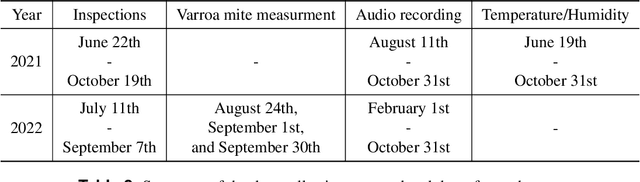
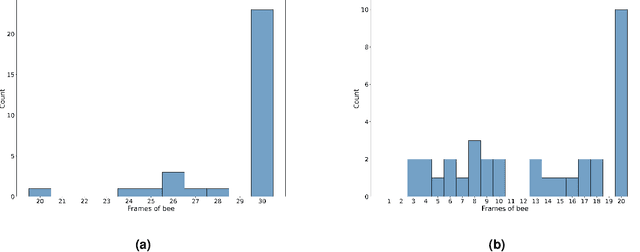
In this paper, we present a multimodal dataset obtained from a honey bee colony in Montr\'eal, Quebec, Canada, spanning the years of 2021 to 2022. This apiary comprised 10 beehives, with microphones recording more than 2000 hours of high quality raw audio, and also sensors capturing temperature, and humidity. Periodic hive inspections involved monitoring colony honey bee population changes, assessing queen-related conditions, and documenting overall hive health. Additionally, health metrics, such as Varroa mite infestation rates and winter mortality assessments were recorded, offering valuable insights into factors affecting hive health status and resilience. In this study, we first outline the data collection process, sensor data description, and dataset structure. Furthermore, we demonstrate a practical application of this dataset by extracting various features from the raw audio to predict colony population using the number of frames of bees as a proxy.
MSPB: a longitudinal multi-sensor dataset with phenotypic trait measurements from honey bees
Nov 17, 2023We present a longitudinal multi-sensor dataset collected from honey bee colonies (Apis mellifera) with rich phenotypic measurements. Data were continuously collected between May-2020 and April-2021 from 53 hives located at two apiaries in Qu\'ebec, Canada. The sensor data included audio features, temperature, and relative humidity. The phenotypic measurements contained beehive population, number of brood cells (eggs, larva and pupa), Varroa destructor infestation levels, defensive and hygienic behaviors, honey yield, and winter mortality. Our study is amongst the first to provide a wide variety of phenotypic trait measurements annotated by apicultural science experts, which facilitate a broader scope of analysis. We first summarize the data collection procedure, sensor data pre-processing steps, and data composition. We then provide an overview of the phenotypic data distribution as well as a visualization of the sensor data patterns. Lastly, we showcase several hive monitoring applications based on sensor data analysis and machine learning, such as winter mortality prediction, hive population estimation, and the presence of an active and laying queen.