 Add to Chrome
 Add to Firefox
 Add to Edge
High-Load-Density Electro-Permanent Magnetic Foot with Controllable Adhesion for Quadruped Wall-Climbing Robots
May 29, 2026
To enable reliable climbing locomotion of quadruped robots on ferromagnetic surfaces, this paper presents a high-load-density electro-permanent magnetic foot with controllable adhesion, featuring force-feedback circular Halbach-net electro-permanent magnet (CHN-EPM) adhesion units and a magnetization control system. Due to its three-dimensional magnetic circuit structure and flux-concentration effect, the CHN-EPM enables a distributed parallel magnetic flux path with enhanced flux utilization, resulting in reduced sensitivity to air-gap variations and allowing effective adhesion to be maintained even under partial contact conditions. The proposed CHN-EPM generates a maximum adhesion force exceeding 1000 N with a load-to-weight ratio over 200:1. A magnetization driver and a two-stage pulse current control strategy are developed to regulate the excitation current amplitude and duration, enabling accurate and reliable magnetization. By incorporating a flexible pressure sensor for contact force feedback, the system can effectively monitor attachment and detachment states, ensuring robust adhesion switching under uncertain contact conditions. The proposed system is integrated into a commercial quadruped robot (Unitree GO2), demonstrating high-load adhesion on ceiling and vertical-wall surfaces and stable locomotion on painted, perforated, and curved ferromagnetic surfaces.

Safactory: A Scalable Agent Factory for Trustworthy Autonomous Intelligence
May 07, 2026As large models evolve from conversational assistants into autonomous agents, challenges increasingly arise from long-horizon decision making, tool use, and real environment interaction. Existing agenticinfrastructure remain fragmented across evaluation, data management, and agent evolution, making it difficult to discover risks systematically and improve models in a continuous closed loop. In this report, we present \textbf{Safactory}, a scalable agent factory for trustworthy autonomous intelligence. Safactory integrates three tightly coupled platforms: a \textbf{Parallel Simulation Platform} for trajectory generation, a \textbf{Trustworthy Data Platform} for trajectory storage and experience extraction, and an \textbf{Autonomous Evolution Platform} for asynchronous reinforcement learning and on-policy distillation. As far as we know, Safactory is the first framework to propose a unified evolutionary pipeline for next-generation trustworthy autonomous intelligence.
CauCLIP: Bridging the Sim-to-Real Gap in Surgical Video Understanding via Causality-Inspired Vision-Language Modeling
Feb 06, 2026Surgical phase recognition is a critical component for context-aware decision support in intelligent operating rooms, yet training robust models is hindered by limited annotated clinical videos and large domain gaps between synthetic and real surgical data. To address this, we propose CauCLIP, a causality-inspired vision-language framework that leverages CLIP to learn domain-invariant representations for surgical phase recognition without access to target domain data. Our approach integrates a frequency-based augmentation strategy to perturb domain-specific attributes while preserving semantic structures, and a causal suppression loss that mitigates non-causal biases and reinforces causal surgical features. These components are combined in a unified training framework that enables the model to focus on stable causal factors underlying surgical workflows. Experiments on the SurgVisDom hard adaptation benchmark demonstrate that our method substantially outperforms all competing approaches, highlighting the effectiveness of causality-guided vision-language models for domain-generalizable surgical video understanding.
GenPC: Zero-shot Point Cloud Completion via 3D Generative Priors
Feb 27, 2025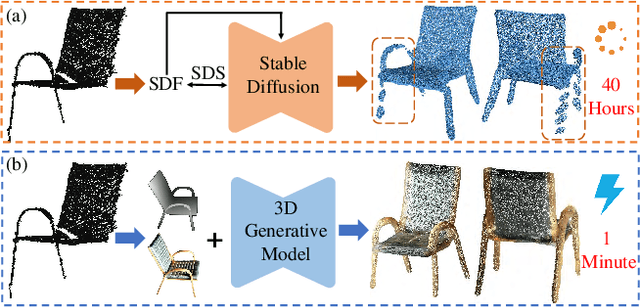

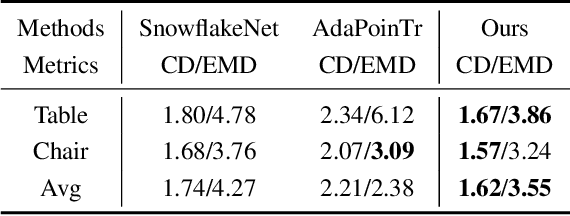
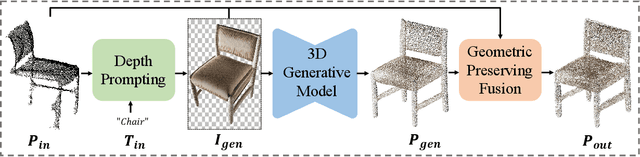
Existing point cloud completion methods, which typically depend on predefined synthetic training datasets, encounter significant challenges when applied to out-of-distribution, real-world scans. To overcome this limitation, we introduce a zero-shot completion framework, termed GenPC, designed to reconstruct high-quality real-world scans by leveraging explicit 3D generative priors. Our key insight is that recent feed-forward 3D generative models, trained on extensive internet-scale data, have demonstrated the ability to perform 3D generation from single-view images in a zero-shot setting. To harness this for completion, we first develop a Depth Prompting module that links partial point clouds with image-to-3D generative models by leveraging depth images as a stepping stone. To retain the original partial structure in the final results, we design the Geometric Preserving Fusion module that aligns the generated shape with input by adaptively adjusting its pose and scale. Extensive experiments on widely used benchmarks validate the superiority and generalizability of our approach, bringing us a step closer to robust real-world scan completion.