 Add to Chrome
 Add to Firefox
 Add to Edge
Tiny Aya: Bridging Scale and Multilingual Depth
Mar 12, 2026
Tiny Aya redefines what a small multilingual language model can achieve. Trained on 70 languages and refined through region-aware posttraining, it delivers state-of-the-art in translation quality, strong multilingual understanding, and high-quality target-language generation, all with just 3.35B parameters. The release includes a pretrained foundation model, a globally balanced instruction-tuned variant, and three region-specialized models targeting languages from Africa, South Asia, Europe, Asia-Pacific, and West Asia. This report details the training strategy, data composition, and comprehensive evaluation framework behind Tiny Aya, and presents an alternative scaling path for multilingual AI: one centered on efficiency, balanced performance across languages, and practical deployment.

When Life Gives You Samples: The Benefits of Scaling up Inference Compute for Multilingual LLMs
Jun 25, 2025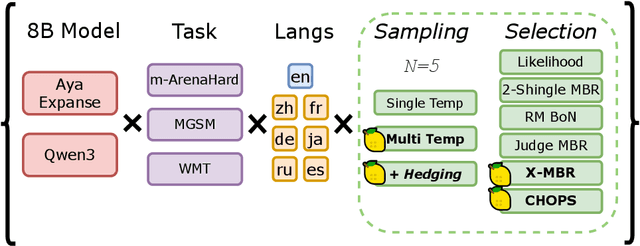

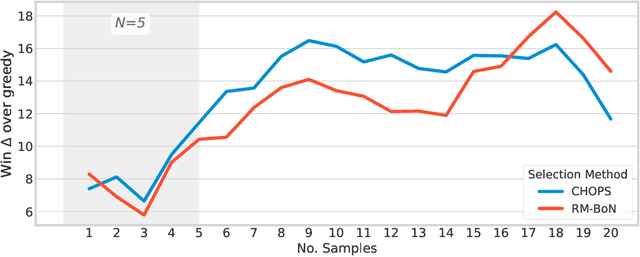
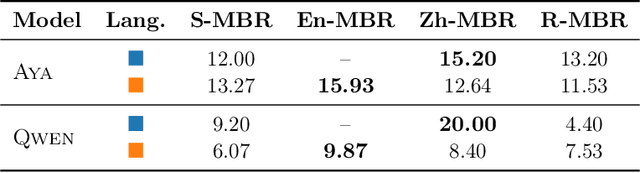
Recent advancements in large language models (LLMs) have shifted focus toward scaling inference-time compute, improving performance without retraining the model. A common approach is to sample multiple outputs in parallel, and select one of these as the final output. However, work to date has focused on English and a handful of domains such as math and code. In contrast, we are most interested in techniques that generalize across open-ended tasks, formally verifiable tasks, and across languages. In this work, we study how to robustly scale inference-time compute for open-ended generative tasks in a multilingual, multi-task setting. Our findings show that both sampling strategy based on temperature variation and selection strategy must be adapted to account for diverse domains and varied language settings. We evaluate existing selection methods, revealing that strategies effective in English often fail to generalize across languages. We propose novel sampling and selection strategies specifically adapted for multilingual and multi-task inference scenarios, and show they yield notable gains across languages and tasks. In particular, our combined sampling and selection methods lead to an average +6.8 jump in win-rates for our 8B models on m-ArenaHard-v2.0 prompts, against proprietary models such as Gemini. At larger scale, Command-A (111B model) equipped with our methods, shows +9.0 improvement in win-rates on the same benchmark with just five samples against single-sample decoding, a substantial increase at minimal cost. Our results underscore the need for language- and task-aware approaches to inference-time compute, aiming to democratize performance improvements in underrepresented languages.