 Add to Chrome
 Add to Firefox
 Add to Edge
Momentum Based Reward Design for Low Emission Traffic Signal Control
May 28, 2026
Urban traffic congestion is a growing global issue contributing significantly to long commute times and environmental pollution. Traditional traffic signal control systems often fail to adapt to dynamic traffic conditions. Adaptive traffic signal control can improve urban traffic without changing road infrastructure. Deep Reinforcement Learning (DRL) has shown strong performance for this task, but existing delay and queue-based rewards often produce short-sighted or unstable policies. This paper proposes a Momentum-Based Reward Function (MBRF) that encourages vehicles to keep moving rather than penalizing congestion alone. The method is evaluated in SUMO (Simulation of Urban MObility) using standard traffic metrics such as waiting time, queue length, throughput, and CO2 emissions. Results show that the proposed reward produces better throughput-emission trade-offs and more stable learning behavior than delay or queue-based rewards, as well as classical controllers such as Max Pressure and LQF.

$π$-MPPI: A Projection-based Model Predictive Path Integral Scheme for Smooth Optimal Control of Fixed-Wing Aerial Vehicles
Apr 16, 2025Model Predictive Path Integral (MPPI) is a popular sampling-based Model Predictive Control (MPC) algorithm for nonlinear systems. It optimizes trajectories by sampling control sequences and averaging them. However, a key issue with MPPI is the non-smoothness of the optimal control sequence, leading to oscillations in systems like fixed-wing aerial vehicles (FWVs). Existing solutions use post-hoc smoothing, which fails to bound control derivatives. This paper introduces a new approach: we add a projection filter $\pi$ to minimally correct control samples, ensuring bounds on control magnitude and higher-order derivatives. The filtered samples are then averaged using MPPI, leading to our $\pi$-MPPI approach. We minimize computational overhead by using a neural accelerated custom optimizer for the projection filter. $\pi$-MPPI offers a simple way to achieve arbitrary smoothness in control sequences. While we focus on FWVs, this projection filter can be integrated into any MPPI pipeline. Applied to FWVs, $\pi$-MPPI is easier to tune than the baseline, resulting in smoother, more robust performance.
Bi-level Trajectory Optimization on Uneven Terrains with Differentiable Wheel-Terrain Interaction Model
Apr 11, 2024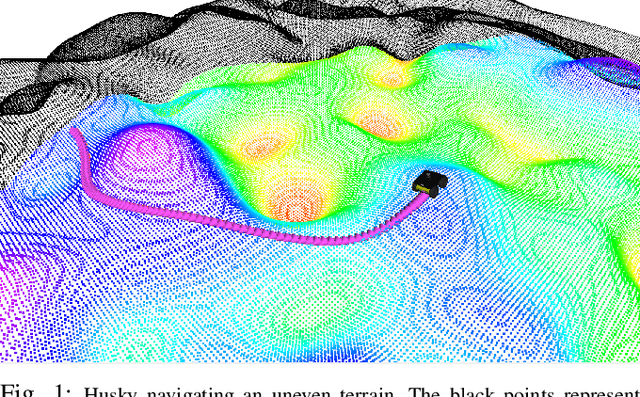
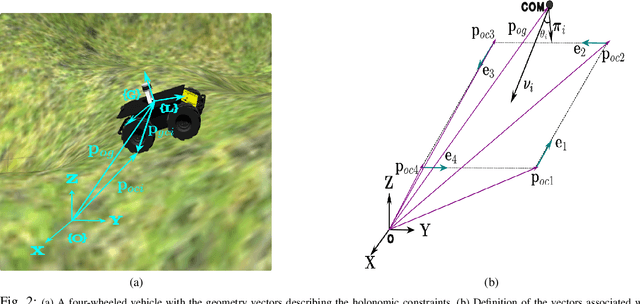
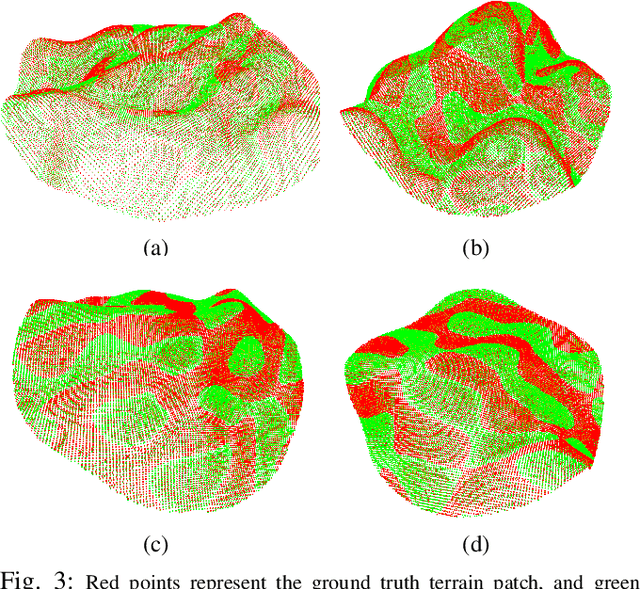
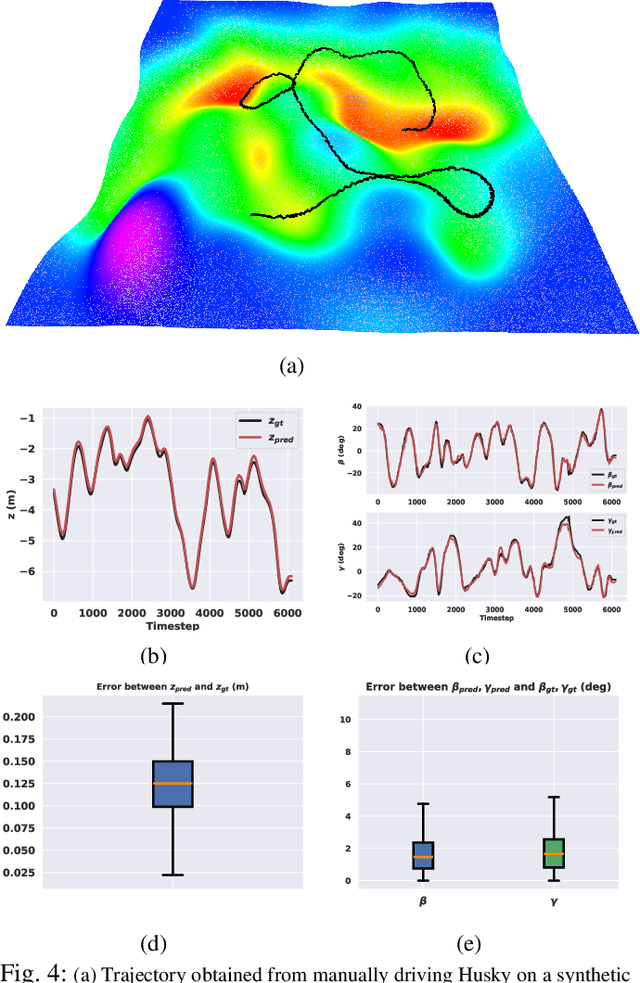
Navigation of wheeled vehicles on uneven terrain necessitates going beyond the 2D approaches for trajectory planning. Specifically, it is essential to incorporate the full 6dof variation of vehicle pose and its associated stability cost in the planning process. To this end, most recent works aim to learn a neural network model to predict the vehicle evolution. However, such approaches are data-intensive and fraught with generalization issues. In this paper, we present a purely model-based approach that just requires the digital elevation information of the terrain. Specifically, we express the wheel-terrain interaction and 6dof pose prediction as a non-linear least squares (NLS) problem. As a result, trajectory planning can be viewed as a bi-level optimization. The inner optimization layer predicts the pose on the terrain along a given trajectory, while the outer layer deforms the trajectory itself to reduce the stability and kinematic costs of the pose. We improve the state-of-the-art in the following respects. First, we show that our NLS based pose prediction closely matches the output from a high-fidelity physics engine. This result coupled with the fact that we can query gradients of the NLS solver, makes our pose predictor, a differentiable wheel-terrain interaction model. We further leverage this differentiability to efficiently solve the proposed bi-level trajectory optimization problem. Finally, we perform extensive experiments, and comparison with a baseline to showcase the effectiveness of our approach in obtaining smooth, stable trajectories.
Multi-AAV Cooperative Path Planning using Nonlinear Model Predictive Control with Localization Constraints
Jan 23, 2022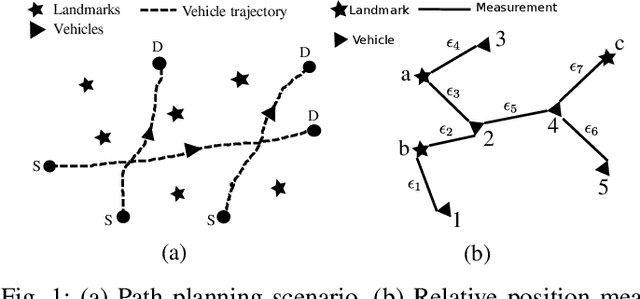
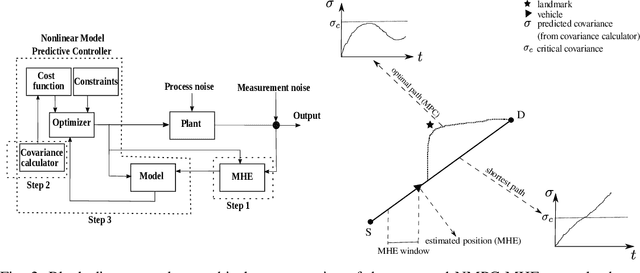
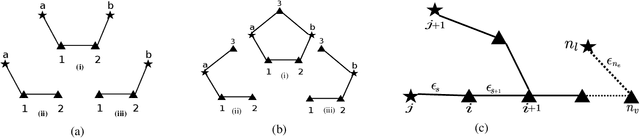
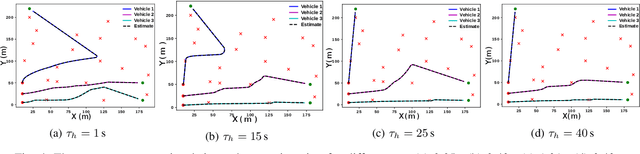
In this paper, we solve a joint cooperative localization and path planning problem for a group of Autonomous Aerial Vehicles (AAVs) in GPS-denied areas using nonlinear model predictive control (NMPC). A moving horizon estimator (MHE) is used to estimate the vehicle states with the help of relative bearing information to known landmarks and other vehicles. The goal of the NMPC is to devise optimal paths for each vehicle between a given source and destination while maintaining desired localization accuracy. Estimating localization covariance in the NMPC is computationally intensive, hence we develop an approximate analytical closed form expression based on the relationship between covariance and path lengths to landmarks. Using this expression while computing NMPC commands reduces the computational complexity significantly. We present numerical simulations to validate the proposed approach for different numbers of vehicles and landmark configurations. We also compare the results with EKF-based estimation to show the superiority of the proposed closed form approach.