 Add to Chrome
 Add to Firefox
 Add to Edge
CalcSeg: Confidence-aware 3D Latent Context Curriculum Learning For Myocardial Scar Segmentation From Single-Stack LGE-CMRs
Aug 20, 2026
Myocardial scar segmentation from single-stack late gadolinium-enhanced cardiac magnetic resonance (LGE-CMR) imaging has been a longstanding and clinically important challenge, particularly in the presence of low tissue contrast, diffuse, and small scar regions. These challenges are further intensified by the limited availability of 3D spatial context. This paper presents CalcSeg, a Confidence-aware latent context curriculum learning framework that leverages fused 3D feature representations from single-stack 2D LGE-CMR images for robust scar segmentation. Specifically, we introduce a dynamic semi-supervised curriculum learning strategy that progressively expands training from easier to more challenging scar cases using a learned confidence-aware scoring function. Such a function integrates errors in the predicted scar maps with quantified epistemic uncertainty and scar burden estimation to automatically assess sample difficulty without requiring manual labels. To compensate for the limited spatial context in single-stack acquisitions, we then develop a latent slice-wise self-attention to capture inter-slice dependencies and infer 3D spatial representations from sparse 2D inputs. We evaluate CalcSeg on multi-center clinical LGE-CMR datasets and benchmark against existing scar segmentation networks. Experimental results show that CalcSeg consistently outperforms all competing methods, particularly with substantial improvements on clinically challenging cases. Our code is released on Github.

MSAIC-Net: A Multi-Scale Attention and Imbalance-Aware Contrastive Network for ECG-Based Myocardial Substrate Abnormality Detection
Jun 04, 2026Myocardial substrate abnormalities, such as myocardial scar and myocardial infarction (MI), are associated with adverse cardiovascular outcomes. Electrocardiography (ECG) provides a low-cost and widely available tool for detecting these abnormalities, but ECG-based detection remains challenging due to heterogeneous lead-dependent manifestations, high-dimensional multi-lead signals, class imbalance, and the limited interpretability of deep learning models. We propose a multi-scale attention-enhanced convolutional network (MSAIC-Net) for ECG-based myocardial substrate abnormality detection. MSAIC-Net employs parallel atrous convolutional branches to extract ECG features across multiple temporal receptive fields. %, enabling the model to capture both local and longer-range temporal patterns. Channel attention is then used to adaptively reweight informative lead-wise and feature-channel representations. To address class imbalance and improve feature separability, we introduce a novel imbalance-aware supervised contrastive learning strategy that encourages samples from the same class to form compact representations while increasing separation between abnormal and normal samples. Lead-wise permutation importance is further incorporated to quantify the contribution of each ECG lead and improve model interpretability. The proposed method was evaluated on two complementary datasets: a low-data institutional cohort from the University of Virginia (UVA) Health System for myocardial scar classification and the large-scale public PTB-XL dataset from PhysioNet for MI identification. Experimental results show that MSAIC-Net outperforms baseline models, with particularly pronounced improvements in the low-data UVA cohort. Overall, the proposed framework provides an effective and interpretable approach for ECG-based detection of myocardial substrate abnormalities.
Curriculum-Guided Myocardial Scar Segmentation for Ischemic and Non-ischemic Cardiomyopathy
Mar 30, 2026Identification and quantification of myocardial scar is important for diagnosis and prognosis of cardiovascular diseases. However, reliable scar segmentation from Late Gadolinium Enhancement Cardiac Magnetic Resonance (LGE-CMR) images remains a challenge due to variations in contrast enhancement across patients, suboptimal imaging conditions such as post contrast washout, and inconsistencies in ground truth annotations on diffuse scars caused by inter observer variability. In this work, we propose a curriculum learning-based framework designed to improve segmentation performance under these challenging conditions. The method introduces a progressive training strategy that guides the model from high-confidence, clearly defined scar regions to low confidence or visually ambiguous samples with limited scar burden. By structuring the learning process in this manner, the network develops robustness to uncertain labels and subtle scar appearances that are often underrepresented in conventional training pipelines. Experimental results show that the proposed approach enhances segmentation accuracy and consistency, particularly for cases with minimal or diffuse scar, outperforming standard training baselines. This strategy provides a principled way to leverage imperfect data for improved myocardial scar quantification in clinical applications. Our code is publicly available on GitHub.
Multitask Learning for Improved Late Mechanical Activation Detection of Heart from Cine DENSE MRI
Nov 11, 2022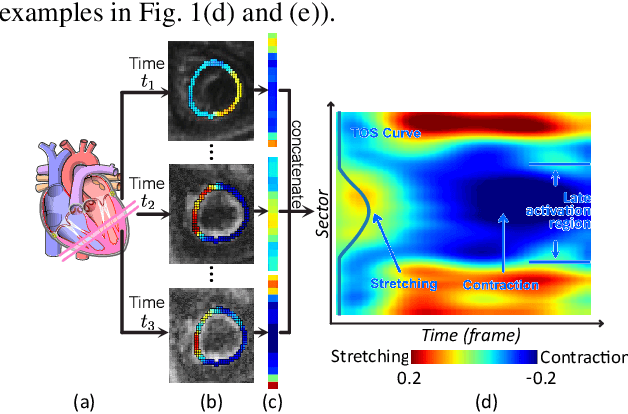

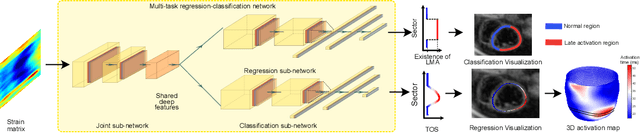
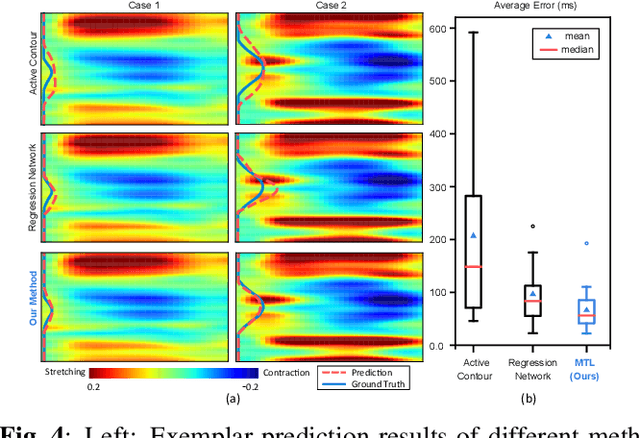
The selection of an optimal pacing site, which is ideally scar-free and late activated, is critical to the response of cardiac resynchronization therapy (CRT). Despite the success of current approaches formulating the detection of such late mechanical activation (LMA) regions as a problem of activation time regression, their accuracy remains unsatisfactory, particularly in cases where myocardial scar exists. To address this issue, this paper introduces a multi-task deep learning framework that simultaneously estimates LMA amount and classify the scar-free LMA regions based on cine displacement encoding with stimulated echoes (DENSE) magnetic resonance imaging (MRI). With a newly introduced auxiliary LMA region classification sub-network, our proposed model shows more robustness to the complex pattern cause by myocardial scar, significantly eliminates their negative effects in LMA detection, and in turn improves the performance of scar classification. To evaluate the effectiveness of our method, we tests our model on real cardiac MR images and compare the predicted LMA with the state-of-the-art approaches. It shows that our approach achieves substantially increased accuracy. In addition, we employ the gradient-weighted class activation mapping (Grad-CAM) to visualize the feature maps learned by all methods. Experimental results suggest that our proposed model better recognizes the LMA region pattern.
Joint Deep Learning for Improved Myocardial Scar Detection from Cardiac MRI
Nov 11, 2022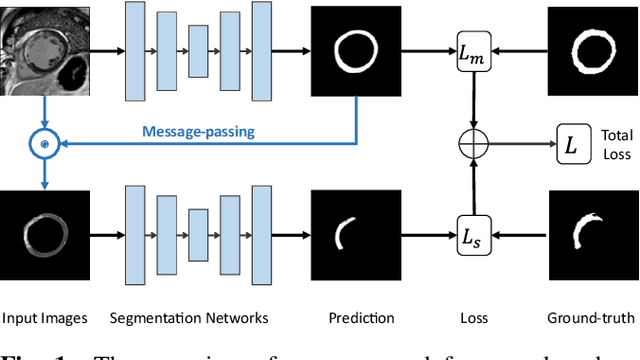
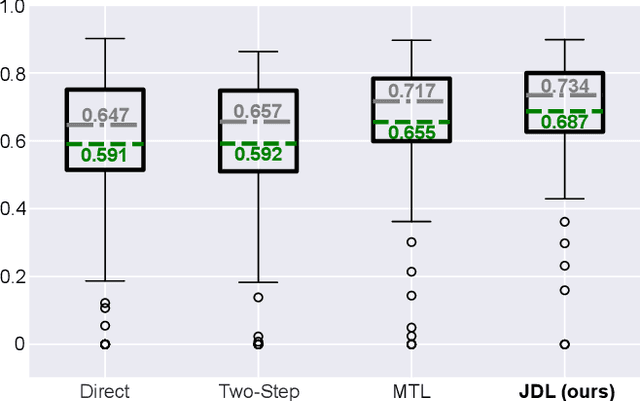

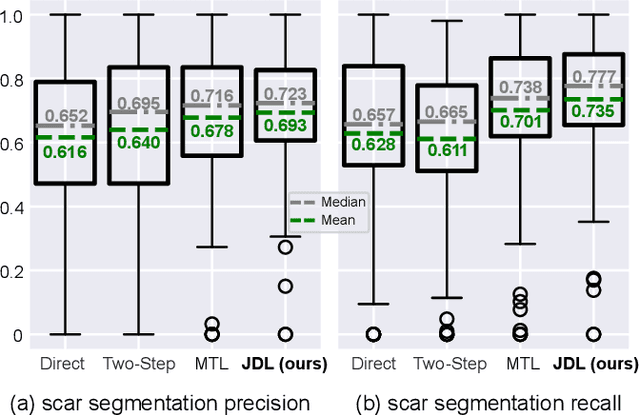
Automated identification of myocardial scar from late gadolinium enhancement cardiac magnetic resonance images (LGE-CMR) is limited by image noise and artifacts such as those related to motion and partial volume effect. This paper presents a novel joint deep learning (JDL) framework that improves such tasks by utilizing simultaneously learned myocardium segmentations to eliminate negative effects from non-region-of-interest areas. In contrast to previous approaches treating scar detection and myocardium segmentation as separate or parallel tasks, our proposed method introduces a message passing module where the information of myocardium segmentation is directly passed to guide scar detectors. This newly designed network will efficiently exploit joint information from the two related tasks and use all available sources of myocardium segmentation to benefit scar identification. We demonstrate the effectiveness of JDL on LGE-CMR images for automated left ventricular (LV) scar detection, with great potential to improve risk prediction in patients with both ischemic and non-ischemic heart disease and to improve response rates to cardiac resynchronization therapy (CRT) for heart failure patients. Experimental results show that our proposed approach outperforms multiple state-of-the-art methods, including commonly used two-step segmentation-classification networks, and multitask learning schemes where subtasks are indirectly interacted.