 Add to Chrome
 Add to Firefox
 Add to Edge
Who Guards the Guardians? The Challenges of Evaluating Identifiability of Learned Representations
Feb 27, 2026
Identifiability in representation learning is commonly evaluated using standard metrics (e.g., MCC, DCI, R^2) on synthetic benchmarks with known ground-truth factors. These metrics are assumed to reflect recovery up to the equivalence class guaranteed by identifiability theory. We show that this assumption holds only under specific structural conditions: each metric implicitly encodes assumptions about both the data-generating process (DGP) and the encoder. When these assumptions are violated, metrics become misspecified and can produce systematic false positives and false negatives. Such failures occur both within classical identifiability regimes and in post-hoc settings where identifiability is most needed. We introduce a taxonomy separating DGP assumptions from encoder geometry, use it to characterise the validity domains of existing metrics, and release an evaluation suite for reproducible stress testing and comparison.

Improving Molecular Modeling with Geometric GNNs: an Empirical Study
Jul 11, 2024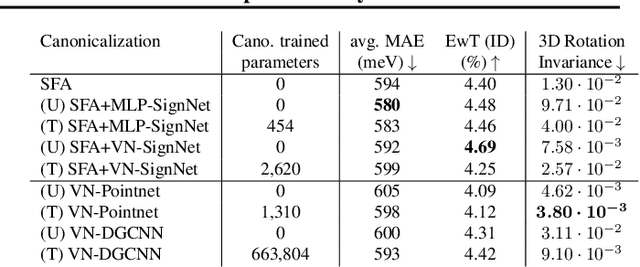
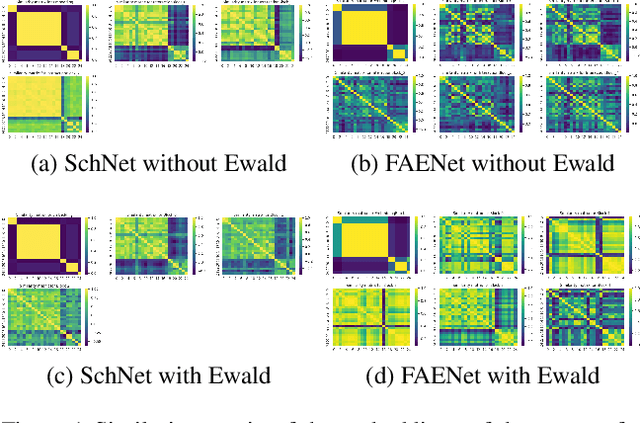
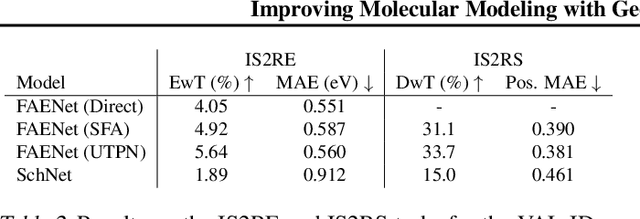
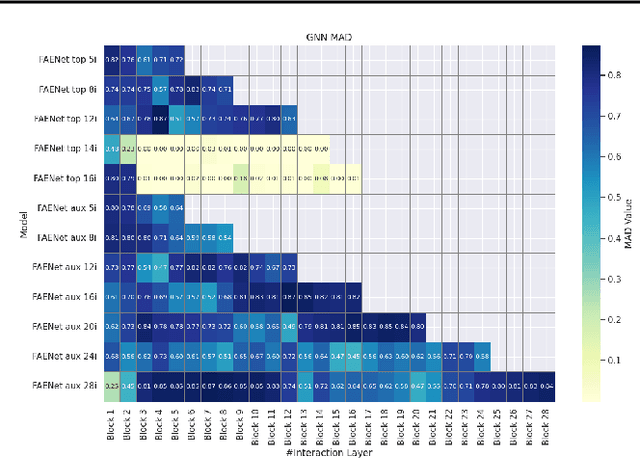
Rapid advancements in machine learning (ML) are transforming materials science by significantly speeding up material property calculations. However, the proliferation of ML approaches has made it challenging for scientists to keep up with the most promising techniques. This paper presents an empirical study on Geometric Graph Neural Networks for 3D atomic systems, focusing on the impact of different (1) canonicalization methods, (2) graph creation strategies, and (3) auxiliary tasks, on performance, scalability and symmetry enforcement. Our findings and insights aim to guide researchers in selecting optimal modeling components for molecular modeling tasks.