 Add to Chrome
 Add to Firefox
 Add to Edge
Automated Borehole Core Analysis with Report-Derived Weak Labels and Supervised Crack Segmentation
Aug 12, 2026
Borehole archives commonly contain core tray photographs and corresponding digital log reports, but no native pixel-level crack annotations. We investigate two complementary approaches for extracting defect-spacing information from these archives. First, structured spacing categories recovered from the report text layer provide weak interval-level labels for classification. A DINO encoder trained on unlabeled core crops supplies domain-specific representations, and a manually verified subset is used to identify label inconsistencies. Second, we manually annotate 5,087 extracted core-row images and evaluate fully supervised crack-segmentation models. Our gated U-Net combines PiDiNet edge maps with Mask R-CNN masks through a learned spatial gating mechanism. This configuration achieves an F1 score of 0.860 and a crack-class IoU of 0.754, the highest result among the evaluated segmentation configurations. Deterministic post-processing converts predicted crack locations into defect-spacing categories. Separate rule-based branches estimate core-relative bedding angles and lithological color descriptors; their predictions agree with log-report references on 75.4% and 84.7% of 1,200 evaluated images, respectively. Because these references are extracted from existing reports, the reported values measure agreement with recorded geological observations rather than independent physical accuracy. The resulting framework combines report-derived weak supervision for spacing classification with fully supervised segmentation for image-based crack localization.

VAmoS Bench: Voice Agent Simulation Bench
Jul 29, 2026Production voice agents span cascaded, speech-to-speech, and hybrid architectures. Voice-agent benchmarks typically measure component quality and conversational properties such as word error rate, latency, naturalness, and turn-taking. Fewer measure whether the agent handled a phone call correctly on its own. Contact centers refer to this as ``containment'': the share of phone calls the automated system resolves without handing off to a human. On some phone calls the right outcome is refusal or a redirect. To address this gap, we introduce VAmoS Bench, the Voice Agent Simulation Bench. It measures complete voice-agent systems end to end in a stateful customer-support task. The agent is Riley, a credit-card support representative for a fictional bank who can freeze, cancel, replace, or activate a card. Each of 100 scenarios supplies a simulated caller with a private goal and a seeded PostgreSQL backend. The platform uses each scenario to populate and activate an isolated simulation in which the caller reaches Riley over audio; roughly one-third apply adversarial pressure. The agent can use five tools that execute real SQL against the backend. Each scenario also defines binary assertions. A grader evaluates them against the complete trace of what the caller and agent said and what the agent did, including tool invocations, arguments, and returned rows. This catches an agent that claims to have changed a card without updating the database, as well as one that makes the right database change while disclosing protected information. This first benchmark version focuses on financial services. Its evaluation protocol supports an evolving leaderboard: additional voice agents can be evaluated on the same version, while later versions can expand the tasks and scenarios.
Robustness for Free: Quality-Diversity Driven Discovery of Agile Soft Robotic Gaits
Nov 02, 2023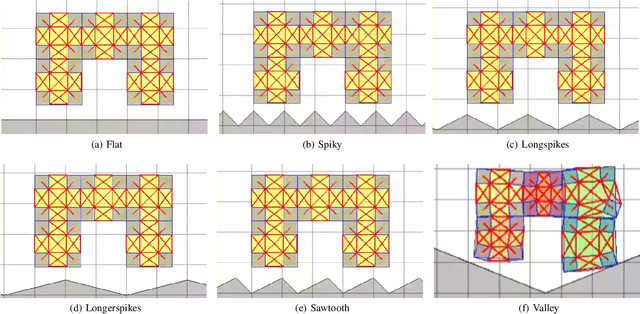
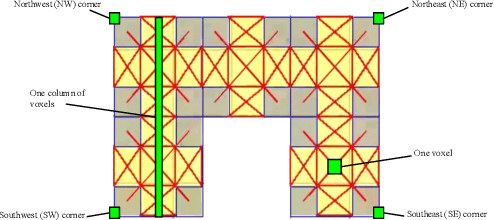
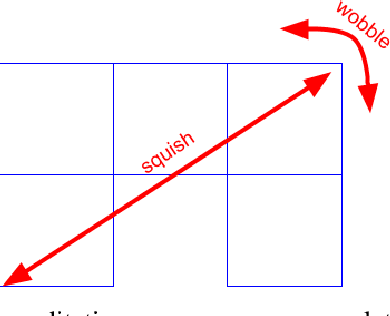
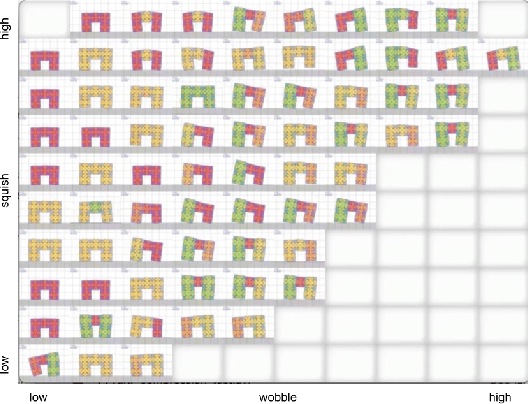
Soft robotics aims to develop robots able to adapt their behavior across a wide range of unstructured and unknown environments. A critical challenge of soft robotic control is that nonlinear dynamics often result in complex behaviors hard to model and predict. Typically behaviors for mobile soft robots are discovered through empirical trial and error and hand-tuning. More recently, optimization algorithms such as Genetic Algorithms (GA) have been used to discover gaits, but these behaviors are often optimized for a single environment or terrain, and can be brittle to unplanned changes to terrain. In this paper we demonstrate how Quality Diversity Algorithms, which search of a range of high-performing behaviors, can produce repertoires of gaits that are robust to changing terrains. This robustness significantly out-performs that of gaits produced by a single objective optimization algorithm.
GaitGraph: Graph Convolutional Network for Skeleton-Based Gait Recognition
Jan 27, 2021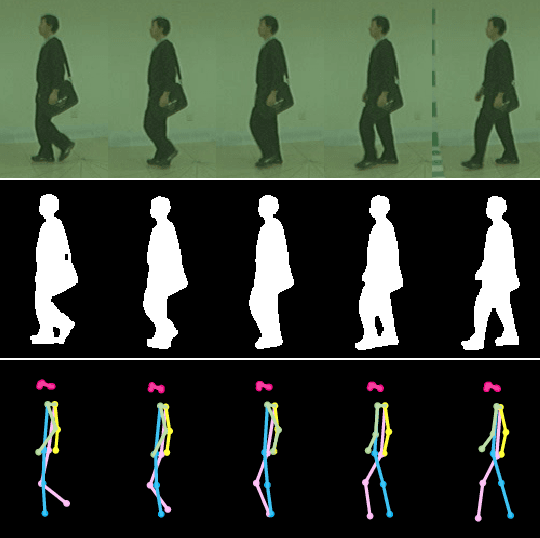
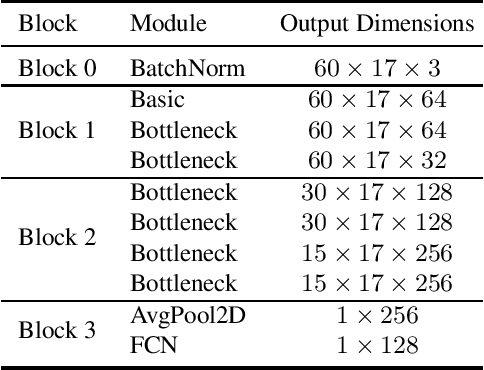
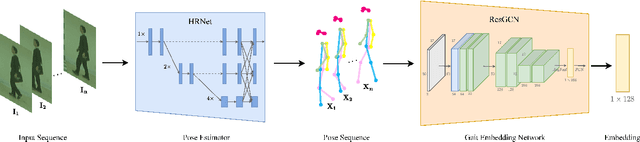
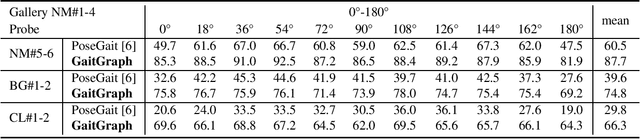
Gait recognition is a promising video-based biometric for identifying individual walking patterns from a long distance. At present, most gait recognition methods use silhouette images to represent a person in each frame. However, silhouette images can lose fine-grained spatial information, and most papers do not regard how to obtain these silhouettes in complex scenes. Furthermore, silhouette images contain not only gait features but also other visual clues that can be recognized. Hence these approaches can not be considered as strict gait recognition. We leverage recent advances in human pose estimation to estimate robust skeleton poses directly from RGB images to bring back model-based gait recognition with a cleaner representation of gait. Thus, we propose GaitGraph that combines skeleton poses with Graph Convolutional Network (GCN) to obtain a modern model-based approach for gait recognition. The main advantages are a cleaner, more elegant extraction of the gait features and the ability to incorporate powerful spatio-temporal modeling using GCN. Experiments on the popular CASIA-B gait dataset show that our method archives state-of-the-art performance in model-based gait recognition. The code and models are publicly available.
Behavioral Repertoires for Soft Tensegrity Robots
Sep 23, 2020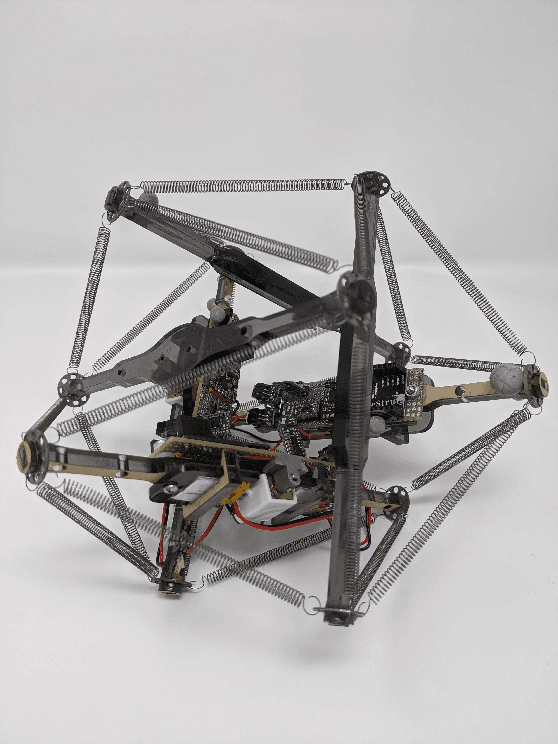
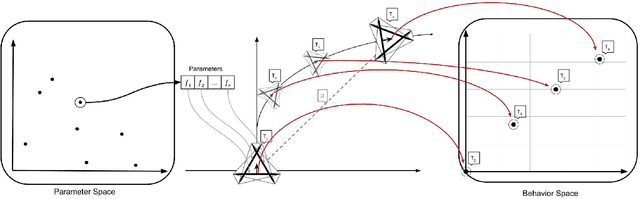
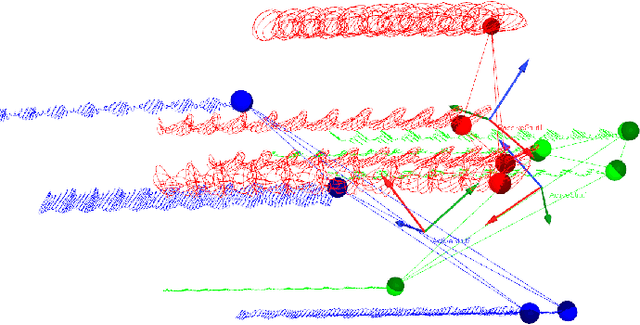
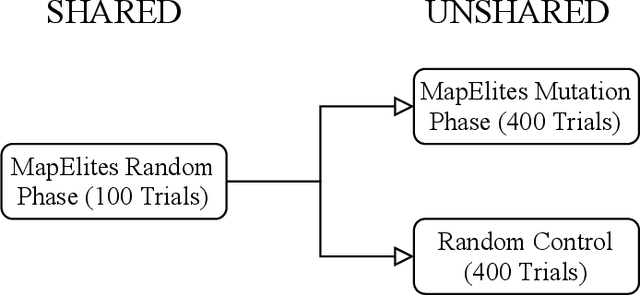
Mobile soft robots offer compelling applications in fields ranging from urban search and rescue to planetary exploration. A critical challenge of soft robotic control is that the nonlinear dynamics imposed by soft materials often result in complex behaviors that are counterintuitive and hard to model or predict. As a consequence, most behaviors for mobile soft robots are discovered through empirical trial and error and hand-tuning. A second challenge is that soft materials are difficult to simulate with high fidelity -- leading to a significant reality gap when trying to discover or optimize new behaviors. In this work we employ a Quality Diversity Algorithm running model-free on a physical soft tensegrity robot that autonomously generates a behavioral repertoire with no a priori knowledge of the robot dynamics, and minimal human intervention. The resulting behavior repertoire displays a diversity of unique locomotive gaits useful for a variety of tasks. These results help provide a road map for increasing the behavioral capabilities of mobile soft robots through real-world automation.