 Add to Chrome
 Add to Firefox
 Add to Edge
VAmoS Bench: Voice Agent Simulation Bench
Jul 29, 2026
Production voice agents span cascaded, speech-to-speech, and hybrid architectures. Voice-agent benchmarks typically measure component quality and conversational properties such as word error rate, latency, naturalness, and turn-taking. Fewer measure whether the agent handled a phone call correctly on its own. Contact centers refer to this as ``containment'': the share of phone calls the automated system resolves without handing off to a human. On some phone calls the right outcome is refusal or a redirect. To address this gap, we introduce VAmoS Bench, the Voice Agent Simulation Bench. It measures complete voice-agent systems end to end in a stateful customer-support task. The agent is Riley, a credit-card support representative for a fictional bank who can freeze, cancel, replace, or activate a card. Each of 100 scenarios supplies a simulated caller with a private goal and a seeded PostgreSQL backend. The platform uses each scenario to populate and activate an isolated simulation in which the caller reaches Riley over audio; roughly one-third apply adversarial pressure. The agent can use five tools that execute real SQL against the backend. Each scenario also defines binary assertions. A grader evaluates them against the complete trace of what the caller and agent said and what the agent did, including tool invocations, arguments, and returned rows. This catches an agent that claims to have changed a card without updating the database, as well as one that makes the right database change while disclosing protected information. This first benchmark version focuses on financial services. Its evaluation protocol supports an evolving leaderboard: additional voice agents can be evaluated on the same version, while later versions can expand the tasks and scenarios.

Towards personalized human AI interaction - adapting the behavior of AI agents using neural signatures of subjective interest
Sep 14, 2017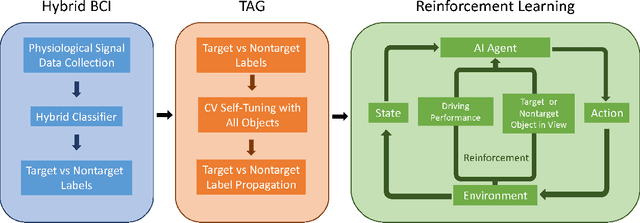

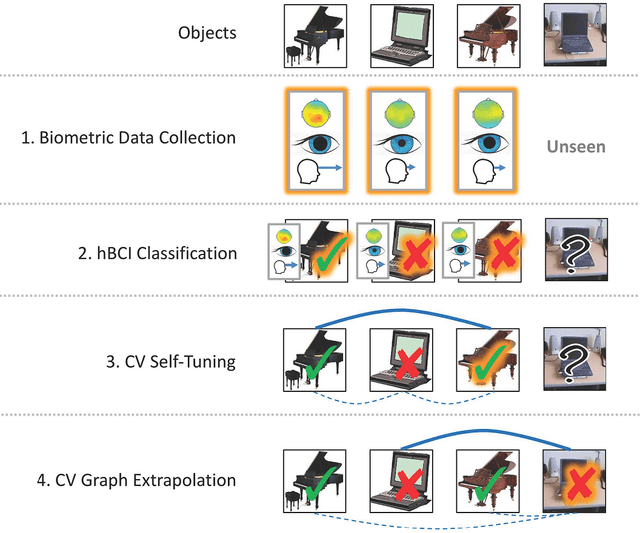
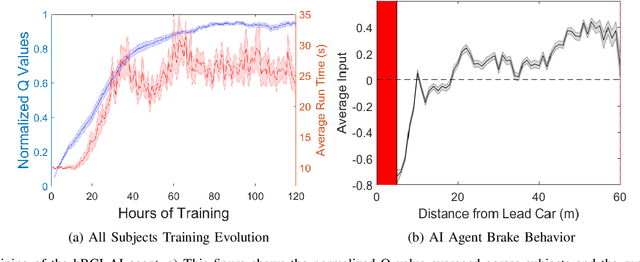
Reinforcement Learning AI commonly uses reward/penalty signals that are objective and explicit in an environment -- e.g. game score, completion time, etc. -- in order to learn the optimal strategy for task performance. However, Human-AI interaction for such AI agents should include additional reinforcement that is implicit and subjective -- e.g. human preferences for certain AI behavior -- in order to adapt the AI behavior to idiosyncratic human preferences. Such adaptations would mirror naturally occurring processes that increase trust and comfort during social interactions. Here, we show how a hybrid brain-computer-interface (hBCI), which detects an individual's level of interest in objects/events in a virtual environment, can be used to adapt the behavior of a Deep Reinforcement Learning AI agent that is controlling a virtual autonomous vehicle. Specifically, we show that the AI learns a driving strategy that maintains a safe distance from a lead vehicle, and most novelly, preferentially slows the vehicle when the human passengers of the vehicle encounter objects of interest. This adaptation affords an additional 20\% viewing time for subjectively interesting objects. This is the first demonstration of how an hBCI can be used to provide implicit reinforcement to an AI agent in a way that incorporates user preferences into the control system.