 Add to Chrome
 Add to Firefox
 Add to Edge
Twin: Playing an Unknown Game with a Test-Time Digital Twin
Aug 14, 2026
We present a Test-time World-model Inference (Twin) system, in which a frontier coding agent writes an executable world model for completing continual learning tasks, such as ARC-AGI-3 games. Traditional approaches hand-engineer such models, one custom design per task. Each game hides its rules and goal, and our system constructs them from simulation and interaction alone. Its inductive prior over grid games is strong enough to recover the true transitions of the game and the goal on nearly all levels. Replay validation happens in a twin world model. The harness enforces that an action is not made until the program reproduces every previous observed game transition. Each mismatch between a world model prediction and the actual action result becomes a counterexample that is used to repair the world model. Twin clears 179 out of 183 levels (97.8%), and does so more efficiently than humans in 158 out of 179 levels (88.3%). The system infers the goal before any reward on 156 of the levels it clears (87.2%), and in the remaining levels automatically discovers the goal by search. The benchmark scores completion and action efficiency, between 0 and 100, against humans playing each game for the first time. Played directly, the base model scores only 7.8%; an off-the-shelf harness increases it to 61.1%, whereas our twin world model increases the same base model to 93.3%, clearing 23 out of 25 games. Building a usable world model is simpler than anticipated, whereas the harder problem is inferring the right goal.

QTOS: An Open-Source Quadruped Trajectory Optimization Stack
Sep 16, 2023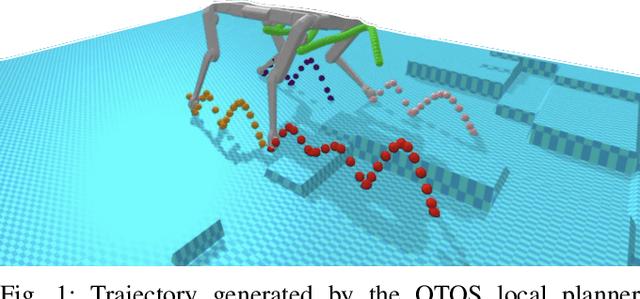
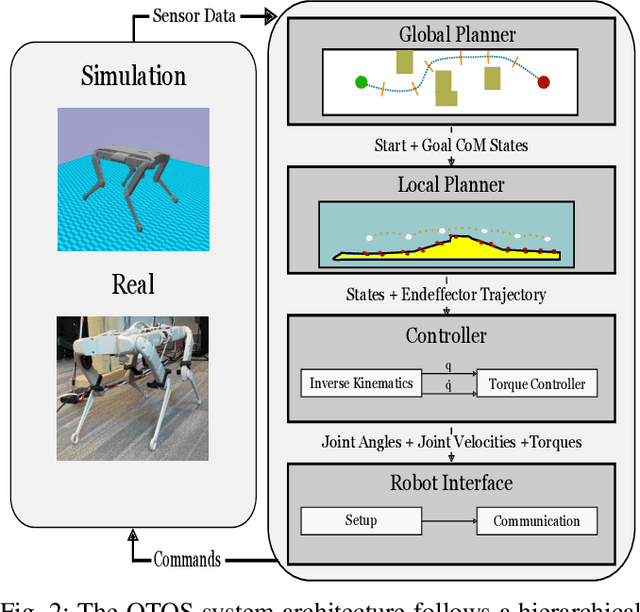
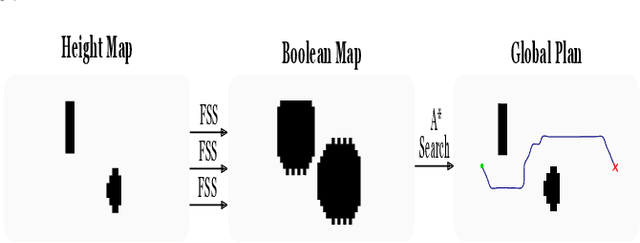
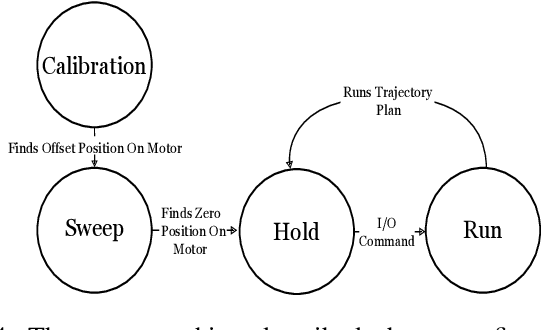
We introduce a new open-source framework, Quadruped Trajectory Optimization Stack (QTOS), which integrates a global planner, local planner, simulator, controller, and robot interface into a single package. QTOS serves as a full-stack interface, simplifying continuous motion planning on an open-source quadruped platform by bridging the gap between middleware and gait planning. It empowers users to effortlessly translate high-level navigation objectives into low-level robot commands. Furthermore, QTOS enhances the stability and adaptability of long-distance gait planning across challenging terrain.
Learning to Walk by Steering: Perceptive Quadrupedal Locomotion in Dynamic Environments
Sep 19, 2022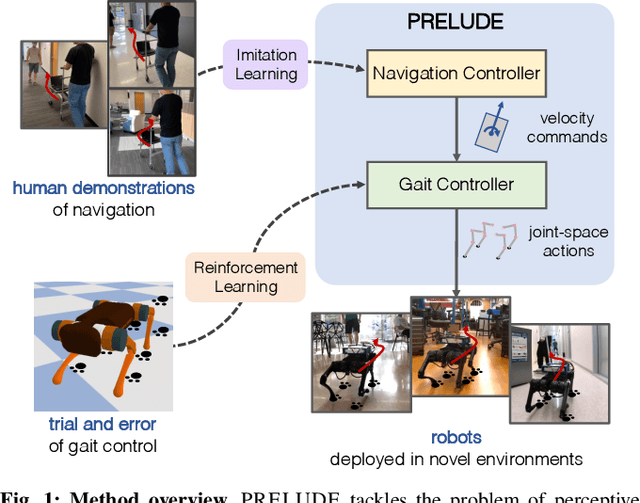

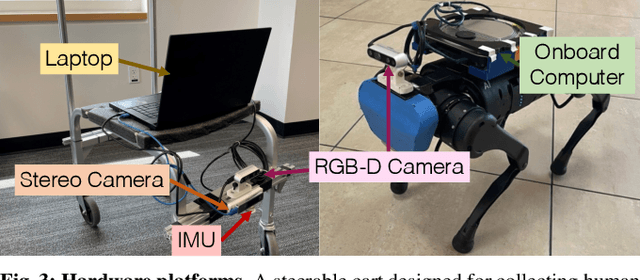
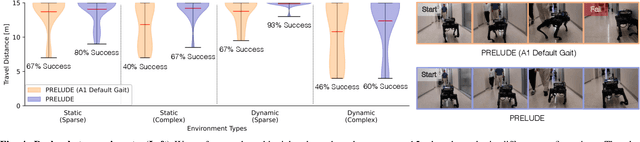
We tackle the problem of perceptive locomotion in dynamic environments. In this problem, a quadrupedal robot must exhibit robust and agile walking behaviors in response to environmental clutter and moving obstacles. We present a hierarchical learning framework, named PRELUDE, which decomposes the problem of perceptive locomotion into high-level decision-making to predict navigation commands and low-level gait generation to realize the target commands. In this framework, we train the high-level navigation controller with imitation learning on human demonstrations collected on a steerable cart and the low-level gait controller with reinforcement learning (RL). Therefore, our method can acquire complex navigation behaviors from human supervision and discover versatile gaits from trial and error. We demonstrate the effectiveness of our approach in simulation and with hardware experiments. Video and code can be found on https://ut-austin-rpl.github.io/PRELUDE.