 Add to Chrome
 Add to Firefox
 Add to Edge
Twin: Playing an Unknown Game with a Test-Time Digital Twin
Aug 14, 2026
We present a Test-time World-model Inference (Twin) system, in which a frontier coding agent writes an executable world model for completing continual learning tasks, such as ARC-AGI-3 games. Traditional approaches hand-engineer such models, one custom design per task. Each game hides its rules and goal, and our system constructs them from simulation and interaction alone. Its inductive prior over grid games is strong enough to recover the true transitions of the game and the goal on nearly all levels. Replay validation happens in a twin world model. The harness enforces that an action is not made until the program reproduces every previous observed game transition. Each mismatch between a world model prediction and the actual action result becomes a counterexample that is used to repair the world model. Twin clears 179 out of 183 levels (97.8%), and does so more efficiently than humans in 158 out of 179 levels (88.3%). The system infers the goal before any reward on 156 of the levels it clears (87.2%), and in the remaining levels automatically discovers the goal by search. The benchmark scores completion and action efficiency, between 0 and 100, against humans playing each game for the first time. Played directly, the base model scores only 7.8%; an off-the-shelf harness increases it to 61.1%, whereas our twin world model increases the same base model to 93.3%, clearing 23 out of 25 games. Building a usable world model is simpler than anticipated, whereas the harder problem is inferring the right goal.

Analyzing the Resource Utilization of Lambda Functions on Mobile Devices: Case Studies on Kotlin and Swift
Feb 07, 2025With billions of smartphones in use globally, the daily time spent on these devices contributes significantly to overall electricity consumption. Given this scale, even minor reductions in smartphone power use could result in substantial energy savings. This study explores the impact of Lambda functions on resource consumption in mobile programming. While Lambda functions are known for enhancing code readability and conciseness, their use does not add to the functional capabilities of a programming language. Our research investigates the implications of using Lambda functions in terms of battery utilization, memory usage, and execution time compared to equivalent code structures without Lambda functions. Our findings reveal that Lambda functions impose a considerable resource overhead on mobile devices without offering additional functionalities.
AI-Driven Review Systems: Evaluating LLMs in Scalable and Bias-Aware Academic Reviews
Aug 19, 2024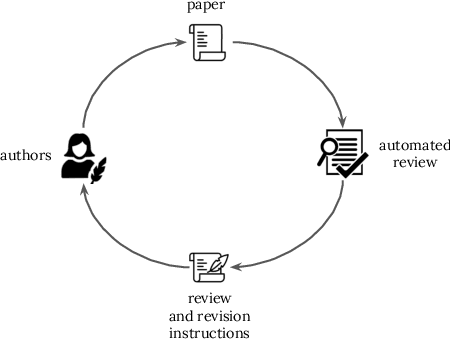
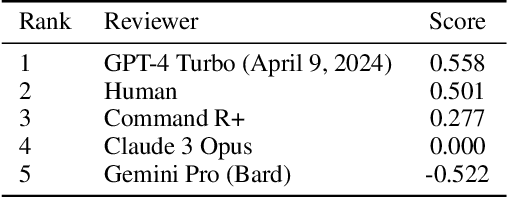
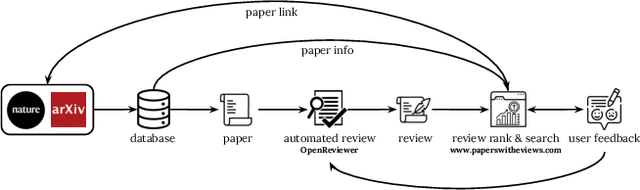
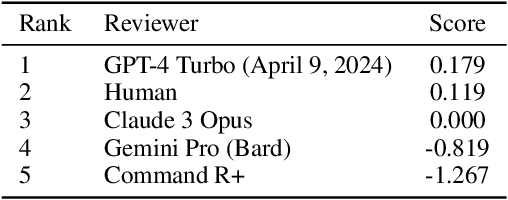
Automatic reviewing helps handle a large volume of papers, provides early feedback and quality control, reduces bias, and allows the analysis of trends. We evaluate the alignment of automatic paper reviews with human reviews using an arena of human preferences by pairwise comparisons. Gathering human preference may be time-consuming; therefore, we also use an LLM to automatically evaluate reviews to increase sample efficiency while reducing bias. In addition to evaluating human and LLM preferences among LLM reviews, we fine-tune an LLM to predict human preferences, predicting which reviews humans will prefer in a head-to-head battle between LLMs. We artificially introduce errors into papers and analyze the LLM's responses to identify limitations, use adaptive review questions, meta prompting, role-playing, integrate visual and textual analysis, use venue-specific reviewing materials, and predict human preferences, improving upon the limitations of the traditional review processes. We make the reviews of publicly available arXiv and open-access Nature journal papers available online, along with a free service which helps authors review and revise their research papers and improve their quality. This work develops proof-of-concept LLM reviewing systems that quickly deliver consistent, high-quality reviews and evaluate their quality. We mitigate the risks of misuse, inflated review scores, overconfident ratings, and skewed score distributions by augmenting the LLM with multiple documents, including the review form, reviewer guide, code of ethics and conduct, area chair guidelines, and previous year statistics, by finding which errors and shortcomings of the paper may be detected by automated reviews, and evaluating pairwise reviewer preferences. This work identifies and addresses the limitations of using LLMs as reviewers and evaluators and enhances the quality of the reviewing process.