 Add to Chrome
 Add to Firefox
 Add to Edge
FRESCO: Benchmarking and Optimizing Re-rankers for Evolving Semantic Conflict in Retrieval-Augmented Generation
Apr 14, 2026
Retrieval-Augmented Generation (RAG) is a key approach to mitigating the temporal staleness of large language models (LLMs) by grounding responses in up-to-date evidence. Within the RAG pipeline, re-rankers play a pivotal role in selecting the most useful documents from retrieved candidates. However, existing benchmarks predominantly evaluate re-rankers in static settings and do not adequately assess performance under evolving information -- a critical gap, as real-world systems often must choose among temporally different pieces of evidence. To address this limitation, we introduce FRESCO (Factual Recency and Evolving Semantic COnflict), a benchmark for evaluating re-rankers in temporally dynamic contexts. By pairing recency-seeking queries with historical Wikipedia revisions, FRESCO tests whether re-rankers can prioritize factually recent evidence while maintaining semantic relevance. Our evaluation reveals a consistent failure mode across existing re-rankers: a strong bias toward older, semantically rich documents, even when they are factually obsolete. We further investigate an instruction optimization framework to mitigate this issue. By identifying Pareto-optimal instructions that balance Evolving and Non-Evolving Knowledge tasks, we obtain gains of up to 27% on Evolving Knowledge tasks while maintaining competitive performance on Non-Evolving Knowledge tasks.

Cycle-Consistent Search: Question Reconstructability as a Proxy Reward for Search Agent Training
Apr 14, 2026Reinforcement Learning (RL) has shown strong potential for optimizing search agents in complex information retrieval tasks. However, existing approaches predominantly rely on gold supervision, such as ground-truth answers, which is difficult to scale. To address this limitation, we propose Cycle-Consistent Search (CCS), a gold-supervision-free framework for training search agents, inspired by cycle-consistency techniques from unsupervised machine translation and image-to-image translation. Our key hypothesis is that an optimal search trajectory, unlike insufficient or irrelevant ones, serves as a lossless encoding of the question's intent. Consequently, a high-quality trajectory should preserve the information required to accurately reconstruct the original question, thereby inducing a reward signal for policy optimization. However, naive cycle-consistency objectives are vulnerable to information leakage, as reconstruction may rely on superficial lexical cues rather than the underlying search process. To reduce this effect, we apply information bottlenecks, including exclusion of the final response and named entity recognition (NER) masking of search queries. These constraints force reconstruction to rely on retrieved observations together with the structural scaffold, ensuring that the resulting reward signal reflects informational adequacy rather than linguistic redundancy. Experiments on question-answering benchmarks show that CCS achieves performance comparable to supervised baselines while outperforming prior methods that do not rely on gold supervision. These results suggest that CCS provides a scalable training paradigm for training search agents in settings where gold supervision is unavailable.
Co-training and Co-distillation for Quality Improvement and Compression of Language Models
Nov 07, 2023
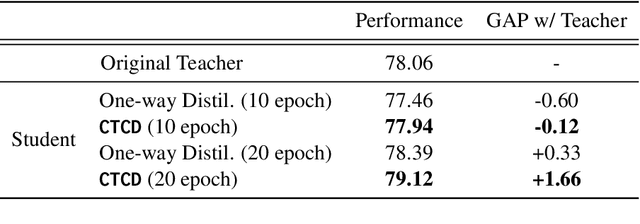
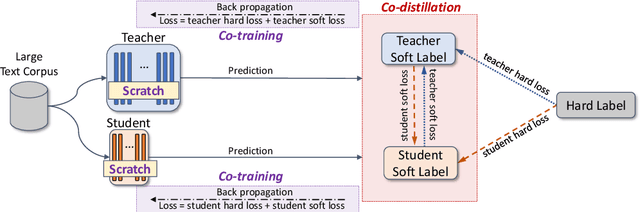

Knowledge Distillation (KD) compresses computationally expensive pre-trained language models (PLMs) by transferring their knowledge to smaller models, allowing their use in resource-constrained or real-time settings. However, most smaller models fail to surpass the performance of the original larger model, resulting in sacrificing performance to improve inference speed. To address this issue, we propose Co-Training and Co-Distillation (CTCD), a novel framework that improves performance and inference speed together by co-training two models while mutually distilling knowledge. The CTCD framework successfully achieves this based on two significant findings: 1) Distilling knowledge from the smaller model to the larger model during co-training improves the performance of the larger model. 2) The enhanced performance of the larger model further boosts the performance of the smaller model. The CTCD framework shows promise as it can be combined with existing techniques like architecture design or data augmentation, replacing one-way KD methods, to achieve further performance improvement. Extensive ablation studies demonstrate the effectiveness of CTCD, and the small model distilled by CTCD outperforms the original larger model by a significant margin of 1.66 on the GLUE benchmark.
A Study on Knowledge Distillation from Weak Teacher for Scaling Up Pre-trained Language Models
May 26, 2023Distillation from Weak Teacher (DWT) is a method of transferring knowledge from a smaller, weaker teacher model to a larger student model to improve its performance. Previous studies have shown that DWT can be effective in the vision domain and natural language processing (NLP) pre-training stage. Specifically, DWT shows promise in practical scenarios, such as enhancing new generation or larger models using pre-trained yet older or smaller models and lacking a resource budget. However, the optimal conditions for using DWT have yet to be fully investigated in NLP pre-training. Therefore, this study examines three key factors to optimize DWT, distinct from those used in the vision domain or traditional knowledge distillation. These factors are: (i) the impact of teacher model quality on DWT effectiveness, (ii) guidelines for adjusting the weighting value for DWT loss, and (iii) the impact of parameter remapping as a student model initialization technique for DWT.