 Add to Chrome
 Add to Firefox
 Add to Edge
End-to-End Differential Privacy in Training Deep Neural Network Classifiers
Jul 21, 2026
Differentially private machine learning enables model training on sensitive data while ensuring that individual data is unlikely to be recoverable from the parameters of the resulting model. However, existing work often privatizes both training inputs and their labels, and these protections may be conservative when labels are public or can be safely made public. Therefore, in this work we propose a novel private training framework that instead privatizes training inputs while keeping labels public. We consider neural networks with softmax output layers, and thus the mapping from training inputs to the output of the softmax layer is a mapping onto the unit simplex. We randomize softmax outputs during training by applying the Dirichlet mechanism to enforce differential privacy for the training inputs, hence the ``end-to-end'' label. Because training data is reused across multiple training epochs, we use the notion of \Renyi differential privacy to formulate tight bounds on the strength of privacy provided by the Dirichlet mechanism across repeated uses. We show empirically that we attain new state-of-the-art accuracy when training from scratch on CIFAR10, MNIST, MedMNIST, FashionMNIST, and SVHN across all privacy budgets evaluated. Notably, when implementing $(ε, δ)$-differential privacy with $δ=10^{-5}$, we improve the prior state-of-the-art accuracy from $78.37\%$ to $88.17\%$ at $ε=4$ on CIFAR10, and our approach has $82.96\%$ accuracy even for $ε=1$, which significantly outperforms prior work.

Deceptive Sequential Decision-Making via Regularized Policy Optimization
Jan 30, 2025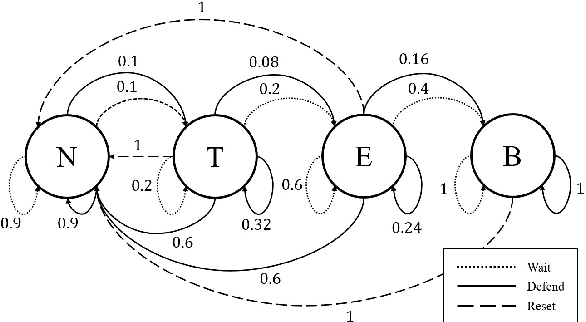
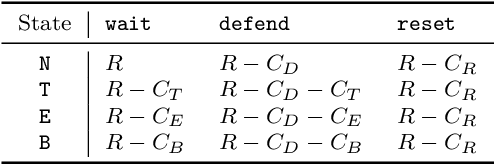
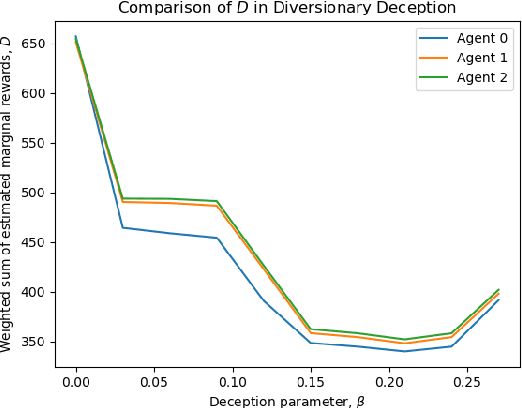
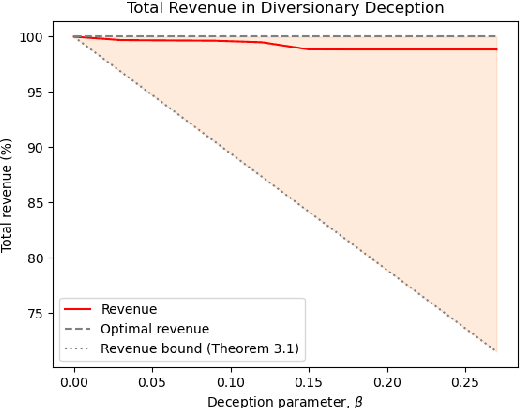
Autonomous systems are increasingly expected to operate in the presence of adversaries, though an adversary may infer sensitive information simply by observing a system, without even needing to interact with it. Therefore, in this work we present a deceptive decision-making framework that not only conceals sensitive information, but in fact actively misleads adversaries about it. We model autonomous systems as Markov decision processes, and we consider adversaries that attempt to infer their reward functions using inverse reinforcement learning. To counter such efforts, we present two regularization strategies for policy synthesis problems that actively deceive an adversary about a system's underlying rewards. The first form of deception is ``diversionary'', and it leads an adversary to draw any false conclusion about what the system's reward function is. The second form of deception is ``targeted'', and it leads an adversary to draw a specific false conclusion about what the system's reward function is. We then show how each form of deception can be implemented in policy optimization problems, and we analytically bound the loss in total accumulated reward that is induced by deception. Next, we evaluate these developments in a multi-agent sequential decision-making problem with one real agent and multiple decoys. We show that diversionary deception can cause the adversary to believe that the most important agent is the least important, while attaining a total accumulated reward that is $98.83\%$ of its optimal, non-deceptive value. Similarly, we show that targeted deception can make any decoy appear to be the most important agent, while still attaining a total accumulated reward that is $99.25\%$ of its optimal, non-deceptive value.