 Add to Chrome
 Add to Firefox
 Add to Edge
Scalable Attention for 5G NR Channel Estimation
Jul 17, 2026
Attention-based neural estimators achieve strong channel-estimation accuracy, but the computational cost of global attention over the time-frequency resource grid grows quadratically with the number of subcarriers, and these estimators are typically tied to a single resource allocation. This paper proposes Channel Estimation Attention (CHEA), a low-complexity channel estimator for 5G New Radio (5G NR) multi-user multiple-input multiple-output (MU-MIMO). CHEA replaces global attention with a multi-resolution windowed design: a high-resolution encoder preserves local pilot detail, a low-resolution encoder captures wider frequency-domain context, and a local cross-attention decoder transfers this coarse context back to the high-resolution pilot tokens. A per-Physical Resource Block (PRB) upsampling module then reconstructs the channel over the full slot. Because every attention operation is confined to a fixed-size window and reconstruction is performed per PRB, the cost of CHEA scales linearly with the number of subcarriers, and a single trained model supports different PRB allocations without retraining. On a standard-compliant Physical Uplink Shared Channel (PUSCH), CHEA achieves the lowest Mean Squared Error (MSE) among conventional and state-of-the-art neural estimators, while requiring 2.8\(\times\) to 22.0\(\times\) lower operations than existing attention-based estimators.

On-board AI-based Channel Estimation for LEO NTNs
Jul 16, 2026Artificial Intelligence(AI) methods have shown strong channel estimation performance in terrestrial networks, but they typically rely on substantial computational resources. As 6G moves toward a unified architecture that will include Non-Terrestrial Networks (NTN) from day 0, availability of large and power hungry computational resources shall not be taken for granted. At the same time, NTN propagation often exhibits high predictability, limited multipath richness and significant Doppler shifts, representing a specific channel estimation problem. In this work, we propose a lightweight convolution-based channel estimator designed specifically for NTN operation and real-time onboard inference. We evaluate its channel estimation accuracy under stringent NGSO power budgets and quantify the resulting end-to-end impact on link performance. We show the improvement in terms of Mean Squared Error (MSE) achieved by the proposed approach compared with established algorithms, demonstrating that efficient AI models can deliver robust performance even on power-constrained spaceborne nodes. In addition, the proposed design by exploiting the domain knowledge, improves parameter efficiency by $27\%$ compared with state-of-the-art AI models and requires approximately $29\times$ fewer floating-point operations than conventional methods while achieving superior MSE performance.
DRIFT: Joint Channel Estimation and Prediction Towards Pilotless 6G Non-Terrestrial Networks
May 29, 2026Non-terrestrial networks (NTNs) are expected to play a pivotal role in sixth-generation (6G) systems by enabling ubiquitous connectivity and massive communication. In this context, channel prediction emerges as a key technique to improve the spectrum utilization efficiency by limiting the pilot overhead. However, many proposed predictors based on artificial intelligence (AI) are characterized by high inference complexity, posing challenges to onboard implementation. In this paper, we address the challenge of designing accurate yet computationally efficient channel prediction techniques tailored to low Earth orbit (LEO) NTNs, where strict power constraints limit model complexity, to enable spectral efficiency gains. We propose an iterative joint channel estimation and prediction framework in the context of 6G NTNs that significantly reduces pilot overhead by transmitting pilots only in the initial slot and relying on data-driven processing for subsequent slots. We introduce Data-driven Refinement and Iterative Forecast for wireless channel Tracking (DRIFT), a lightweight architecture that refines data-aided channel estimates and predicts future channel frequency responses with low computational cost and reduced error propagation. Two predictor variants based on convolutional and long short-term memory layers are investigated. Simulation results in an end-to-end simulation of an uplink LEO NTN scenario show that the proposed approach achieves up to 12% spectral efficiency gain compared to conventional pilot-based systems, with robustness to training-test mismatches and consistent performance across different channel models. Moreover, DRIFT requires fewer than 200k multiply-accumulate operations, making it suitable for on-board satellite implementation under stringent power constraints.
Toward Multi-Satellite Cooperative Transmission: A Joint Framework for CSI Acquisition, Feedback, and Phase Synchronization
Mar 30, 2026The stringent link budget, caused by long propagation distances and payload constraints, poses a fundamental bottleneck for single-satellite transmission. Although LEO mega-constellations make multi-satellite cooperative transmission (MSCT), such as distributed precoding (DP), increasingly feasible, its cooperative gains critically rely on stringent time-frequency-phase synchronization (TFP-Sync), which is difficult to maintain under rapid channel variation and feedback latency. To address this issue, this paper proposes a joint CSI acquisition, feedback, and phase-level synchronization (JCAFPS) framework for MSCT. Specifically, to enable reliable, overhead-efficient CSI acquisition, we design a beam-domain adjustable phase-shift tracking reference signal (TRS) transmission scheme, along with criteria for the TRS and CSI-feedback periods. Then, exploiting deterministic orbital motion and dominant LoS propagation, we establish a polynomial model for the temporal evolution of delay and Doppler shift, and derive an OFDM-based multi-satellite signal model under non-ideal synchronization. The analysis reveals that, unlike the single-satellite case, the composite multi-satellite channel exhibits nonlinear time-frequency-varying phase behavior, necessitating symbol- and subcarrier-wise phase precompensation for coherent transmission. Based on these results, we develop a practical closed-loop realization integrating single-TRS-based channel parameter estimation, multi-TRS-based channel prediction, predictive CSI feedback, and user-specific TFP precompensation. Numerical results demonstrate that the proposed framework achieves accurate CSI acquisition and precise TFP-Sync, enabling DP-based dual-satellite cooperative transmission to approach the theoretical 6 dB power gain over single-satellite transmission, while remaining robust under extended prediction durations and enlarged TRS periods.
Attention-Based SINR Estimation in User-Centric Non-Terrestrial Networks
Feb 24, 2026The signal-to-interference-plus-noise ratio (SINR) is central to performance optimization in user-centric beamforming for satellite-based non-terrestrial networks (NTNs). Its assessment either requires the transmission of dedicated pilots or relies on computing the beamforming matrix through minimum mean squared error (MMSE)-based formulations beforehand, a process that introduces significant computational overhead. In this paper, we propose a low-complexity SINR estimation framework that leverages multi-head self-attention (MHSA) to extract inter-user interference features directly from either channel state information or user location reports. The proposed dual MHSA (DMHSA) models evaluate the SINR of a scheduled user group without requiring explicit MMSE calculations. The architecture achieves a computational complexity reduction by a factor of three in the CSI-based setting and by two orders of magnitude in the location-based configuration, the latter benefiting from the lower dimensionality of user reports. We show that both DMHSA models maintain high estimation accuracy, with the root mean squared error typically below 1 dB with priority-queuing-based scheduled users. These results enable the integration of DMHSA-based estimators into scheduling procedures, allowing the evaluation of multiple candidate user groups and the selection of those offering the highest average SINR and capacity.
Fast End-to-End Simulation and Exploration of Many-RISCV-Core Baseband Transceivers for Software-Defined Radio-Access Networks
Aug 08, 2025The fast-rising demand for wireless bandwidth requires rapid evolution of high-performance baseband processing infrastructure. Programmable many-core processors for software-defined radio (SDR) have emerged as high-performance baseband processing engines, offering the flexibility required to capture evolving wireless standards and technologies. This trend must be supported by a design framework enabling functional validation and end-to-end performance analysis of SDR hardware within realistic radio environment models. We propose a static binary translation based simulator augmented with a fast, approximate timing model of the hardware and coupled to wireless channel models to simulate the most performance-critical physical layer functions implemented in software on a many (1024) RISC-V cores cluster customized for SDR. Our framework simulates the detection of a 5G OFDM-symbol on a server-class processor in 9.5s-3min, on a single thread, depending on the input MIMO size (three orders of magnitude faster than RTL simulation). The simulation is easily parallelized to 128 threads with 73-121x speedup compared to a single thread.
A 66-Gb/s/5.5-W RISC-V Many-Core Cluster for 5G+ Software-Defined Radio Uplinks
Aug 08, 2025Following the scale-up of new radio (NR) complexity in 5G and beyond, the physical layer's computing load on base stations is increasing under a strictly constrained latency and power budget; base stations must process > 20-Gb/s uplink wireless data rate on the fly, in < 10 W. At the same time, the programmability and reconfigurability of base station components are the key requirements; it reduces the time and cost of new networks' deployment, it lowers the acceptance threshold for industry players to enter the market, and it ensures return on investments in a fast-paced evolution of standards. In this article, we present the design of a many-core cluster for 5G and beyond base station processing. Our design features 1024, streamlined RISC-V cores with domain-specific FP extensions, and 4-MiB shared memory. It provides the necessary computational capabilities for software-defined processing of the lower physical layer of 5G physical uplink shared channel (PUSCH), satisfying high-end throughput requirements (66 Gb/s for a transition time interval (TTI), 9.4-302 Gb/s depending on the processing stage). The throughput metrics for the implemented functions are ten times higher than in state-of-the-art (SoTA) application-specific instruction processors (ASIPs). The energy efficiency on key NR kernels (2-41 Gb/s/W), measured at 800 MHz, 25 {\deg}C, and 0.8 V, on a placed and routed instance in 12-nm CMOS technology, is competitive with SoTA architectures. The PUSCH processing runs end-to-end on a single cluster in 1.7 ms, at <6-W average power consumption, achieving 12 Gb/s/W.
An SCMA Receiver for 6G NTN based on Multi-Task Learning
Jun 05, 2025Future 6G networks are envisioned to enhance the user experience in a multitude of different ways. The unification of existing terrestrial networks with non-terrestrial network (NTN) components will provide users with ubiquitous connectivity. Multi-access edge computing (MEC) will enable low-latency services, with computations performed closer to the end users, and distributed learning paradigms. Advanced multiple access schemes, such as sparse code multiple access (SCMA), can be employed to efficiently move data from edge nodes to spaceborne MEC servers. However, the non-orthogonal nature of SCMA results in interference, limiting the effectiveness of traditional SCMA receivers. Hence, NTN links should be protected with robust channel codes, significantly reducing the uplink throughput. Thus, we investigate the application of artificial intelligence (AI) to SCMA receivers for 6G NTNs. We train an AI model with multi-task learning to optimally separate and receive superimposed SCMA signals. Through link level simulations, we evaluate the block error rate (BLER) and the aggregated theoretical throughput achieved by the AI model as a function of the received energy per bit over noise power spectral density ratio (Eb/N0). We show that the proposed receiver achieves a target 10% BLER with 3.5dB lower Eb/N0 with respect to the benchmark algorithm. We conclude the assessment discussing the complexity-related challenges to the implementation of the AI model on board of a low earth orbit satellite.
Uplink OFDM Channel Prediction with Hybrid CNN-LSTM for 6G Non-Terrestrial Networks
Feb 13, 2025Wireless communications are typically subject to complex channel dynamics, requiring the transmission of pilot sequences to estimate and equalize such effects and correctly receive information bits. This is especially true in 6G non-terrestrial networks (NTNs) in low Earth orbit, where one end of the communication link orbits around the Earth at several kilometers per second, and a multi-carrier waveform, such as orthogonal frequency division multiplexing (OFDM), is employed. To minimize the pilot overhead, we remove pilot symbols every other OFDM slot and propose a channel predictor to obtain the channel frequency response (CFR) matrix in absence of pilots. The algorithm employs an encoder-decoder convolutional neural network and a long short-term memory layer, along with skip connections, to predict the CFR matrix on the upcoming slot based on the current one. We demonstrate the effectiveness of the proposed predictor through numerical simulations in tapped delay line channel models, highlighting the effective throughput improvement. We further assess the generalization capabilities of the model, showing minimal throughput degradation when testing under different Doppler spreads and in both line of sight (LoS) and non-LoS propagation conditions. Finally, we discuss computational-complexity-related aspects of the lightweight hybrid CNN-LSTM architecture.
Faster-Than-Nyquist Equalization with Convolutional Neural Networks
Jan 20, 2025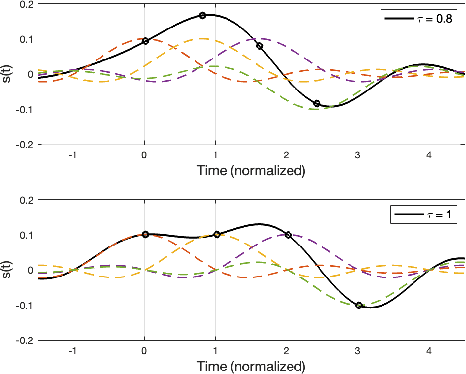
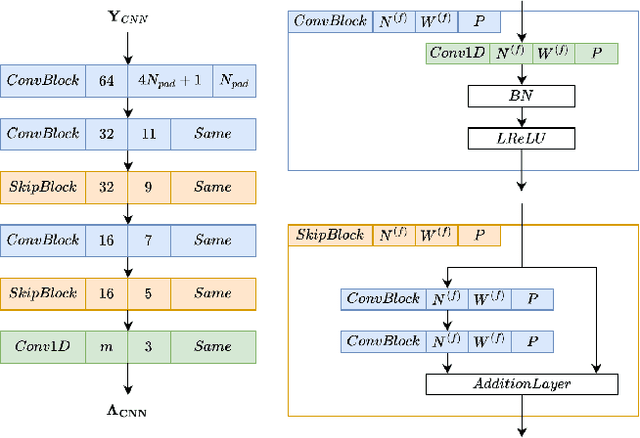
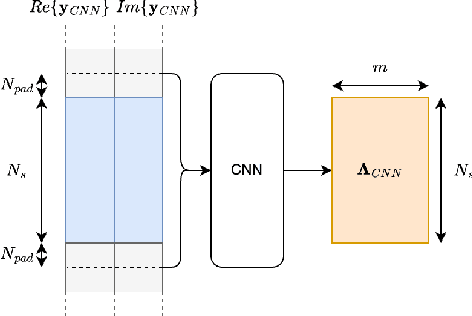
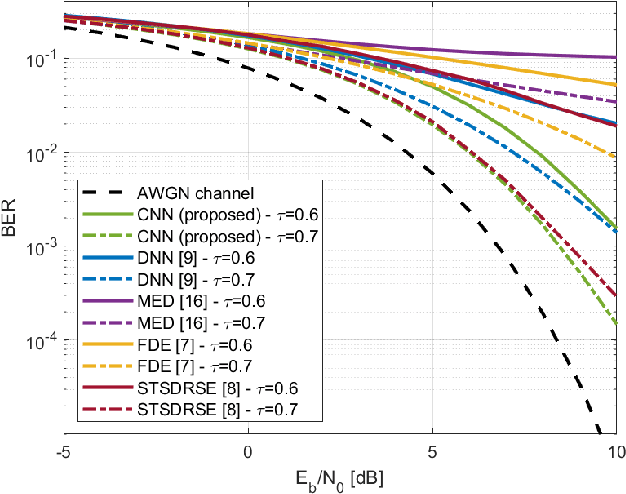
Faster-than-Nyquist (FTN) signaling aims at improving the spectral efficiency of wireless communication systems by exceeding the boundaries set by the Nyquist-Shannon sampling theorem. 50 years after its first introduction in the scientific literature, wireless communications have significantly changed, but spectral efficiency remains one of the key challenges. To adopt FTN signaling, inter-symbol interference (ISI) patterns need to be equalized at the receiver. Motivated by the pattern recognition capabilities of convolutional neural networks with skip connections, we propose such deep learning architecture for ISI equalization and symbol demodulation in FTN receivers. We investigate the performance of the proposed model considering quadrature phase shift keying modulation and low density parity check coding, and compare it to a set of benchmarks, including frequency-domain equalization, a quadratic-programming-based receiver, and an equalization scheme based on a deep neural network. We show that our receiver outperforms any benchmark, achieving error rates comparable to those in additive white Gaussian noise channel, and higher effective throughput, thanks to the increased spectral efficiency of FTN signaling. With a compression factor of 60% and code rate 3/4, the proposed model achieves a peak effective throughput of 2.5 Mbps at just 10dB of energy per bit over noise power spectral density ratio, with other receivers being limited by error floors due to the strong inter-symbol interference. To promote reproducibility in deep learning for wireless communications, our code is open source at the repository provided in the references.