 Add to Chrome
 Add to Firefox
 Add to Edge
On-board AI-based Channel Estimation for LEO NTNs
Jul 16, 2026
Artificial Intelligence(AI) methods have shown strong channel estimation performance in terrestrial networks, but they typically rely on substantial computational resources. As 6G moves toward a unified architecture that will include Non-Terrestrial Networks (NTN) from day 0, availability of large and power hungry computational resources shall not be taken for granted. At the same time, NTN propagation often exhibits high predictability, limited multipath richness and significant Doppler shifts, representing a specific channel estimation problem. In this work, we propose a lightweight convolution-based channel estimator designed specifically for NTN operation and real-time onboard inference. We evaluate its channel estimation accuracy under stringent NGSO power budgets and quantify the resulting end-to-end impact on link performance. We show the improvement in terms of Mean Squared Error (MSE) achieved by the proposed approach compared with established algorithms, demonstrating that efficient AI models can deliver robust performance even on power-constrained spaceborne nodes. In addition, the proposed design by exploiting the domain knowledge, improves parameter efficiency by $27\%$ compared with state-of-the-art AI models and requires approximately $29\times$ fewer floating-point operations than conventional methods while achieving superior MSE performance.

DRIFT: Joint Channel Estimation and Prediction Towards Pilotless 6G Non-Terrestrial Networks
May 29, 2026Non-terrestrial networks (NTNs) are expected to play a pivotal role in sixth-generation (6G) systems by enabling ubiquitous connectivity and massive communication. In this context, channel prediction emerges as a key technique to improve the spectrum utilization efficiency by limiting the pilot overhead. However, many proposed predictors based on artificial intelligence (AI) are characterized by high inference complexity, posing challenges to onboard implementation. In this paper, we address the challenge of designing accurate yet computationally efficient channel prediction techniques tailored to low Earth orbit (LEO) NTNs, where strict power constraints limit model complexity, to enable spectral efficiency gains. We propose an iterative joint channel estimation and prediction framework in the context of 6G NTNs that significantly reduces pilot overhead by transmitting pilots only in the initial slot and relying on data-driven processing for subsequent slots. We introduce Data-driven Refinement and Iterative Forecast for wireless channel Tracking (DRIFT), a lightweight architecture that refines data-aided channel estimates and predicts future channel frequency responses with low computational cost and reduced error propagation. Two predictor variants based on convolutional and long short-term memory layers are investigated. Simulation results in an end-to-end simulation of an uplink LEO NTN scenario show that the proposed approach achieves up to 12% spectral efficiency gain compared to conventional pilot-based systems, with robustness to training-test mismatches and consistent performance across different channel models. Moreover, DRIFT requires fewer than 200k multiply-accumulate operations, making it suitable for on-board satellite implementation under stringent power constraints.
Fast 5G Signal Acquisition by Using Non-Uniform Sampling
May 18, 2026This paper proposes a framework for fast signal acquisition based on deterministic non-uniform sampling, with emphasis on multi-coset architectures and receivers driven by known synchronization sequences, pilots, or preambles. Unlike conventional sampling theory, which is formulated from a waveform-reconstruction perspective, the proposed approach is derived from the observation that acquisition is fundamentally a parametric inference problem in delay-Doppler space. Accordingly, the objective is not to reconstruct the full Nyquist-rate signal, but to preserve the statistics required for detection and estimation. The paper formulates compressed-domain acquisition through a generalized likelihood ratio test and shows how multi-coset sampling leads to reduced correlator structures operating directly on the retained samples. An offline exhaustive design procedure is introduced to select the coset pattern for a given sampling ratio by minimizing a cost that jointly enforces peak isolation in the acquisition surface and uniform retained-energy coverage over the delay search interval. The framework is evaluated on 5G NR synchronization using the PSS/SSS signals under a worst-case Doppler scenario. Results show that substantial reductions in mean acquisition time can be achieved relative to uniform sampling, with measured gains ranging from 2.8x to 34.2x, depending on the selected compression ratio. The corresponding delay and Doppler root-mean-square errors quantify the estimation penalty introduced by aggressive sample reduction. These results demonstrate a clear complexity-performance trade-off and confirm the potential of multi-coset sampling for fast synchronization-oriented receivers.
Toward Multi-Satellite Cooperative Transmission: A Joint Framework for CSI Acquisition, Feedback, and Phase Synchronization
Mar 30, 2026The stringent link budget, caused by long propagation distances and payload constraints, poses a fundamental bottleneck for single-satellite transmission. Although LEO mega-constellations make multi-satellite cooperative transmission (MSCT), such as distributed precoding (DP), increasingly feasible, its cooperative gains critically rely on stringent time-frequency-phase synchronization (TFP-Sync), which is difficult to maintain under rapid channel variation and feedback latency. To address this issue, this paper proposes a joint CSI acquisition, feedback, and phase-level synchronization (JCAFPS) framework for MSCT. Specifically, to enable reliable, overhead-efficient CSI acquisition, we design a beam-domain adjustable phase-shift tracking reference signal (TRS) transmission scheme, along with criteria for the TRS and CSI-feedback periods. Then, exploiting deterministic orbital motion and dominant LoS propagation, we establish a polynomial model for the temporal evolution of delay and Doppler shift, and derive an OFDM-based multi-satellite signal model under non-ideal synchronization. The analysis reveals that, unlike the single-satellite case, the composite multi-satellite channel exhibits nonlinear time-frequency-varying phase behavior, necessitating symbol- and subcarrier-wise phase precompensation for coherent transmission. Based on these results, we develop a practical closed-loop realization integrating single-TRS-based channel parameter estimation, multi-TRS-based channel prediction, predictive CSI feedback, and user-specific TFP precompensation. Numerical results demonstrate that the proposed framework achieves accurate CSI acquisition and precise TFP-Sync, enabling DP-based dual-satellite cooperative transmission to approach the theoretical 6 dB power gain over single-satellite transmission, while remaining robust under extended prediction durations and enlarged TRS periods.
A Ray-Based Characterization of Satellite-to-Urban Propagation
Mar 26, 2026The evolution toward 6G communication systems is expected to rely on integrated three-dimensional network architectures where terrestrial infrastructures coexist with non-terrestrial stations such as satellites, enabling ubiquitous connectivity and service continuity. In this context, accurate channel models for satellite-to-ground propagation in urban environments are essential, particularly for user equipment located at street level where obstruction and multipath effects are significant. This work investigates satellite-to-urban propagation through deterministic ray-tracing simulations. Three representative urban layouts are considered, namely dense urban, urban, and suburban. Multiple use cases are investigated, including handheld devices, vehicular terminals, and fixed rooftop receivers operating across several frequency bands. The analysis focuses on the relative importance of competing propagation mechanisms and on two key channel parameters, namely the Rician K-factor and the delay spread, which are relevant for the calibration of channel models to be used in link- and system-level simulations. Results highlight the strong - and in some cases unconventional - dependence of channel dispersion and fading characteristics on satellite elevation, antenna placement, and urban morphology.
An SCMA Receiver for 6G NTN based on Multi-Task Learning
Jun 05, 2025Future 6G networks are envisioned to enhance the user experience in a multitude of different ways. The unification of existing terrestrial networks with non-terrestrial network (NTN) components will provide users with ubiquitous connectivity. Multi-access edge computing (MEC) will enable low-latency services, with computations performed closer to the end users, and distributed learning paradigms. Advanced multiple access schemes, such as sparse code multiple access (SCMA), can be employed to efficiently move data from edge nodes to spaceborne MEC servers. However, the non-orthogonal nature of SCMA results in interference, limiting the effectiveness of traditional SCMA receivers. Hence, NTN links should be protected with robust channel codes, significantly reducing the uplink throughput. Thus, we investigate the application of artificial intelligence (AI) to SCMA receivers for 6G NTNs. We train an AI model with multi-task learning to optimally separate and receive superimposed SCMA signals. Through link level simulations, we evaluate the block error rate (BLER) and the aggregated theoretical throughput achieved by the AI model as a function of the received energy per bit over noise power spectral density ratio (Eb/N0). We show that the proposed receiver achieves a target 10% BLER with 3.5dB lower Eb/N0 with respect to the benchmark algorithm. We conclude the assessment discussing the complexity-related challenges to the implementation of the AI model on board of a low earth orbit satellite.
Uplink OFDM Channel Prediction with Hybrid CNN-LSTM for 6G Non-Terrestrial Networks
Feb 13, 2025Wireless communications are typically subject to complex channel dynamics, requiring the transmission of pilot sequences to estimate and equalize such effects and correctly receive information bits. This is especially true in 6G non-terrestrial networks (NTNs) in low Earth orbit, where one end of the communication link orbits around the Earth at several kilometers per second, and a multi-carrier waveform, such as orthogonal frequency division multiplexing (OFDM), is employed. To minimize the pilot overhead, we remove pilot symbols every other OFDM slot and propose a channel predictor to obtain the channel frequency response (CFR) matrix in absence of pilots. The algorithm employs an encoder-decoder convolutional neural network and a long short-term memory layer, along with skip connections, to predict the CFR matrix on the upcoming slot based on the current one. We demonstrate the effectiveness of the proposed predictor through numerical simulations in tapped delay line channel models, highlighting the effective throughput improvement. We further assess the generalization capabilities of the model, showing minimal throughput degradation when testing under different Doppler spreads and in both line of sight (LoS) and non-LoS propagation conditions. Finally, we discuss computational-complexity-related aspects of the lightweight hybrid CNN-LSTM architecture.
Faster-Than-Nyquist Equalization with Convolutional Neural Networks
Jan 20, 2025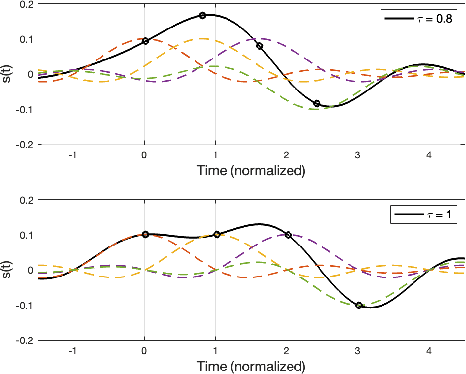
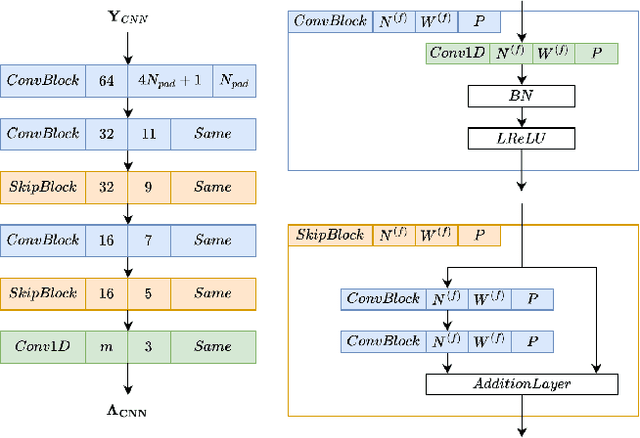
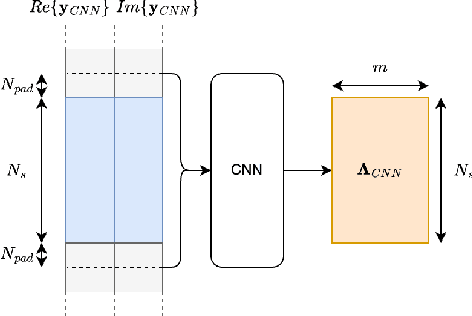
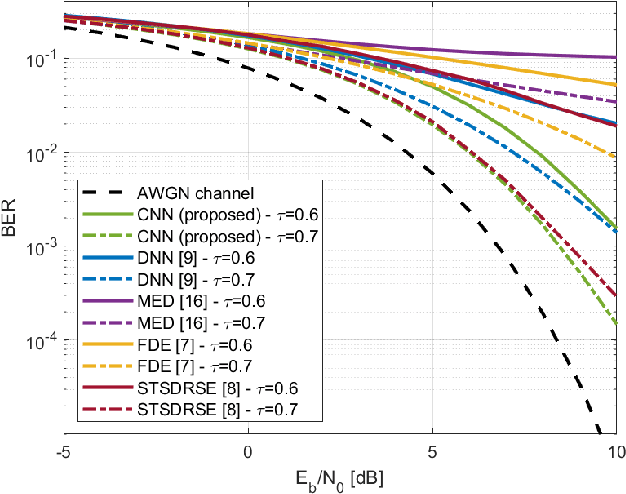
Faster-than-Nyquist (FTN) signaling aims at improving the spectral efficiency of wireless communication systems by exceeding the boundaries set by the Nyquist-Shannon sampling theorem. 50 years after its first introduction in the scientific literature, wireless communications have significantly changed, but spectral efficiency remains one of the key challenges. To adopt FTN signaling, inter-symbol interference (ISI) patterns need to be equalized at the receiver. Motivated by the pattern recognition capabilities of convolutional neural networks with skip connections, we propose such deep learning architecture for ISI equalization and symbol demodulation in FTN receivers. We investigate the performance of the proposed model considering quadrature phase shift keying modulation and low density parity check coding, and compare it to a set of benchmarks, including frequency-domain equalization, a quadratic-programming-based receiver, and an equalization scheme based on a deep neural network. We show that our receiver outperforms any benchmark, achieving error rates comparable to those in additive white Gaussian noise channel, and higher effective throughput, thanks to the increased spectral efficiency of FTN signaling. With a compression factor of 60% and code rate 3/4, the proposed model achieves a peak effective throughput of 2.5 Mbps at just 10dB of energy per bit over noise power spectral density ratio, with other receivers being limited by error floors due to the strong inter-symbol interference. To promote reproducibility in deep learning for wireless communications, our code is open source at the repository provided in the references.
Emerging Advancements in 6G NTN Radio Access Technologies: An Overview
Apr 22, 2024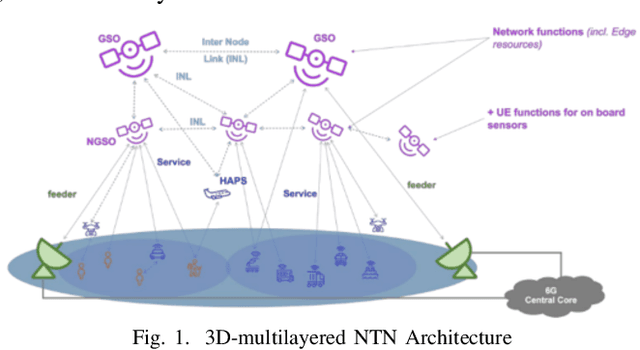
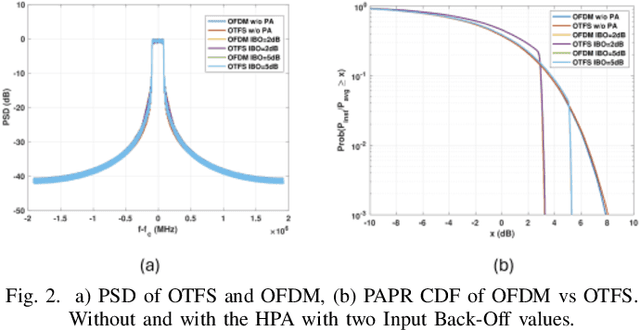
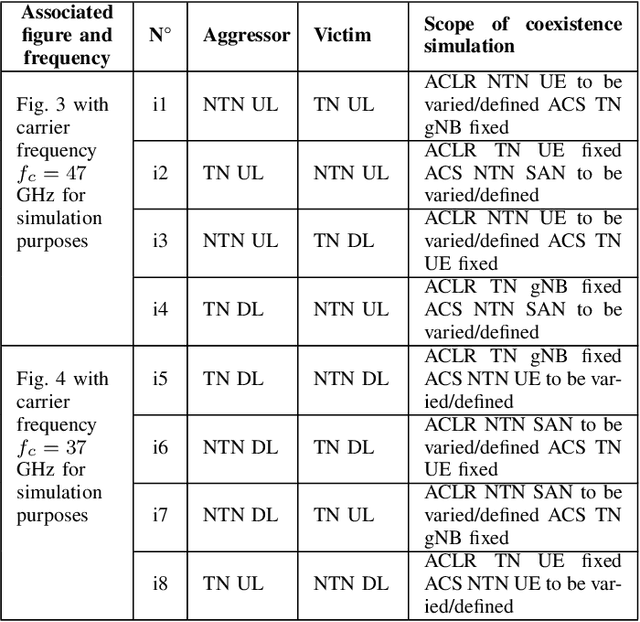
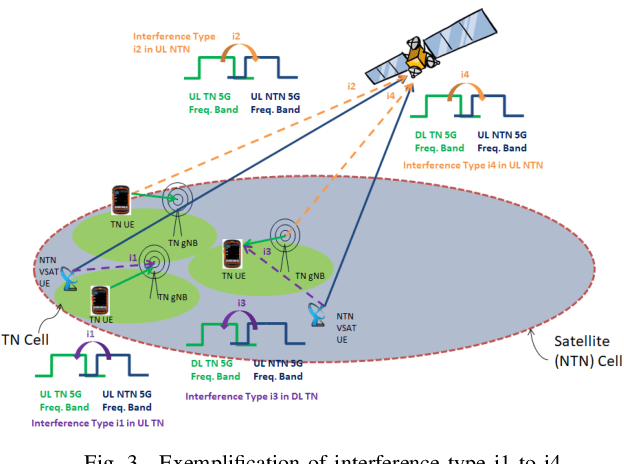
The efforts on the development, standardization and improvements to communication systems towards 5G Advanced and 6G are on track to provide benefits such as an unprecedented level of connectivity and performance, enabling a diverse range of vertical services. The full integration of non-terrestrial components into 6G plays a pivotal role in realizing this paradigm shift towards ubiquitous communication and global coverage. However, this integration into 6G brings forth a set of its own challenges, particularly in Radio Access Technologies (RATs). To this end, this paper comprehensively discusses those challenges at different levels of RATs and proposes the corresponding potential emerging advancements in the realm of 6G NTN. In particular, the focus is on advancing the prospective aspects of Radio Resource Management (RRM), spectral coexistence in terrestrial and non-terrestrial components and flexible waveform design solutions to combat the impediments. This discussion with a specific focus on emerging advancements in 6G NTN RATs is critical for shaping the next generation networks and potentially relevant in contributing the part in standardization in forthcoming releases
Federated Cell-Free MIMO in Non-Terrestrial Networks: Architectures and Performance
Jan 31, 2023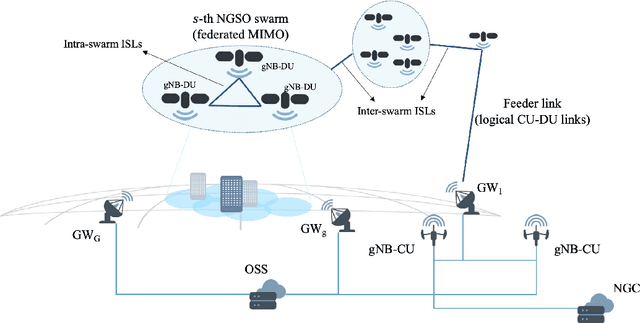


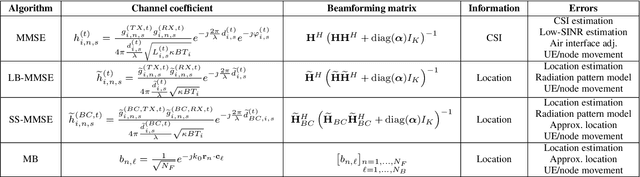
While 5G networks are being rolled out, the definition of the potential 5G-Advanced features and the identification of disruptive technologies for 6G systems are being addressed by the scientific and academic communities to tackle the challenges that 2030 communication systems will face, such as terabit-capacity and always-on networks. In this framework, it is globally recognised that Non-Terrestrial Networks (NTN) will play a fundamental role in support to a fully connected world, in which physical, human, and digital domains will converge. In this framework, one of the main challenges that NTN have to address is the provision of the high throughput requested by the new ecosystem. In this paper, we focus on Cell-Free Multiple Input Multiple Output (CF-MIMO) algorithms for NTN. In particular: i) we discuss the architecture design supporting centralised and federated CF-MIMO in NTN, with the latter implementing distributed MIMO algorithms from multiple satellites in the same formation (swarm); ii) propose a novel location-based CF-MIMO algorithm, which does not require Channel State Information (CSI) at the transmitter; and iii) design novel normalisation approaches for federated CF-MIMO in NTN, to cope with the constraints on non-colocated radiating elements. The numerical results substantiate the good performance of the proposed algorithm, also in the presence of non-ideal information.