 Add to Chrome
 Add to Firefox
 Add to Edge
DiffKillR: Killing and Recreating Diffeomorphisms for Cell Annotation in Dense Microscopy Images
Oct 04, 2024
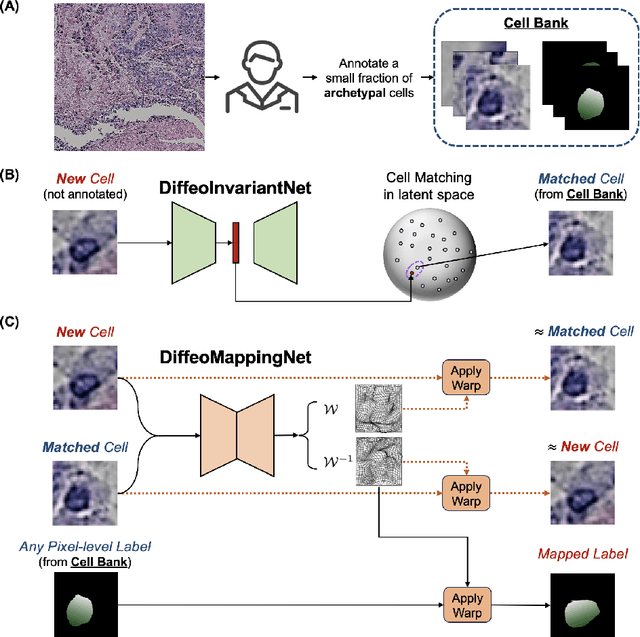


The proliferation of digital microscopy images, driven by advances in automated whole slide scanning, presents significant opportunities for biomedical research and clinical diagnostics. However, accurately annotating densely packed information in these images remains a major challenge. To address this, we introduce DiffKillR, a novel framework that reframes cell annotation as the combination of archetype matching and image registration tasks. DiffKillR employs two complementary neural networks: one that learns a diffeomorphism-invariant feature space for robust cell matching and another that computes the precise warping field between cells for annotation mapping. Using a small set of annotated archetypes, DiffKillR efficiently propagates annotations across large microscopy images, reducing the need for extensive manual labeling. More importantly, it is suitable for any type of pixel-level annotation. We will discuss the theoretical properties of DiffKillR and validate it on three microscopy tasks, demonstrating its advantages over existing supervised, semi-supervised, and unsupervised methods.

ICL-TSVD: Bridging Theory and Practice in Continual Learning with Pre-trained Models
Oct 01, 2024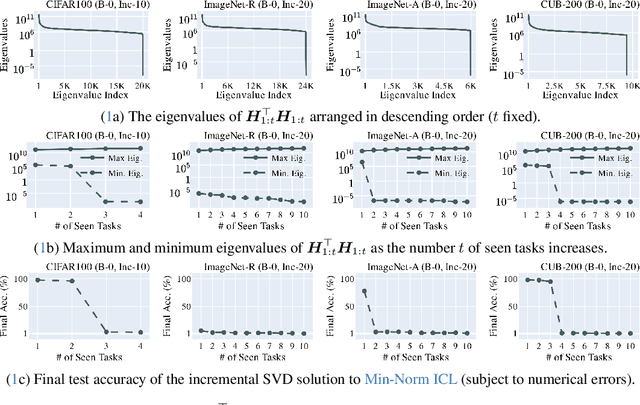


The goal of continual learning (CL) is to train a model that can solve multiple tasks presented sequentially. Recent CL approaches have achieved strong performance by leveraging large pre-trained models that generalize well to downstream tasks. However, such methods lack theoretical guarantees, making them prone to unexpected failures. Conversely, principled CL approaches often fail to achieve competitive performance. In this work, we bridge this gap between theory and practice by integrating an empirically strong approach (RanPAC) into a principled framework, Ideal Continual Learner (ICL), designed to prevent forgetting. Specifically, we lift pre-trained features into a higher dimensional space and formulate an over-parametrized minimum-norm least-squares problem. We find that the lifted features are highly ill-conditioned, potentially leading to large training errors (numerical instability) and increased generalization errors (double descent). We address these challenges by continually truncating the singular value decomposition (SVD) of the lifted features. Our approach, termed ICL-TSVD, is stable with respect to the choice of hyperparameters, can handle hundreds of tasks, and outperforms state-of-the-art CL methods on multiple datasets. Importantly, our method satisfies a recurrence relation throughout its continual learning process, which allows us to prove it maintains small training and generalization errors by appropriately truncating a fraction of SVD factors. This results in a stable continual learning method with strong empirical performance and theoretical guarantees.
Generalizability of Graph Neural Networks for Decentralized Unlabeled Motion Planning
Sep 29, 2024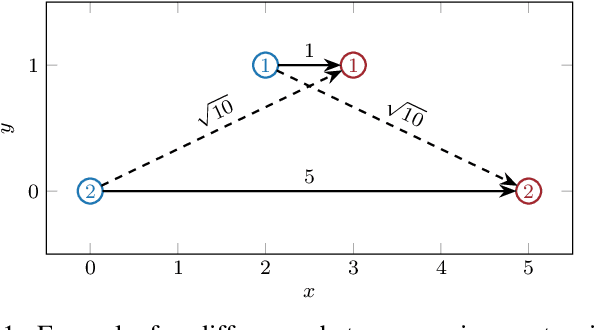
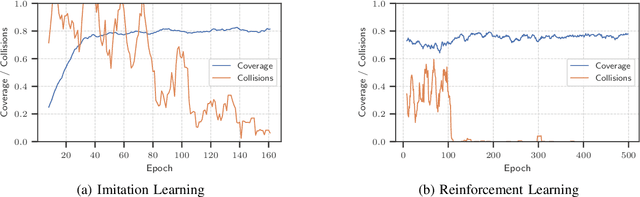
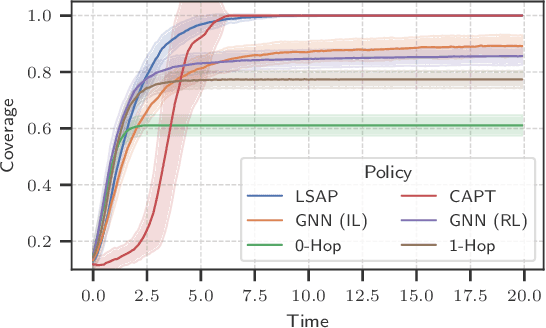
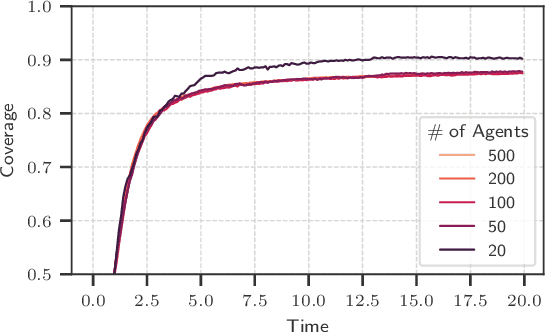
Unlabeled motion planning involves assigning a set of robots to target locations while ensuring collision avoidance, aiming to minimize the total distance traveled. The problem forms an essential building block for multi-robot systems in applications such as exploration, surveillance, and transportation. We address this problem in a decentralized setting where each robot knows only the positions of its $k$-nearest robots and $k$-nearest targets. This scenario combines elements of combinatorial assignment and continuous-space motion planning, posing significant scalability challenges for traditional centralized approaches. To overcome these challenges, we propose a decentralized policy learned via a Graph Neural Network (GNN). The GNN enables robots to determine (1) what information to communicate to neighbors and (2) how to integrate received information with local observations for decision-making. We train the GNN using imitation learning with the centralized Hungarian algorithm as the expert policy, and further fine-tune it using reinforcement learning to avoid collisions and enhance performance. Extensive empirical evaluations demonstrate the scalability and effectiveness of our approach. The GNN policy trained on 100 robots generalizes to scenarios with up to 500 robots, outperforming state-of-the-art solutions by 8.6\% on average and significantly surpassing greedy decentralized methods. This work lays the foundation for solving multi-robot coordination problems in settings where scalability is important.
Generalization of Geometric Graph Neural Networks
Sep 08, 2024In this paper, we study the generalization capabilities of geometric graph neural networks (GNNs). We consider GNNs over a geometric graph constructed from a finite set of randomly sampled points over an embedded manifold with topological information captured. We prove a generalization gap between the optimal empirical risk and the optimal statistical risk of this GNN, which decreases with the number of sampled points from the manifold and increases with the dimension of the underlying manifold. This generalization gap ensures that the GNN trained on a graph on a set of sampled points can be utilized to process other unseen graphs constructed from the same underlying manifold. The most important observation is that the generalization capability can be realized with one large graph instead of being limited to the size of the graph as in previous results. The generalization gap is derived based on the non-asymptotic convergence result of a GNN on the sampled graph to the underlying manifold neural networks (MNNs). We verify this theoretical result with experiments on both Arxiv dataset and Cora dataset.
Constrained Diffusion Models via Dual Training
Aug 27, 2024
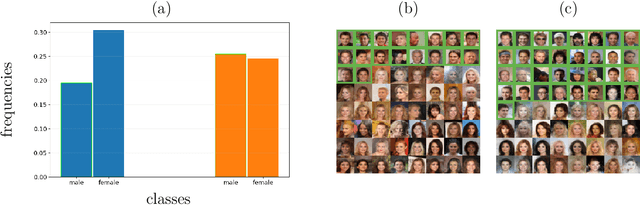
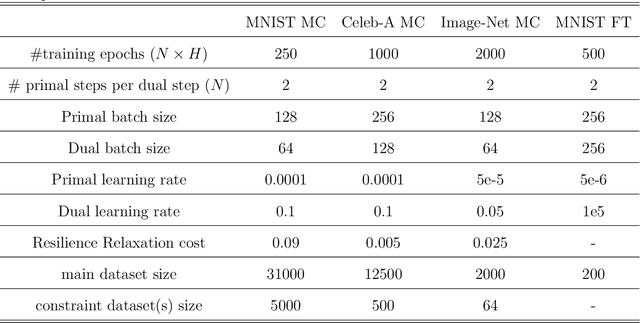
Diffusion models have attained prominence for their ability to synthesize a probability distribution for a given dataset via a diffusion process, enabling the generation of new data points with high fidelity. However, diffusion processes are prone to generating biased data based on the training dataset. To address this issue, we develop constrained diffusion models by imposing diffusion constraints based on desired distributions that are informed by requirements. Specifically, we cast the training of diffusion models under requirements as a constrained distribution optimization problem that aims to reduce the distribution difference between original and generated data while obeying constraints on the distribution of generated data. We show that our constrained diffusion models generate new data from a mixture data distribution that achieves the optimal trade-off among objective and constraints. To train constrained diffusion models, we develop a dual training algorithm and characterize the optimality of the trained constrained diffusion model. We empirically demonstrate the effectiveness of our constrained models in two constrained generation tasks: (i) we consider a dataset with one or more underrepresented classes where we train the model with constraints to ensure fairly sampling from all classes during inference; (ii) we fine-tune a pre-trained diffusion model to sample from a new dataset while avoiding overfitting.
Generalization of Graph Neural Networks is Robust to Model Mismatch
Aug 25, 2024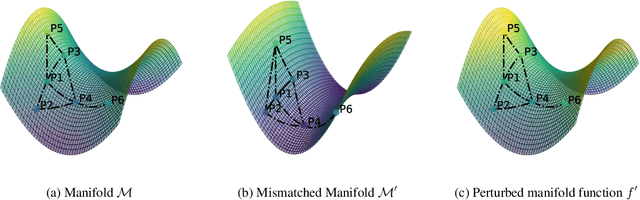
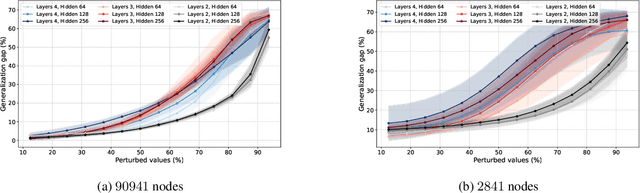
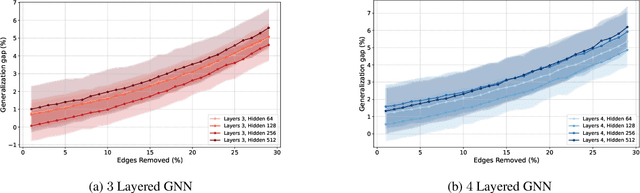
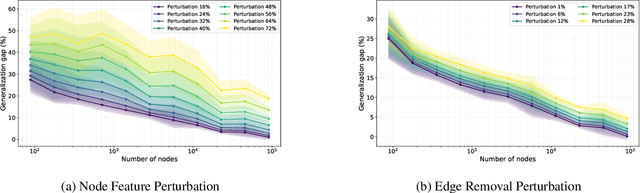
Graph neural networks (GNNs) have demonstrated their effectiveness in various tasks supported by their generalization capabilities. However, the current analysis of GNN generalization relies on the assumption that training and testing data are independent and identically distributed (i.i.d). This imposes limitations on the cases where a model mismatch exists when generating testing data. In this paper, we examine GNNs that operate on geometric graphs generated from manifold models, explicitly focusing on scenarios where there is a mismatch between manifold models generating training and testing data. Our analysis reveals the robustness of the GNN generalization in the presence of such model mismatch. This indicates that GNNs trained on graphs generated from a manifold can still generalize well to unseen nodes and graphs generated from a mismatched manifold. We attribute this mismatch to both node feature perturbations and edge perturbations within the generated graph. Our findings indicate that the generalization gap decreases as the number of nodes grows in the training graph while increasing with larger manifold dimension as well as larger mismatch. Importantly, we observe a trade-off between the generalization of GNNs and the capability to discriminate high-frequency components when facing a model mismatch. The most important practical consequence of this analysis is to shed light on the filter design of generalizable GNNs robust to model mismatch. We verify our theoretical findings with experiments on multiple real-world datasets.
Deterministic Policy Gradient Primal-Dual Methods for Continuous-Space Constrained MDPs
Aug 19, 2024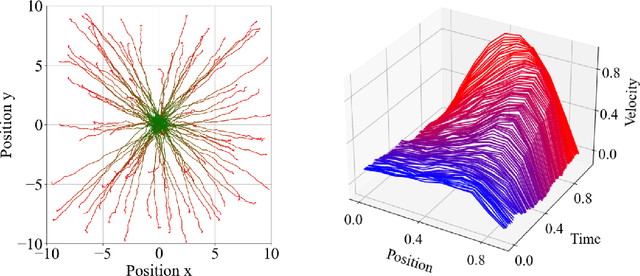
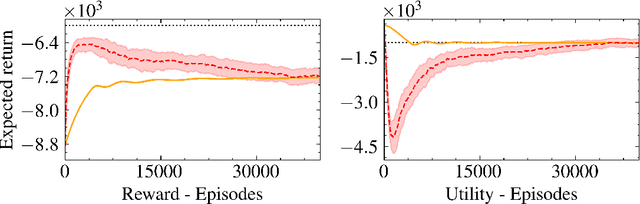
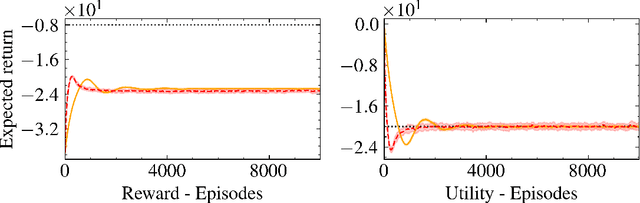
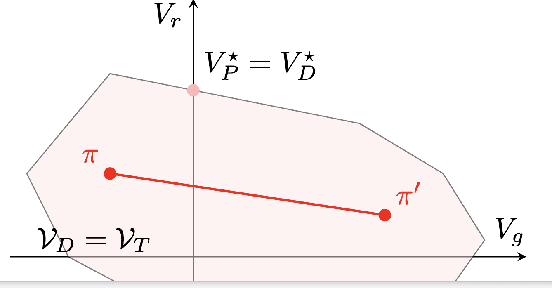
We study the problem of computing deterministic optimal policies for constrained Markov decision processes (MDPs) with continuous state and action spaces, which are widely encountered in constrained dynamical systems. Designing deterministic policy gradient methods in continuous state and action spaces is particularly challenging due to the lack of enumerable state-action pairs and the adoption of deterministic policies, hindering the application of existing policy gradient methods for constrained MDPs. To this end, we develop a deterministic policy gradient primal-dual method to find an optimal deterministic policy with non-asymptotic convergence. Specifically, we leverage regularization of the Lagrangian of the constrained MDP to propose a deterministic policy gradient primal-dual (D-PGPD) algorithm that updates the deterministic policy via a quadratic-regularized gradient ascent step and the dual variable via a quadratic-regularized gradient descent step. We prove that the primal-dual iterates of D-PGPD converge at a sub-linear rate to an optimal regularized primal-dual pair. We instantiate D-PGPD with function approximation and prove that the primal-dual iterates of D-PGPD converge at a sub-linear rate to an optimal regularized primal-dual pair, up to a function approximation error. Furthermore, we demonstrate the effectiveness of our method in two continuous control problems: robot navigation and fluid control. To the best of our knowledge, this appears to be the first work that proposes a deterministic policy search method for continuous-space constrained MDPs.
Distributed Training of Large Graph Neural Networks with Variable Communication Rates
Jun 25, 2024Training Graph Neural Networks (GNNs) on large graphs presents unique challenges due to the large memory and computing requirements. Distributed GNN training, where the graph is partitioned across multiple machines, is a common approach to training GNNs on large graphs. However, as the graph cannot generally be decomposed into small non-interacting components, data communication between the training machines quickly limits training speeds. Compressing the communicated node activations by a fixed amount improves the training speeds, but lowers the accuracy of the trained GNN. In this paper, we introduce a variable compression scheme for reducing the communication volume in distributed GNN training without compromising the accuracy of the learned model. Based on our theoretical analysis, we derive a variable compression method that converges to a solution equivalent to the full communication case, for all graph partitioning schemes. Our empirical results show that our method attains a comparable performance to the one obtained with full communication. We outperform full communication at any fixed compression ratio for any communication budget.
A Manifold Perspective on the Statistical Generalization of Graph Neural Networks
Jun 07, 2024Convolutional neural networks have been successfully extended to operate on graphs, giving rise to Graph Neural Networks (GNNs). GNNs combine information from adjacent nodes by successive applications of graph convolutions. GNNs have been implemented successfully in various learning tasks while the theoretical understanding of their generalization capability is still in progress. In this paper, we leverage manifold theory to analyze the statistical generalization gap of GNNs operating on graphs constructed on sampled points from manifolds. We study the generalization gaps of GNNs on both node-level and graph-level tasks. We show that the generalization gaps decrease with the number of nodes in the training graphs, which guarantees the generalization of GNNs to unseen points over manifolds. We validate our theoretical results in multiple real-world datasets.
Learning to Slice Wi-Fi Networks: A State-Augmented Primal-Dual Approach
May 09, 2024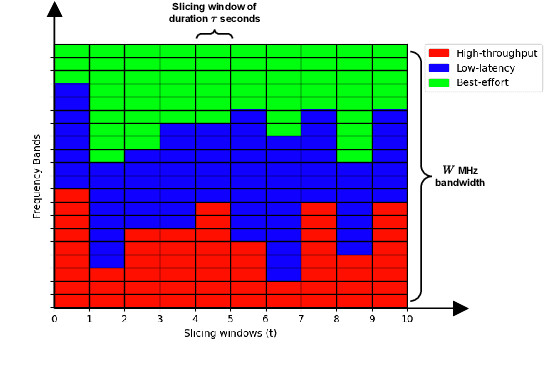
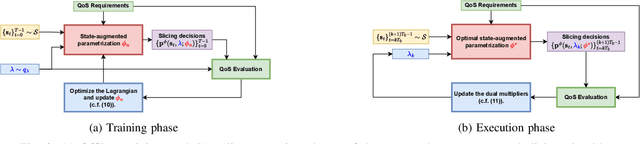
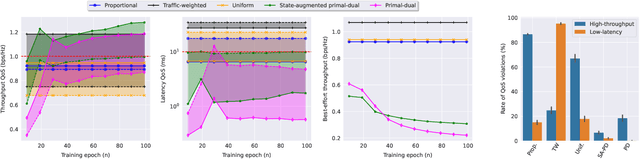
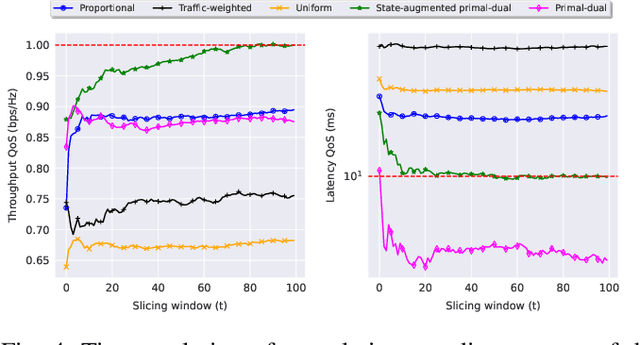
Network slicing is a key feature in 5G/NG cellular networks that creates customized slices for different service types with various quality-of-service (QoS) requirements, which can achieve service differentiation and guarantee service-level agreement (SLA) for each service type. In Wi-Fi networks, there is limited prior work on slicing, and a potential solution is based on a multi-tenant architecture on a single access point (AP) that dedicates different channels to different slices. In this paper, we define a flexible, constrained learning framework to enable slicing in Wi-Fi networks subject to QoS requirements. We specifically propose an unsupervised learning-based network slicing method that leverages a state-augmented primal-dual algorithm, where a neural network policy is trained offline to optimize a Lagrangian function and the dual variable dynamics are updated online in the execution phase. We show that state augmentation is crucial for generating slicing decisions that meet the ergodic QoS requirements.