 Add to Chrome
 Add to Firefox
 Add to Edge
PRECTR-V2:Unified Relevance-CTR Framework with Cross-User Preference Mining, Exposure Bias Correction, and LLM-Distilled Encoder Optimization
Feb 24, 2026
In search systems, effectively coordinating the two core objectives of search relevance matching and click-through rate (CTR) prediction is crucial for discovering users' interests and enhancing platform revenue. In our prior work PRECTR, we proposed a unified framework to integrate these two subtasks,thereby eliminating their inconsistency and leading to mutual benefit.However, our previous work still faces three main challenges. First, low-active users and new users have limited search behavioral data, making it difficult to achieve effective personalized relevance preference modeling. Second, training data for ranking models predominantly come from high-relevance exposures, creating a distribution mismatch with the broader candidate space in coarse-ranking, leading to generalization bias. Third, due to the latency constraint, the original model employs an Emb+MLP architecture with a frozen BERT encoder, which prevents joint optimization and creates misalignment between representation learning and CTR fine-tuning. To solve these issues, we further reinforce our method and propose PRECTR-V2. Specifically, we mitigate the low-activity users' sparse behavior problem by mining global relevance preferences under the specific query, which facilitates effective personalized relevance modeling for cold-start scenarios. Subsequently, we construct hard negative samples through embedding noise injection and relevance label reconstruction, and optimize their relative ranking against positive samples via pairwise loss, thereby correcting exposure bias. Finally, we pretrain a lightweight transformer-based encoder via knowledge distillation from LLM and SFT on the text relevance classification task. This encoder replaces the frozen BERT module, enabling better adaptation to CTR fine-tuning and advancing beyond the traditional Emb+MLP paradigm.

DAIAN: Deep Adaptive Intent-Aware Network for CTR Prediction in Trigger-Induced Recommendation
Feb 15, 2026Recommendation systems are essential for personalizing e-commerce shopping experiences. Among these, Trigger-Induced Recommendation (TIR) has emerged as a key scenario, which utilizes a trigger item (explicitly represents a user's instantaneous interest), enabling precise, real-time recommendations. Although several trigger-based techniques have been proposed, most of them struggle to address the intent myopia issue, that is, a recommendation system overemphasizes the role of trigger items and narrowly focuses on suggesting commodities that are highly relevant to trigger items. Meanwhile, existing methods rely on collaborative behavior patterns between trigger and recommended items to identify the user's preferences, yet the sparsity of ID-based interaction restricts their effectiveness. To this end, we propose the Deep Adaptive Intent-Aware Network (DAIAN) that dynamically adapts to users' intent preferences. In general, we first extract the users' personalized intent representations by analyzing the correlation between a user's click and the trigger item, and accordingly retrieve the user's related historical behaviors to mine the user's diverse intent. Besides, sparse collaborative behaviors constrain the performance in capturing items associated with user intent. Hence, we reinforce similarity by leveraging a hybrid enhancer with ID and semantic information, followed by adaptive selection based on varying intents. Experimental results on public datasets and our industrial e-commerce datasets demonstrate the effectiveness of DAIAN.
MetaSplit: Meta-Split Network for Limited-Stock Product Recommendation
Mar 16, 2024Compared to business-to-consumer (B2C) e-commerce systems, consumer-to-consumer (C2C) e-commerce platforms usually encounter the limited-stock problem, that is, a product can only be sold one time in a C2C system. This poses several unique challenges for click-through rate (CTR) prediction. Due to limited user interactions for each product (i.e. item), the corresponding item embedding in the CTR model may not easily converge. This makes the conventional sequence modeling based approaches cannot effectively utilize user history information since historical user behaviors contain a mixture of items with different volume of stocks. Particularly, the attention mechanism in a sequence model tends to assign higher score to products with more accumulated user interactions, making limited-stock products being ignored and contribute less to the final output. To this end, we propose the Meta-Split Network (MSNet) to split user history sequence regarding to the volume of stock for each product, and adopt differentiated modeling approaches for different sequences. As for the limited-stock products, a meta-learning approach is applied to address the problem of inconvergence, which is achieved by designing meta scaling and shifting networks with ID and side information. In addition, traditional approach can hardly update item embedding once the product is consumed. Thereby, we propose an auxiliary loss that makes the parameters updatable even when the product is no longer in distribution. To the best of our knowledge, this is the first solution addressing the recommendation of limited-stock product. Experimental results on the production dataset and online A/B testing demonstrate the effectiveness of our proposed method.
Unstructured Semantic Model supported Deep Neural Network for Click-Through Rate Prediction
Dec 04, 2018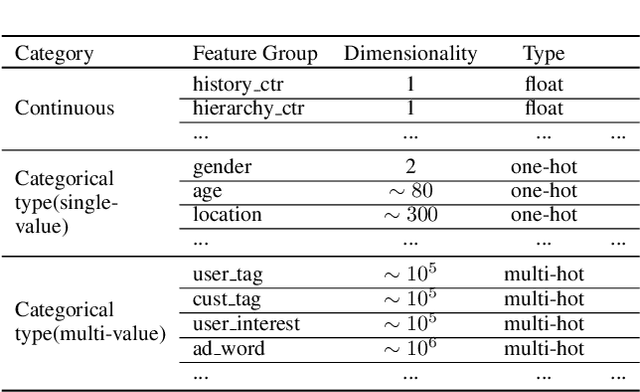
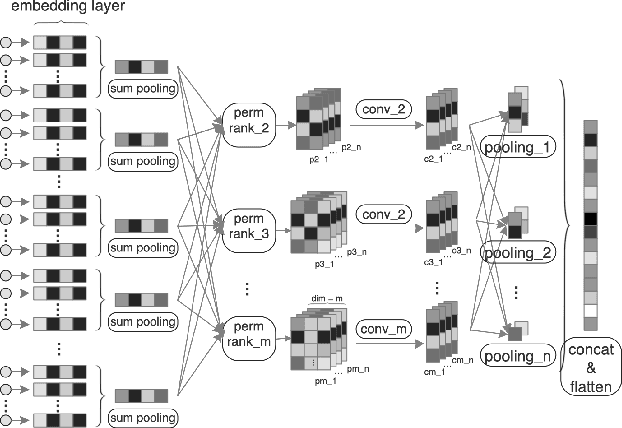
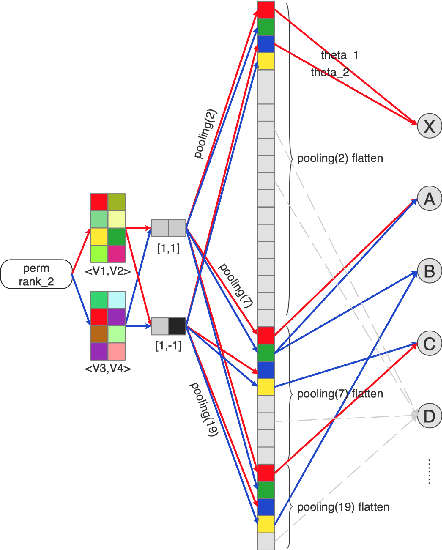
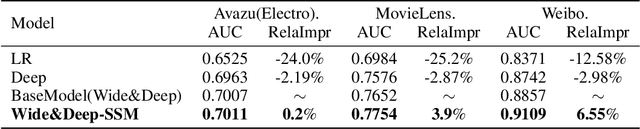
With the rapid development of online advertising and recommendation systems, click-through rate prediction is expected to play an increasingly important role.Recently many DNN-based models which follow a similar Embedding&MLP paradigm have been proposed, and have achieved good result in image/voice and nlp fields.In these methods the Wide&Deep model announced by Google plays a key role.Most models first map large scale sparse input features into low-dimensional vectors which are transformed to fixed-length vectors, then concatenated together before being fed into a multilayer perceptron (MLP) to learn non-linear relations among input features. The number of trainable variables normally grow dramatically the number of feature fields and the embedding dimension grow. It is a big challenge to get state-of-the-art result through training deep neural network and embedding together, which falls into local optimal or overfitting easily.In this paper, we propose an Unstructured Semantic Model (USM) to tackles this challenge by designing a orthogonal base convolution and pooling model which adaptively learn the multi-scale base semantic representation between features supervised by the click label.The output of USM are then used in the Wide&Deep for CTR prediction.Experiments on two public datasets as well as real Weibo production dataset with over 1 billion samples have demonstrated the effectiveness of our proposed approach with superior performance comparing to state-of-the-art methods.