 Add to Chrome
 Add to Firefox
 Add to Edge
Beyond Transformers: Linear Attention Policy for Open-Vocabulary Object Goal Navigation
Jul 21, 2026
Open-Vocabulary Object Goal Navigation (OVON) requires agents to operate under partial observability, making effective internal state updates critical for navigation performance. This update is implemented by the policy network, where recent approaches adopt Transformer-based backbones with self-attention over a context window to integrate temporal information. However, our controlled experiments show that performance does not scale with context length under Transformer-based policies, questioning the suitability of self-attention for state integration in navigation. To this end, we propose Linear Attention-based Navigation (LANav), which adopts linear attention (LA) as the policy backbone to maintain a structured state update rather than self-attention over the context window. Across multiple LA variants evaluated under identical settings, LANav consistently outperforms Transformer-based baselines. Performance improves as state update mechanisms become more structured and regulated, highlighting the importance of state update design. To improve state update effectiveness, we introduce Weighted State-Expansion Linear Attention (WSLA), which expands each attention head's state into multiple sub-states and uses learnable weighted readout to aggregate expanded sub-states. Equipped with WSLA, LANav achieves 36.4% average success rate (SR) on HM3D-OVON, outperforming Transformer-based counterparts by 6.3 percentage points in macro-averaged SR, while maintaining computational efficiency. Distance-stratified results show larger gains in long-distance episodes, while HSSD transfer and fine-tuning demonstrate robustness across scene distributions. Real-world deployment on a Unitree Go2 further achieves an 82% success rate over 50 trials, supporting the practical feasibility and sim-to-real transfer of LANav.

Unstructured Semantic Model supported Deep Neural Network for Click-Through Rate Prediction
Dec 04, 2018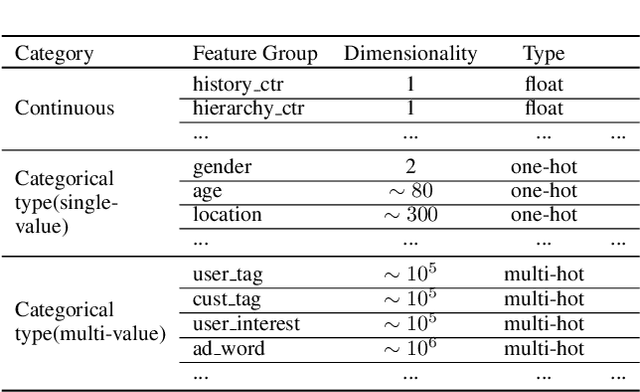
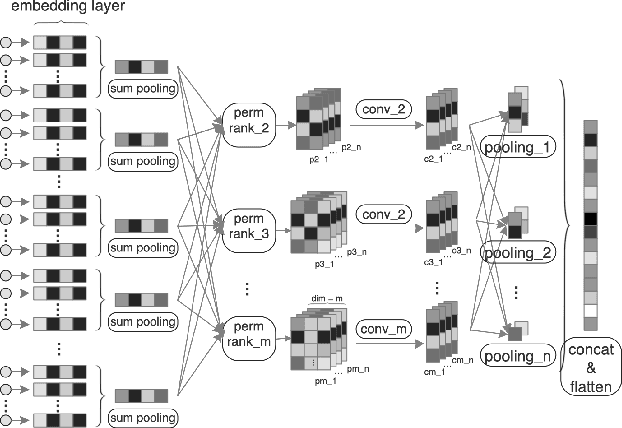
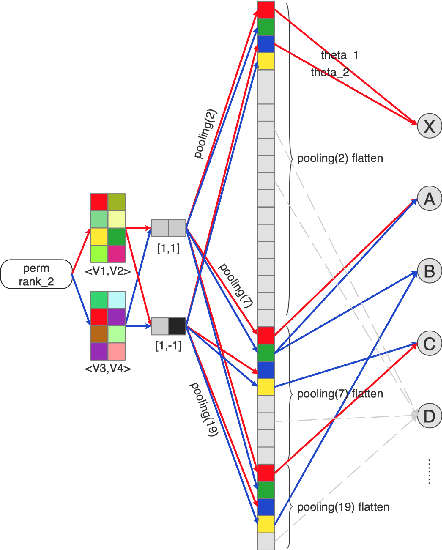
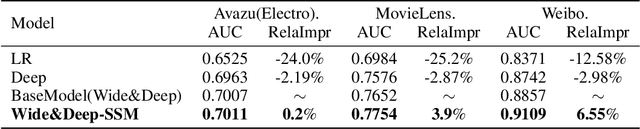
With the rapid development of online advertising and recommendation systems, click-through rate prediction is expected to play an increasingly important role.Recently many DNN-based models which follow a similar Embedding&MLP paradigm have been proposed, and have achieved good result in image/voice and nlp fields.In these methods the Wide&Deep model announced by Google plays a key role.Most models first map large scale sparse input features into low-dimensional vectors which are transformed to fixed-length vectors, then concatenated together before being fed into a multilayer perceptron (MLP) to learn non-linear relations among input features. The number of trainable variables normally grow dramatically the number of feature fields and the embedding dimension grow. It is a big challenge to get state-of-the-art result through training deep neural network and embedding together, which falls into local optimal or overfitting easily.In this paper, we propose an Unstructured Semantic Model (USM) to tackles this challenge by designing a orthogonal base convolution and pooling model which adaptively learn the multi-scale base semantic representation between features supervised by the click label.The output of USM are then used in the Wide&Deep for CTR prediction.Experiments on two public datasets as well as real Weibo production dataset with over 1 billion samples have demonstrated the effectiveness of our proposed approach with superior performance comparing to state-of-the-art methods.