 Add to Chrome
 Add to Firefox
 Add to Edge
DAIAN: Deep Adaptive Intent-Aware Network for CTR Prediction in Trigger-Induced Recommendation
Feb 15, 2026
Recommendation systems are essential for personalizing e-commerce shopping experiences. Among these, Trigger-Induced Recommendation (TIR) has emerged as a key scenario, which utilizes a trigger item (explicitly represents a user's instantaneous interest), enabling precise, real-time recommendations. Although several trigger-based techniques have been proposed, most of them struggle to address the intent myopia issue, that is, a recommendation system overemphasizes the role of trigger items and narrowly focuses on suggesting commodities that are highly relevant to trigger items. Meanwhile, existing methods rely on collaborative behavior patterns between trigger and recommended items to identify the user's preferences, yet the sparsity of ID-based interaction restricts their effectiveness. To this end, we propose the Deep Adaptive Intent-Aware Network (DAIAN) that dynamically adapts to users' intent preferences. In general, we first extract the users' personalized intent representations by analyzing the correlation between a user's click and the trigger item, and accordingly retrieve the user's related historical behaviors to mine the user's diverse intent. Besides, sparse collaborative behaviors constrain the performance in capturing items associated with user intent. Hence, we reinforce similarity by leveraging a hybrid enhancer with ID and semantic information, followed by adaptive selection based on varying intents. Experimental results on public datasets and our industrial e-commerce datasets demonstrate the effectiveness of DAIAN.

A unified framework of predicting binary interestingness of images based on discriminant correlation analysis and multiple kernel learning
Oct 14, 2019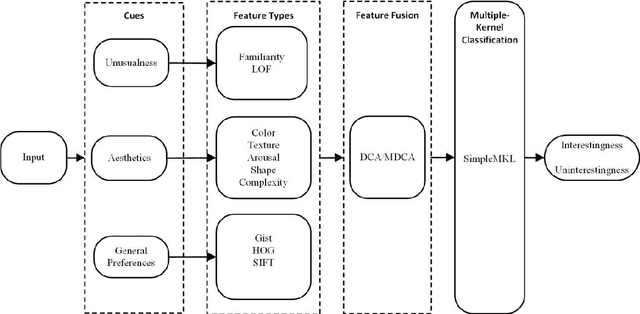
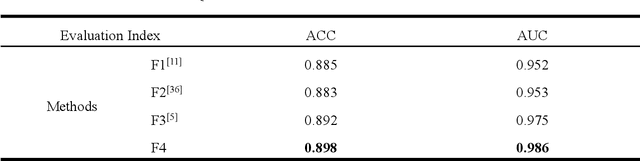
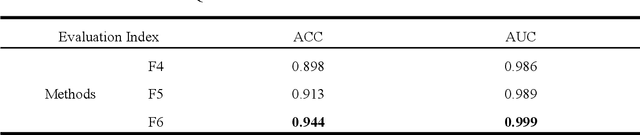

In the modern content-based image retrieval systems, there is an increasingly interest in constructing a computationally effective model to predict the interestingness of images since the measure of image interestingness could improve the human-centered search satisfaction and the user experience in different applications. In this paper, we propose a unified framework to predict the binary interestingness of images based on discriminant correlation analysis (DCA) and multiple kernel learning (MKL) techniques. More specially, on the one hand, to reduce feature redundancy in describing the interestingness cues of images, the DCA or multi-set discriminant correlation analysis (MDCA) technique is adopted to fuse multiple feature sets of the same type for individual cues by taking into account the class structure among the samples involved to describe the three classical interestingness cues, unusualness,aesthetics as well as general preferences, with three sets of compact and representative features; on the other hand, to make good use of the heterogeneity from the three sets of high-level features for describing the interestingness cues, the SimpleMKL method is employed to enhance the generalization ability of the built model for the task of the binary interestingness classification. Experimental results on the publicly-released interestingness prediction data set have demonstrated the rationality and effectiveness of the proposed framework in the binary prediction of image interestingness where we have conducted several groups of comparative studies across different interestingness feature combinations, different interestingness cues, as well as different feature types for the three interestingness cues.