 Add to Chrome
 Add to Firefox
 Add to Edge
MSP-Conversation: A Corpus for Naturalistic, Time-Continuous Emotion Recognition
Mar 23, 2026
Affective computing aims to understand and model human emotions for computational systems. Within this field, speech emotion recognition (SER) focuses on predicting emotions conveyed through speech. While early SER systems relied on limited datasets and traditional machine learning models, recent deep learning approaches demand largescale, naturalistic emotional corpora. To address this need, we introduce the MSP-Conversation corpus: a dataset of more than 70 hours of conversational audio with time-continuous emotional annotations and detailed speaker diarizations. The time-continuous annotations capture the dynamic and contextdependent nature of emotional expression. The annotations in the corpus include fine-grained temporal traces of valence, arousal, and dominance. The audio data is sourced from publicly available podcasts and overlaps with a subset of the isolated speaking turns in the MSP-Podcast corpus to facilitate direct comparisons between annotation methods (i.e., in-context versus out-of-context annotations). The paper outlines the development of the corpus, annotation methodology, analyses of the annotations, and baseline SER experiments, establishing the MSP-Conversation corpus as a valuable resource for advancing research in dynamic SER in naturalistic settings.

ADEPT: RL-Aligned Agentic Decoding of Emotion via Evidence Probing Tools -- From Consensus Learning to Ambiguity-Driven Emotion Reasoning
Feb 13, 2026Speech Large Language Models (SLLMs) enable high-level emotion reasoning but often produce ungrounded, text-biased judgments without verifiable acoustic evidence. In contrast, self-supervised speech encoders such as WavLM provide strong acoustic representations yet remain opaque discriminative models with limited interpretability. To bridge this gap, we introduce ADEPT (Agentic Decoding of Emotion via Evidence Probing Tools), a framework that reframes emotion recognition as a multi-turn inquiry process rather than a single-pass prediction. ADEPT transforms an SLLM into an agent that maintains an evolving candidate emotion set and adaptively invokes dedicated semantic and acoustic probing tools within a structured pipeline of candidate generation, evidence collection, and adjudication. Crucially, ADEPT enables a paradigm shift from consensus learning to ambiguity-driven emotion reasoning. Since human affect exhibits inherent complexity and frequent co-occurrence of emotions, we treat minority annotations as informative perceptual signals rather than discarding them as noise. Finally, we integrate Group Relative Policy Optimization (GRPO) with an Evidence Trust Gate to explicitly couple tool-usage behaviors with prediction quality and enforce evidence-grounded reasoning. Experiments show that ADEPT improves primary emotion accuracy in most settings while substantially improving minor emotion characterization, producing explanations grounded in auditable acoustic and semantic evidence.
Recovering Performance in Speech Emotion Recognition from Discrete Tokens via Multi-Layer Fusion and Paralinguistic Feature Integration
Jan 23, 2026Discrete speech tokens offer significant advantages for storage and language model integration, but their application in speech emotion recognition (SER) is limited by paralinguistic information loss during quantization. This paper presents a comprehensive investigation of discrete tokens for SER. Using a fine-tuned WavLM-Large model, we systematically quantify performance degradation across different layer configurations and k-means quantization granularities. To recover the information loss, we propose two key strategies: (1) attention-based multi-layer fusion to recapture complementary information from different layers, and (2) integration of openSMILE features to explicitly reintroduce paralinguistic cues. We also compare mainstream neural codec tokenizers (SpeechTokenizer, DAC, EnCodec) and analyze their behaviors when fused with acoustic features. Our findings demonstrate that through multi-layer fusion and acoustic feature integration, discrete tokens can close the performance gap with continuous representations in SER tasks.
Can Emotion Fool Anti-spoofing?
May 29, 2025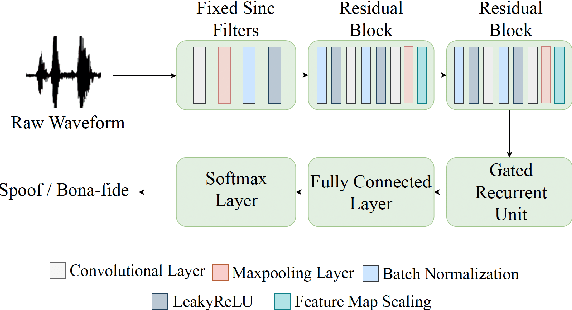
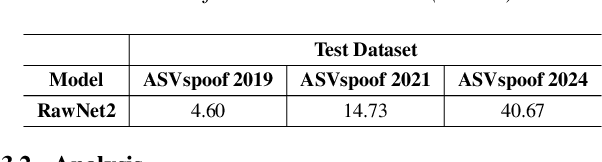
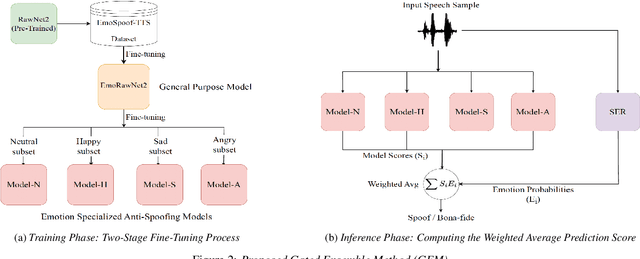
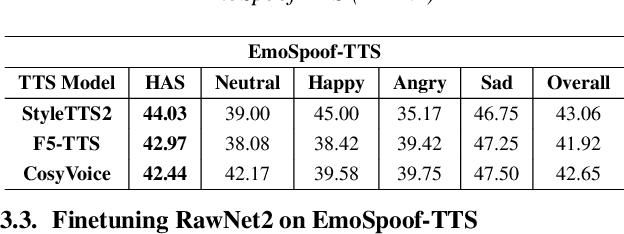
Traditional anti-spoofing focuses on models and datasets built on synthetic speech with mostly neutral state, neglecting diverse emotional variations. As a result, their robustness against high-quality, emotionally expressive synthetic speech is uncertain. We address this by introducing EmoSpoof-TTS, a corpus of emotional text-to-speech samples. Our analysis shows existing anti-spoofing models struggle with emotional synthetic speech, exposing risks of emotion-targeted attacks. Even trained on emotional data, the models underperform due to limited focus on emotional aspect and show performance disparities across emotions. This highlights the need for emotion-focused anti-spoofing paradigm in both dataset and methodology. We propose GEM, a gated ensemble of emotion-specialized models with a speech emotion recognition gating network. GEM performs effectively across all emotions and neutral state, improving defenses against spoofing attacks. We release the EmoSpoof-TTS Dataset: https://emospoof-tts.github.io/Dataset/