 Add to Chrome
 Add to Firefox
 Add to Edge
TRACE-EVC: Text-Guided Relative Affective Control for Zero-Shot Emotional Voice Conversion
Jul 04, 2026
Traditional emotional voice conversion (EVC) conditions generation on explicit target emotions like labels or references, defining the target affective state but omitting the direction or nature of the transition. We introduce instruction-guided relative emotional voice conversion, a task where natural-language instructions specify source-conditioned affective transformations (e.g., "make the speech slightly calmer" or "sound noticeably more confident") instead of fixed targets. To support this task, we construct TRACE-Instruct, a dataset of relative emotion instructions covering categorical transitions, intensity modifications, and open-ended affective changes. We propose TRACE-EVC, a zero-shot framework built around Emo-Compass, a module that models each conversion as a source-anchored rectified flow. Rather than conditioning on an explicit target, it predicts the direction and degree of the affective change. Experiments demonstrate that TRACE-EVC accurately follows relative emotion instructions while preserving speaker identity, linguistic content, and speech quality, and remains competitive with conventional EVC systems on standard categorical emotion conversion.

Who is Speaking or Who is Depressed? A Controlled Study of Speaker Leakage in Speech-Based Depression Detection
Apr 15, 2026This study investigates whether speech-based depression detection models learn depression-related acoustic biomarkers or instead rely on speaker identity cues. Using the DAIC-WOZ dataset, we propose a data-splitting strategy that controls speaker overlap between training and test sets while keeping the training size constant, and evaluate three models of varying complexity. Results show that speaker overlap significantly boosts performance, whereas accuracy drops sharply on unseen speakers. Even with a Domain-Adversarial Neural Network, a substantial performance gap remains. These findings indicate that depression-related features extracted by current speech models are highly entangled with speaker identity. Conventional evaluation protocols may therefore overestimate generalization and clinical utility, highlighting the need for strictly speaker-independent evaluation.
ProSDD: Learning Prosodic Representations for Speech Deepfake Detection against Expressive and Emotional Attacks
Apr 14, 2026Speech deepfake detection (SDD) systems perform well on standard benchmarks datasets but often fail to generalize to expressive and emotional spoofing attacks. Many methods rely on spoof-heavy training data, learning dataset-specific artifacts rather than transferable cues of natural speech. In contrast, humans internalize variability in real speech and detect fakes as deviations from it. We introduce ProSDD, a two-stage framework that enriches model embeddings through supervised masked prediction of speaker-conditioned prosodic variation based on pitch, voice activity, and energy. Stage I learns prosodic variability from real speech, and Stage II jointly optimizes this objective with spoof classification. ProSDD consistently outperforms baselines under both ASVspoof 2019 and 2024 training, reducing ASVspoof 2024 EER from 25.43% to 16.14% (2019-trained) and from 39.62% to 7.38% (2024-trained), while achieving 50% relative reductions on EmoFake and EmoSpoof-TTS.
Can Emotion Fool Anti-spoofing?
May 29, 2025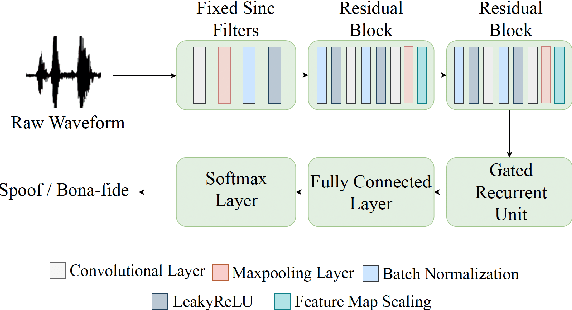
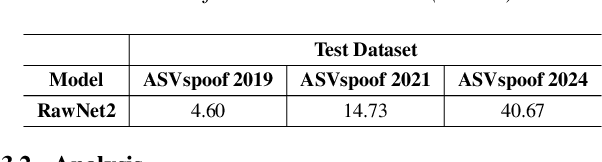
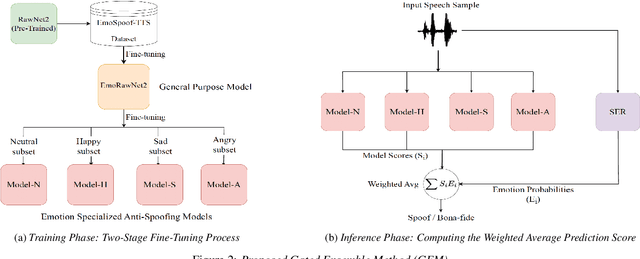
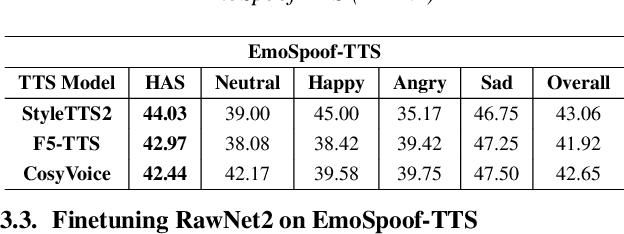
Traditional anti-spoofing focuses on models and datasets built on synthetic speech with mostly neutral state, neglecting diverse emotional variations. As a result, their robustness against high-quality, emotionally expressive synthetic speech is uncertain. We address this by introducing EmoSpoof-TTS, a corpus of emotional text-to-speech samples. Our analysis shows existing anti-spoofing models struggle with emotional synthetic speech, exposing risks of emotion-targeted attacks. Even trained on emotional data, the models underperform due to limited focus on emotional aspect and show performance disparities across emotions. This highlights the need for emotion-focused anti-spoofing paradigm in both dataset and methodology. We propose GEM, a gated ensemble of emotion-specialized models with a speech emotion recognition gating network. GEM performs effectively across all emotions and neutral state, improving defenses against spoofing attacks. We release the EmoSpoof-TTS Dataset: https://emospoof-tts.github.io/Dataset/