 Add to Chrome
 Add to Firefox
 Add to Edge
ADEPT: RL-Aligned Agentic Decoding of Emotion via Evidence Probing Tools -- From Consensus Learning to Ambiguity-Driven Emotion Reasoning
Feb 13, 2026
Speech Large Language Models (SLLMs) enable high-level emotion reasoning but often produce ungrounded, text-biased judgments without verifiable acoustic evidence. In contrast, self-supervised speech encoders such as WavLM provide strong acoustic representations yet remain opaque discriminative models with limited interpretability. To bridge this gap, we introduce ADEPT (Agentic Decoding of Emotion via Evidence Probing Tools), a framework that reframes emotion recognition as a multi-turn inquiry process rather than a single-pass prediction. ADEPT transforms an SLLM into an agent that maintains an evolving candidate emotion set and adaptively invokes dedicated semantic and acoustic probing tools within a structured pipeline of candidate generation, evidence collection, and adjudication. Crucially, ADEPT enables a paradigm shift from consensus learning to ambiguity-driven emotion reasoning. Since human affect exhibits inherent complexity and frequent co-occurrence of emotions, we treat minority annotations as informative perceptual signals rather than discarding them as noise. Finally, we integrate Group Relative Policy Optimization (GRPO) with an Evidence Trust Gate to explicitly couple tool-usage behaviors with prediction quality and enforce evidence-grounded reasoning. Experiments show that ADEPT improves primary emotion accuracy in most settings while substantially improving minor emotion characterization, producing explanations grounded in auditable acoustic and semantic evidence.

Recovering Performance in Speech Emotion Recognition from Discrete Tokens via Multi-Layer Fusion and Paralinguistic Feature Integration
Jan 23, 2026Discrete speech tokens offer significant advantages for storage and language model integration, but their application in speech emotion recognition (SER) is limited by paralinguistic information loss during quantization. This paper presents a comprehensive investigation of discrete tokens for SER. Using a fine-tuned WavLM-Large model, we systematically quantify performance degradation across different layer configurations and k-means quantization granularities. To recover the information loss, we propose two key strategies: (1) attention-based multi-layer fusion to recapture complementary information from different layers, and (2) integration of openSMILE features to explicitly reintroduce paralinguistic cues. We also compare mainstream neural codec tokenizers (SpeechTokenizer, DAC, EnCodec) and analyze their behaviors when fused with acoustic features. Our findings demonstrate that through multi-layer fusion and acoustic feature integration, discrete tokens can close the performance gap with continuous representations in SER tasks.
ForgeryGPT: Multimodal Large Language Model For Explainable Image Forgery Detection and Localization
Oct 14, 2024
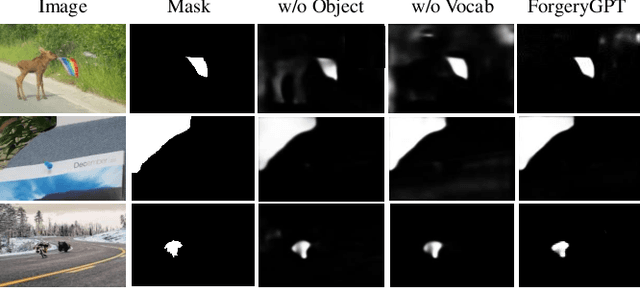

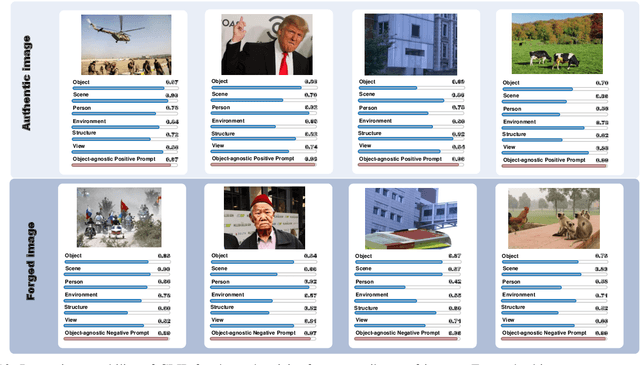
Multimodal Large Language Models (MLLMs), such as GPT4o, have shown strong capabilities in visual reasoning and explanation generation. However, despite these strengths, they face significant challenges in the increasingly critical task of Image Forgery Detection and Localization (IFDL). Moreover, existing IFDL methods are typically limited to the learning of low-level semantic-agnostic clues and merely provide a single outcome judgment. To tackle these issues, we propose ForgeryGPT, a novel framework that advances the IFDL task by capturing high-order forensics knowledge correlations of forged images from diverse linguistic feature spaces, while enabling explainable generation and interactive dialogue through a newly customized Large Language Model (LLM) architecture. Specifically, ForgeryGPT enhances traditional LLMs by integrating the Mask-Aware Forgery Extractor, which enables the excavating of precise forgery mask information from input images and facilitating pixel-level understanding of tampering artifacts. The Mask-Aware Forgery Extractor consists of a Forgery Localization Expert (FL-Expert) and a Mask Encoder, where the FL-Expert is augmented with an Object-agnostic Forgery Prompt and a Vocabulary-enhanced Vision Encoder, allowing for effectively capturing of multi-scale fine-grained forgery details. To enhance its performance, we implement a three-stage training strategy, supported by our designed Mask-Text Alignment and IFDL Task-Specific Instruction Tuning datasets, which align vision-language modalities and improve forgery detection and instruction-following capabilities. Extensive experiments demonstrate the effectiveness of the proposed method.