 Add to Chrome
 Add to Firefox
 Add to Edge
APRES: An Agentic Paper Revision and Evaluation System
Mar 03, 2026
Scientific discoveries must be communicated clearly to realize their full potential. Without effective communication, even the most groundbreaking findings risk being overlooked or misunderstood. The primary way scientists communicate their work and receive feedback from the community is through peer review. However, the current system often provides inconsistent feedback between reviewers, ultimately hindering the improvement of a manuscript and limiting its potential impact. In this paper, we introduce a novel method APRES powered by Large Language Models (LLMs) to update a scientific papers text based on an evaluation rubric. Our automated method discovers a rubric that is highly predictive of future citation counts, and integrate it with APRES in an automated system that revises papers to enhance their quality and impact. Crucially, this objective should be met without altering the core scientific content. We demonstrate the success of APRES, which improves future citation prediction by 19.6% in mean averaged error over the next best baseline, and show that our paper revision process yields papers that are preferred over the originals by human expert evaluators 79% of the time. Our findings provide strong empirical support for using LLMs as a tool to help authors stress-test their manuscripts before submission. Ultimately, our work seeks to augment, not replace, the essential role of human expert reviewers, for it should be humans who discern which discoveries truly matter, guiding science toward advancing knowledge and enriching lives.

AIRS-Bench: a Suite of Tasks for Frontier AI Research Science Agents
Feb 09, 2026LLM agents hold significant promise for advancing scientific research. To accelerate this progress, we introduce AIRS-Bench (the AI Research Science Benchmark), a suite of 20 tasks sourced from state-of-the-art machine learning papers. These tasks span diverse domains, including language modeling, mathematics, bioinformatics, and time series forecasting. AIRS-Bench tasks assess agentic capabilities over the full research lifecycle -- including idea generation, experiment analysis and iterative refinement -- without providing baseline code. The AIRS-Bench task format is versatile, enabling easy integration of new tasks and rigorous comparison across different agentic frameworks. We establish baselines using frontier models paired with both sequential and parallel scaffolds. Our results show that agents exceed human SOTA in four tasks but fail to match it in sixteen others. Even when agents surpass human benchmarks, they do not reach the theoretical performance ceiling for the underlying tasks. These findings indicate that AIRS-Bench is far from saturated and offers substantial room for improvement. We open-source the AIRS-Bench task definitions and evaluation code to catalyze further development in autonomous scientific research.
AI Research Agents for Machine Learning: Search, Exploration, and Generalization in MLE-bench
Jul 03, 2025AI research agents are demonstrating great potential to accelerate scientific progress by automating the design, implementation, and training of machine learning models. We focus on methods for improving agents' performance on MLE-bench, a challenging benchmark where agents compete in Kaggle competitions to solve real-world machine learning problems. We formalize AI research agents as search policies that navigate a space of candidate solutions, iteratively modifying them using operators. By designing and systematically varying different operator sets and search policies (Greedy, MCTS, Evolutionary), we show that their interplay is critical for achieving high performance. Our best pairing of search strategy and operator set achieves a state-of-the-art result on MLE-bench lite, increasing the success rate of achieving a Kaggle medal from 39.6% to 47.7%. Our investigation underscores the importance of jointly considering the search strategy, operator design, and evaluation methodology in advancing automated machine learning.
EvalGIM: A Library for Evaluating Generative Image Models
Dec 18, 2024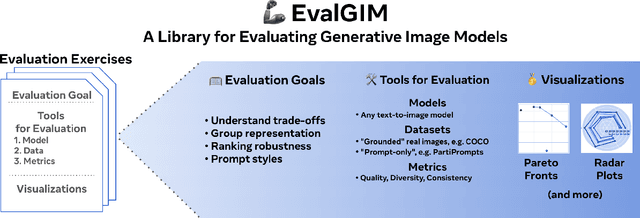


As the use of text-to-image generative models increases, so does the adoption of automatic benchmarking methods used in their evaluation. However, while metrics and datasets abound, there are few unified benchmarking libraries that provide a framework for performing evaluations across many datasets and metrics. Furthermore, the rapid introduction of increasingly robust benchmarking methods requires that evaluation libraries remain flexible to new datasets and metrics. Finally, there remains a gap in synthesizing evaluations in order to deliver actionable takeaways about model performance. To enable unified, flexible, and actionable evaluations, we introduce EvalGIM (pronounced ''EvalGym''), a library for evaluating generative image models. EvalGIM contains broad support for datasets and metrics used to measure quality, diversity, and consistency of text-to-image generative models. In addition, EvalGIM is designed with flexibility for user customization as a top priority and contains a structure that allows plug-and-play additions of new datasets and metrics. To enable actionable evaluation insights, we introduce ''Evaluation Exercises'' that highlight takeaways for specific evaluation questions. The Evaluation Exercises contain easy-to-use and reproducible implementations of two state-of-the-art evaluation methods of text-to-image generative models: consistency-diversity-realism Pareto Fronts and disaggregated measurements of performance disparities across groups. EvalGIM also contains Evaluation Exercises that introduce two new analysis methods for text-to-image generative models: robustness analyses of model rankings and balanced evaluations across different prompt styles. We encourage text-to-image model exploration with EvalGIM and invite contributions at https://github.com/facebookresearch/EvalGIM/.