 Add to Chrome
 Add to Firefox
 Add to Edge
Benchmark Test-Time Scaling of General LLM Agents
Feb 22, 2026
LLM agents are increasingly expected to function as general-purpose systems capable of resolving open-ended user requests. While existing benchmarks focus on domain-aware environments for developing specialized agents, evaluating general-purpose agents requires more realistic settings that challenge them to operate across multiple skills and tools within a unified environment. We introduce General AgentBench, a benchmark that provides such a unified framework for evaluating general LLM agents across search, coding, reasoning, and tool-use domains. Using General AgentBench, we systematically study test-time scaling behaviors under sequential scaling (iterative interaction) and parallel scaling (sampling multiple trajectories). Evaluation of ten leading LLM agents reveals a substantial performance degradation when moving from domain-specific evaluations to this general-agent setting. Moreover, we find that neither scaling methodology yields effective performance improvements in practice, due to two fundamental limitations: context ceiling in sequential scaling and verification gap in parallel scaling. Code is publicly available at https://github.com/cxcscmu/General-AgentBench.

DeepResearchGym: A Free, Transparent, and Reproducible Evaluation Sandbox for Deep Research
May 25, 2025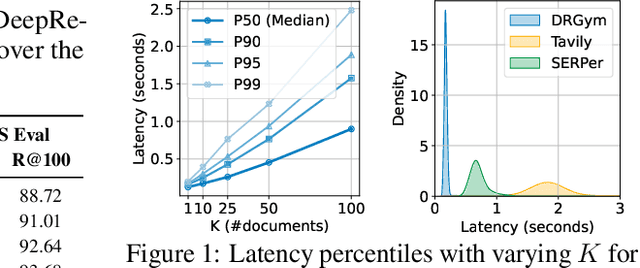
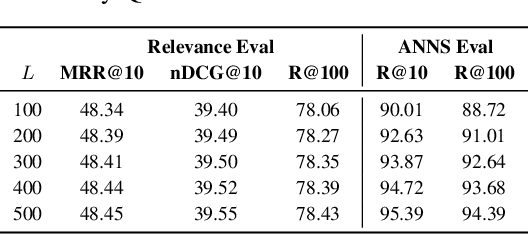
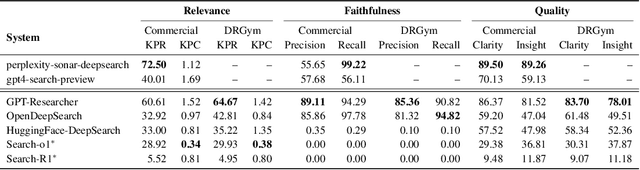
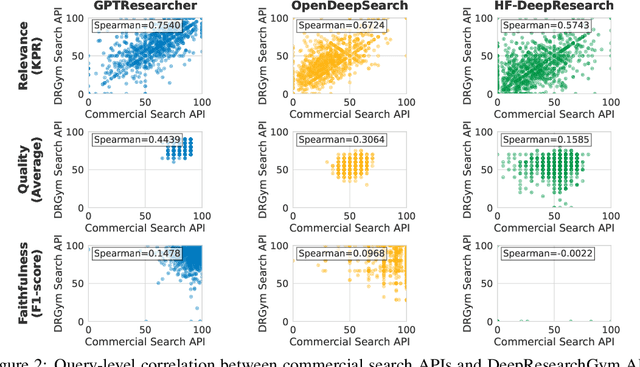
Deep research systems represent an emerging class of agentic information retrieval methods that generate comprehensive and well-supported reports to complex queries. However, most existing frameworks rely on dynamic commercial search APIs, which pose reproducibility and transparency challenges in addition to their cost. To address these limitations, we introduce DeepResearchGym, an open-source sandbox that combines a reproducible search API with a rigorous evaluation protocol for benchmarking deep research systems. The API indexes large-scale public web corpora, namely ClueWeb22 and FineWeb, using a state-of-the-art dense retriever and approximate nearest neighbor search via DiskANN. It achieves lower latency than popular commercial APIs while ensuring stable document rankings across runs, and is freely available for research use. To evaluate deep research systems' outputs, we extend the Researchy Questions benchmark with automatic metrics through LLM-as-a-judge assessments to measure alignment with users' information needs, retrieval faithfulness, and report quality. Experimental results show that systems integrated with DeepResearchGym achieve performance comparable to those using commercial APIs, with performance rankings remaining consistent across evaluation metrics. A human evaluation study further confirms that our automatic protocol aligns with human preferences, validating the framework's ability to help support controlled assessment of deep research systems. Our code and API documentation are available at https://www.deepresearchgym.ai.