 Add to Chrome
 Add to Firefox
 Add to Edge
FROMAT: Multiview Material Appearance Transfer via Few-Shot Self-Attention Adaptation
Dec 10, 2025
Multiview diffusion models have rapidly emerged as a powerful tool for content creation with spatial consistency across viewpoints, offering rich visual realism without requiring explicit geometry and appearance representation. However, compared to meshes or radiance fields, existing multiview diffusion models offer limited appearance manipulation, particularly in terms of material, texture, or style. In this paper, we present a lightweight adaptation technique for appearance transfer in multiview diffusion models. Our method learns to combine object identity from an input image with appearance cues rendered in a separate reference image, producing multi-view-consistent output that reflects the desired materials, textures, or styles. This allows explicit specification of appearance parameters at generation time while preserving the underlying object geometry and view coherence. We leverage three diffusion denoising processes responsible for generating the original object, the reference, and the target images, and perform reverse sampling to aggregate a small subset of layer-wise self-attention features from the object and the reference to influence the target generation. Our method requires only a few training examples to introduce appearance awareness to pretrained multiview models. The experiments show that our method provides a simple yet effective way toward multiview generation with diverse appearance, advocating the adoption of implicit generative 3D representations in practice.

Stable Virtual Camera: Generative View Synthesis with Diffusion Models
Mar 18, 2025We present Stable Virtual Camera (Seva), a generalist diffusion model that creates novel views of a scene, given any number of input views and target cameras. Existing works struggle to generate either large viewpoint changes or temporally smooth samples, while relying on specific task configurations. Our approach overcomes these limitations through simple model design, optimized training recipe, and flexible sampling strategy that generalize across view synthesis tasks at test time. As a result, our samples maintain high consistency without requiring additional 3D representation-based distillation, thus streamlining view synthesis in the wild. Furthermore, we show that our method can generate high-quality videos lasting up to half a minute with seamless loop closure. Extensive benchmarking demonstrates that Seva outperforms existing methods across different datasets and settings.
SPAR3D: Stable Point-Aware Reconstruction of 3D Objects from Single Images
Jan 08, 2025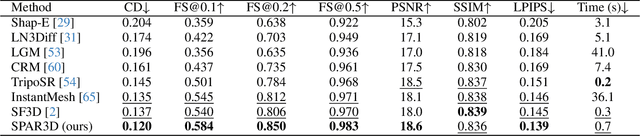

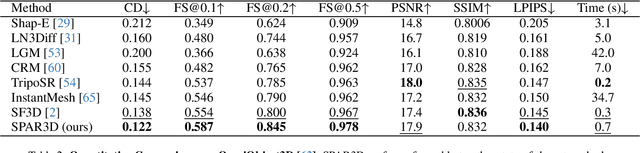
We study the problem of single-image 3D object reconstruction. Recent works have diverged into two directions: regression-based modeling and generative modeling. Regression methods efficiently infer visible surfaces, but struggle with occluded regions. Generative methods handle uncertain regions better by modeling distributions, but are computationally expensive and the generation is often misaligned with visible surfaces. In this paper, we present SPAR3D, a novel two-stage approach aiming to take the best of both directions. The first stage of SPAR3D generates sparse 3D point clouds using a lightweight point diffusion model, which has a fast sampling speed. The second stage uses both the sampled point cloud and the input image to create highly detailed meshes. Our two-stage design enables probabilistic modeling of the ill-posed single-image 3D task while maintaining high computational efficiency and great output fidelity. Using point clouds as an intermediate representation further allows for interactive user edits. Evaluated on diverse datasets, SPAR3D demonstrates superior performance over previous state-of-the-art methods, at an inference speed of 0.7 seconds. Project page with code and model: https://spar3d.github.io
SF3D: Stable Fast 3D Mesh Reconstruction with UV-unwrapping and Illumination Disentanglement
Aug 01, 2024


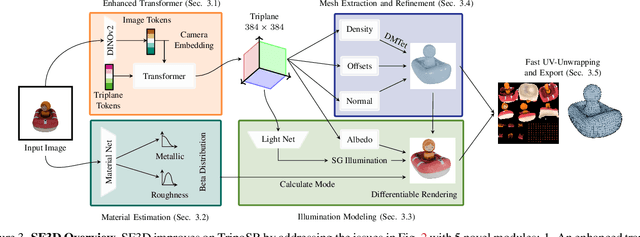
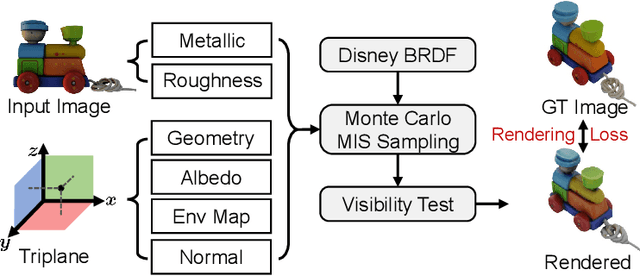
We present SF3D, a novel method for rapid and high-quality textured object mesh reconstruction from a single image in just 0.5 seconds. Unlike most existing approaches, SF3D is explicitly trained for mesh generation, incorporating a fast UV unwrapping technique that enables swift texture generation rather than relying on vertex colors. The method also learns to predict material parameters and normal maps to enhance the visual quality of the reconstructed 3D meshes. Furthermore, SF3D integrates a delighting step to effectively remove low-frequency illumination effects, ensuring that the reconstructed meshes can be easily used in novel illumination conditions. Experiments demonstrate the superior performance of SF3D over the existing techniques. Project page: https://stable-fast-3d.github.io