 Add to Chrome
 Add to Firefox
 Add to Edge
Toward An Analytic Theory of Intrinsic Robustness for Dexterous Grasping
Mar 12, 2024
Conventional approaches to grasp planning require perfect knowledge of an object's pose and geometry. Uncertainties in these quantities induce uncertainties in the quality of planned grasps, which can lead to failure. Classically, grasp robustness refers to the ability to resist external disturbances after grasping an object. In contrast, this work studies robustness to intrinsic sources of uncertainty like object pose or geometry affecting grasp planning before execution. To do so, we develop a novel analytic theory of grasping that reasons about this intrinsic robustness by characterizing the effect of friction cone uncertainty on a grasp's force closure status. As a result, we show the Ferrari-Canny metric -- which measures the size of external disturbances a grasp can reject -- bounds the friction cone uncertainty a grasp can tolerate, and thus also measures intrinsic robustness. In tandem, we show that the recently proposed min-weight metric lower bounds the Ferrari-Canny metric, justifying it as a computationally-efficient, uncertainty-aware alternative. We validate this theory on hardware experiments versus a competitive baseline and demonstrate superior performance. Finally, we use our theory to develop an analytic notion of probabilistic force closure, which we show in simulation generates grasps that can incorporate uncertainty distributions over an object's geometry.

Collision Avoidance and Geofencing for Fixed-wing Aircraft with Control Barrier Functions
Mar 07, 2024


Safety-critical failures often have fatal consequences in aerospace control. Control systems on aircraft, therefore, must ensure the strict satisfaction of safety constraints, preferably with formal guarantees of safe behavior. This paper establishes the safety-critical control of fixed-wing aircraft in collision avoidance and geofencing tasks. A control framework is developed wherein a run-time assurance (RTA) system modulates the nominal flight controller of the aircraft whenever necessary to prevent it from colliding with other aircraft or crossing a boundary (geofence) in space. The RTA is formulated as a safety filter using control barrier functions (CBFs) with formal guarantees of safe behavior. CBFs are constructed and compared for a nonlinear kinematic fixed-wing aircraft model. The proposed CBF-based controllers showcase the capability of safely executing simultaneous collision avoidance and geofencing, as demonstrated by simulations on the kinematic model and a high-fidelity dynamical model.
Towards a Theory of Control Architecture: A quantitative framework for layered multi-rate control
Jan 26, 2024This paper focuses on the need for a rigorous theory of layered control architectures (LCAs) for complex engineered and natural systems, such as power systems, communication networks, autonomous robotics, bacteria, and human sensorimotor control. All deliver extraordinary capabilities, but they lack a coherent theory of analysis and design, partly due to the diverse domains across which LCAs can be found. In contrast, there is a core universal set of control concepts and theory that applies very broadly and accommodates necessary domain-specific specializations. However, control methods are typically used only to design algorithms in components within a larger system designed by others, typically with minimal or no theory. This points towards a need for natural but large extensions of robust performance from control to the full decision and control stack. It is encouraging that the successes of extant architectures from bacteria to the Internet are due to strikingly universal mechanisms and design patterns. This is largely due to convergent evolution by natural selection and not intelligent design, particularly when compared with the sophisticated design of components. Our aim here is to describe the universals of architecture and sketch tentative paths towards a useful design theory.
Safety-Critical Coordination of Legged Robots via Layered Controllers and Forward Reachable Set based Control Barrier Functions
Dec 14, 2023This paper presents a safety-critical approach to the coordination of robots in dynamic environments. To this end, we leverage control barrier functions (CBFs) with the forward reachable set to guarantee the safe coordination of the robots while preserving a desired trajectory via a layered controller. The top-level planner generates a safety-ensured trajectory for each agent, accounting for the dynamic constraints in the environment. This planner leverages high-order CBFs based on the forward reachable set to ensure safety-critical coordination control, i.e., guarantee the safe coordination of the robots during locomotion. The middle-level trajectory planner employs single rigid body (SRB) dynamics to generate optimal ground reaction forces (GRFs) to track the safety-ensured trajectories from the top-level planner. The whole-body motions to adhere to the optimal GRFs while ensuring the friction cone condition at the end of each stance leg are generated from the low-level controller. The effectiveness of the approach is demonstrated through simulation and hardware experiments.
Safety-critical Control of Quadrupedal Robots with Rolling Arms for Autonomous Inspection of Complex Environments
Dec 12, 2023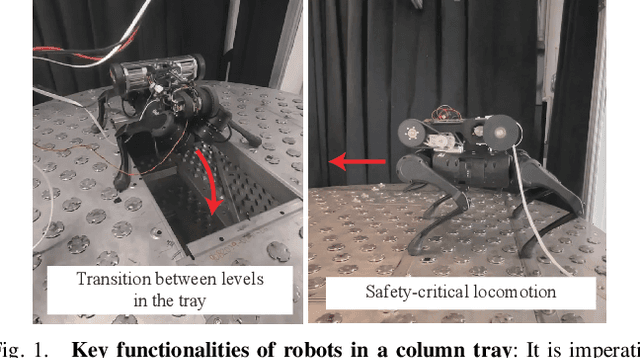
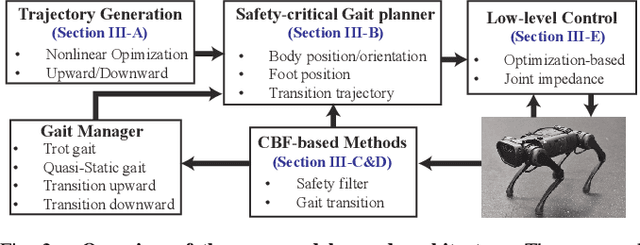
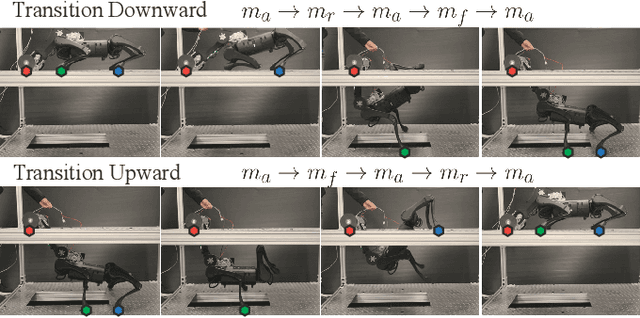
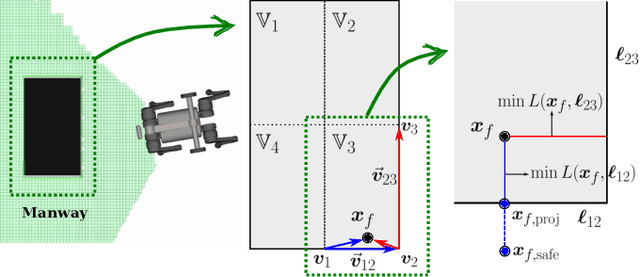
This paper presents a safety-critical control framework tailored for quadruped robots equipped with a roller arm, particularly when performing locomotive tasks such as autonomous robotic inspection in complex, multi-tiered environments. In this study, we consider the problem of operating a quadrupedal robot in distillation columns, locomoting on column trays and transitioning between these trays with a roller arm. To address this problem, our framework encompasses the following key elements: 1) Trajectory generation for seamless transitions between columns, 2) Foothold re-planning in regions deemed unsafe, 3) Safety-critical control incorporating control barrier functions, 4) Gait transitions based on safety levels, and 5) A low-level controller. Our comprehensive framework, comprising these components, enables autonomous and safe locomotion across multiple layers. We incorporate reduced-order and full-body models to ensure safety, integrating safety-critical control and footstep re-planning approaches. We validate the effectiveness of our proposed framework through practical experiments involving a quadruped robot equipped with a roller arm, successfully navigating and transitioning between different levels within the column tray structure.
A Data-driven Method for Safety-critical Control: Designing Control Barrier Functions from State Constraints
Dec 12, 2023This paper addresses the challenge of integrating explicit hard constraints into the control barrier function (CBF) framework for ensuring safety in autonomous systems, including robots. We propose a novel data-driven method to derive CBFs from these hard constraints in practical scenarios. Our approach assumes that the forward invariant safe set is either a subset or equal to the constrained set. The process consists of two main steps. First, we randomly sample states within the constraint boundaries and identify inputs meeting the time derivative criteria of the hard constraint; this iterative process converges using the Jaccard index. Next, we formulate CBFs that enclose the safe set using the sampled boundaries. This enables the creation of a control-invariant safe set, approaching the maximum attainable level of control invariance. This approach, therefore, addresses the complexities posed by complex autonomous systems with constrained control input spaces, culminating in a control-invariant safe set that closely approximates the maximal control invariant set.
Synthesizing Robust Walking Gaits via Discrete-Time Barrier Functions with Application to Multi-Contact Exoskeleton Locomotion
Oct 09, 2023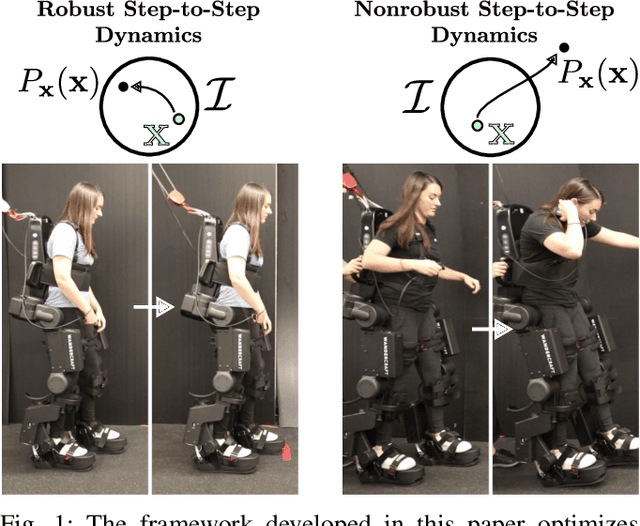
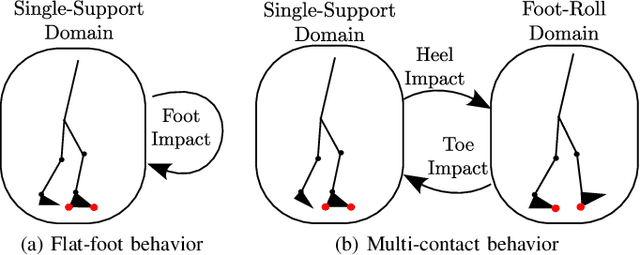
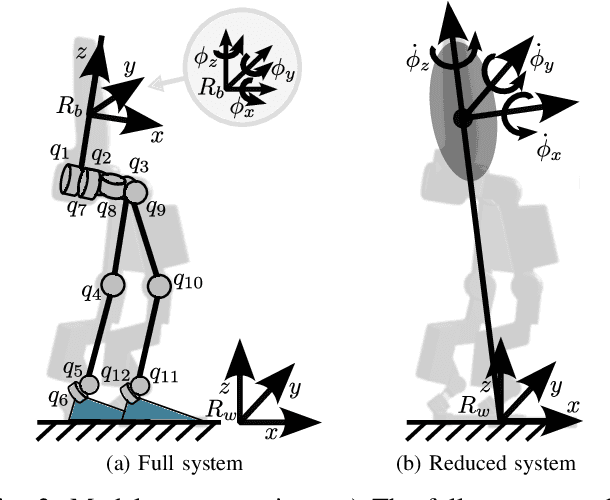
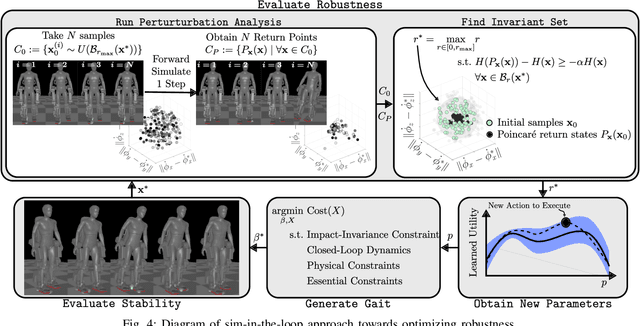
Successfully achieving bipedal locomotion remains challenging due to real-world factors such as model uncertainty, random disturbances, and imperfect state estimation. In this work, we propose the use of discrete-time barrier functions to certify hybrid forward invariance of reduced step-to-step dynamics. The size of these invariant sets can then be used as a metric for locomotive robustness. We demonstrate an application of this metric towards synthesizing robust nominal walking gaits using a simulation-in-the-loop approach. This procedure produces reference motions with step-to-step dynamics that are maximally forward-invariant with respect to the reduced representation of choice. The results demonstrate robust locomotion for both flat-foot walking and multi-contact walking on the Atalante lower-body exoskeleton.
Multi-Domain Walking with Reduced-Order Models of Locomotion
Oct 04, 2023Drawing inspiration from human multi-domain walking, this work presents a novel reduced-order model based framework for realizing multi-domain robotic walking. At the core of our approach is the viewpoint that human walking can be represented by a hybrid dynamical system, with continuous phases that are fully-actuated, under-actuated, and over-actuated and discrete changes in actuation type occurring with changes in contact. Leveraging this perspective, we synthesize a multi-domain linear inverted pendulum (MLIP) model of locomotion. Utilizing the step-to-step dynamics of the MLIP model, we successfully demonstrate multi-domain walking behaviors on the bipedal robot Cassie -- a high degree of freedom 3D bipedal robot. Thus, we show the ability to bridge the gap between multi-domain reduced order models and full-order multi-contact locomotion. Additionally, our results showcase the ability of the proposed method to achieve versatile speed-tracking performance and robust push recovery behaviors.
Safety-Critical Control of Nonholonomic Vehicles in Dynamic Environments using Velocity Obstacles
Oct 01, 2023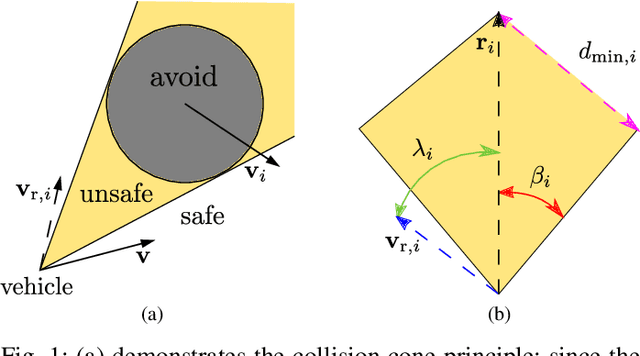
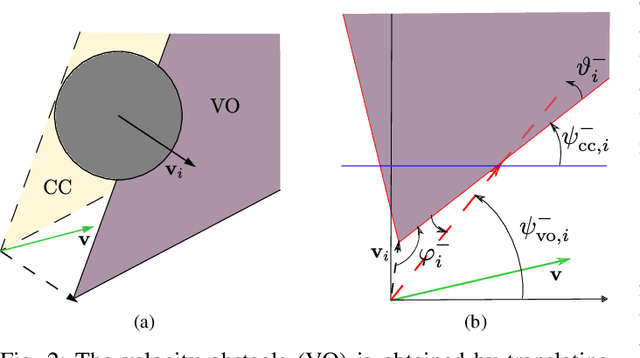
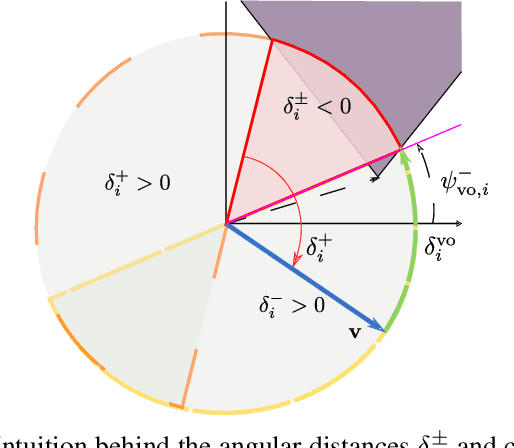
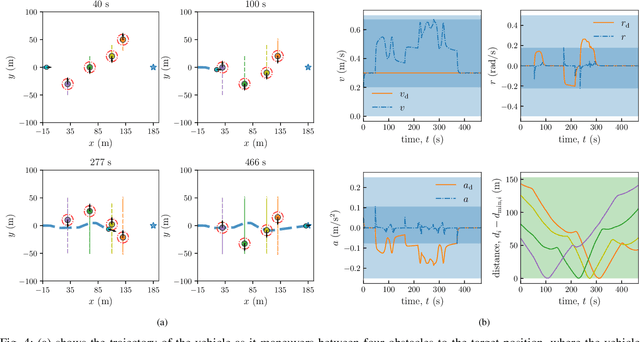
This paper considers collision avoidance for vehicles with first-order nonholonomic constraints maintaining nonzero forward speeds, moving within dynamic environments. We leverage the concept of control barrier functions (CBFs) to synthesize control inputs that prioritize safety, where the safety criteria are derived from the velocity obstacle principle. Existing instantiations of CBFs for collision avoidance, e.g., based on maintaining a minimal distance, can result in control inputs that make the vehicle stop or even reverse. The proposed formulation effectively separates speed control from steering, allowing the vehicle to maintain a forward motion without compromising safety. This is beneficial for ensuring that the vehicle advances towards its desired destination, and it is moreover an underlying requirement for certain vehicles such as marine vessels and fixed-wing UAVs. Theoretical safety guarantees are provided, and numerical simulations demonstrate the efficiency of the strategy in environments containing moving obstacles.
PONG: Probabilistic Object Normals for Grasping via Analytic Bounds on Force Closure Probability
Sep 29, 2023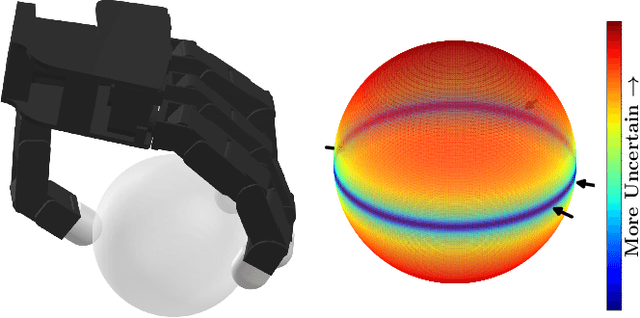

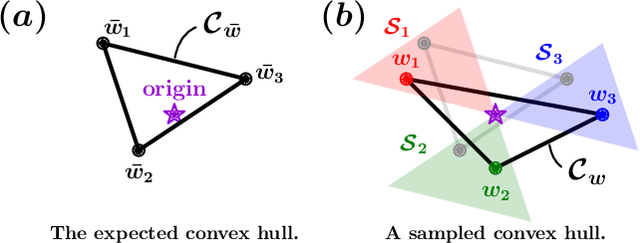
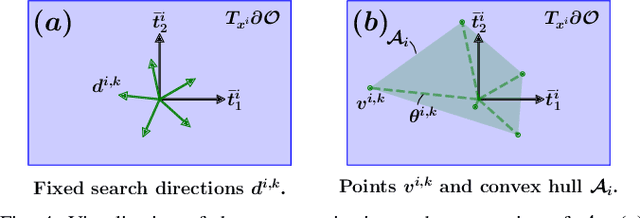
Classical approaches to grasp planning are deterministic, requiring perfect knowledge of an object's pose and geometry. In response, data-driven approaches have emerged that plan grasps entirely from sensory data. While these data-driven methods have excelled in generating parallel-jaw and power grasps, their application to precision grasps (those using the fingertips of a dexterous hand, e.g, for tool use) remains limited. Precision grasping poses a unique challenge due to its sensitivity to object geometry, which allows small uncertainties in the object's shape and pose to cause an otherwise robust grasp to fail. In response to these challenges, we introduce Probabilistic Object Normals for Grasping (PONG), a novel, analytic approach for calculating a conservative estimate of force closure probability in the case when contact locations are known but surface normals are uncertain. We then present a practical application where we use PONG as a grasp metric for generating robust grasps both in simulation and real-world hardware experiments. Our results demonstrate that maximizing PONG efficiently produces robust grasps, even for challenging object geometries, and that it can serve as a well-calibrated, uncertainty-aware metric of grasp quality.